What Should AI Search Monitoring Cost? A Pricing Guide
By Joe Della Mora, Founder, GroundScore
AI search monitoring cost is hard to sanity-check because the category is young: there is no settled market rate, pricing pages vary wildly in what they include, and a buyer has little to compare against. This guide takes a different route than a tool roundup. Instead of listing vendors, it dissects what you are actually paying for — the cost anatomy behind any monitoring price — so you can judge whether a given number is reasonable for what it delivers. I will use GroundScore's own pricing as a transparent reference point throughout, because it is the pricing I can speak to honestly, not because it is the only sane option. We will cover the price drivers, what a small business should budget, what an agency should budget, when free is genuinely enough, and the red flags that should end a conversation.
What actually drives the price of AI search monitoring?
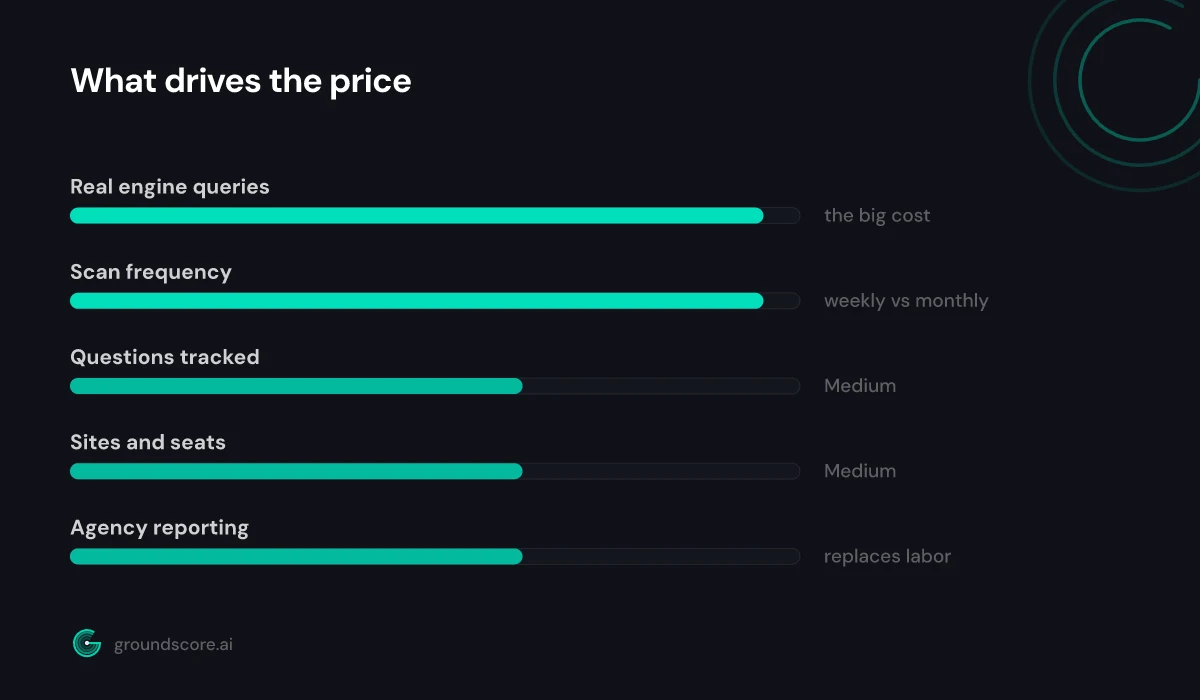
Direct answer: Five factors do most of the work: which engines are queried and whether the queries are real, how many questions are tracked, how often scans run, how many sites or seats are covered, and whether agency features like client-facing reporting are included. Everything else on a pricing page is packaging.
Real engine queries are the expensive part, and the part worth paying for. Every scan that asks ChatGPT, Claude, or Perplexity a question costs the vendor actual inference money, which scales with the number of engines, questions, and repetitions. This is why "which engines do you actually query" is the first question to put to any vendor — a tool estimating your visibility from crawl data or search proxies has a much lighter cost structure and should have a much lighter price.
Question volume and scan frequency multiply that base cost. Tracking twenty questions weekly is a very different workload than five questions monthly, and pricing should visibly scale with it. When I priced GroundScore, engine queries and scan frequency were the two levers that dominated the math — everything else was comparatively cheap to provide.
Sites and seats determine whose visibility is being measured. Per-site pricing is the honest default, since each site carries its own question set and scan load. Agency features — client-facing reports, multi-site dashboards, white-label options — sit on top and justify a real premium, because they replace hours an agency would otherwise bill or eat.
What should not drive price: vague "AI-powered insights," score access sold separately from the monitoring that produces it, or per-report charges for data you already paid to collect.
What should a small business expect to pay?
Direct answer: For one site with real multi-engine queries on a regular cadence, a sane budget sits in the low hundreds per month, comparable to a mid-tier SEO subscription. As a transparent reference, GroundScore Business is $199 per month for one site with weekly monitoring across ChatGPT, Claude, and Perplexity.
The reasoning behind that band follows from the cost anatomy. A single site needs a modest question set — ten to twenty buyer questions — queried across a few engines, repeatedly, on a schedule. That workload costs real money to run but not hundreds of dollars' worth, so a single-site price deep into three figures should come with something visible to justify it: much larger question sets, more engines, deeper action planning, or human review layered on top.
Be equally suspicious in the other direction. A price near zero for "monitoring" usually means no real engine queries — a crawl-based estimate dressed up as measurement, or a one-time scan marketed as ongoing coverage. You get what the inference bill pays for.
The budget question that matters more than the monthly fee: what happens after the measurement? Monitoring tells you where you stand; the value compounds only if the tool converts gaps into fixes you can actually do: unblock this crawler, add this schema, rewrite this opening. When you compare prices, compare action plans. A tool that hands you a prioritized to-do list is worth more than a cheaper dashboard that hands you a chart. The criteria for judging that fit are covered in how to choose an AI visibility monitoring tool.
If cash is tight, remember the sequence: measure once free, do the obvious fixes, and start paying for monitoring when you need to track whether changes hold.
What should an agency budget across clients?
Direct answer: Agencies should budget in the mid hundreds per month for a multi-client roster and evaluate everything as cost per client site. As a reference, GroundScore's agency plan is $499 per month with three client sites included and $149 per additional active site, roughly $166 per client site at three and falling toward $149 as the roster grows.
Per-site math is the only honest way to compare agency plans, because headline prices hide wildly different inclusions. Divide the monthly fee by the sites it genuinely covers, add the per-site overage for your realistic roster size, and compare that number across vendors. A plan that looks expensive at the headline can be the cheap option at twelve clients, and vice versa.
The second thing agencies are buying — often without noticing — is reporting labor. A monitoring tool with client-facing reports replaces hours of manual assembly per client per month. Price that honestly against your own loaded hourly cost: if a tool saves your team even two hours per client each month, the tooling fee is usually the smallest line in the equation. This is also why agency plans carry a premium over solo plans and deserve to.
What an agency should not do is absorb monitoring as an invisible internal cost. It belongs in the retainer as a named deliverable — baseline score, monthly movement, citations earned — because clients renew on visible proof. The packaging and margin questions are their own topic, covered in the agency guide to adding an AI visibility service line.
One caution from the vendor side of the table: distrust agency pricing that requires a sales call to learn. This category is young enough that opaque pricing usually signals price discrimination, not enterprise sophistication.
When is free good enough?
Direct answer: Free is enough when your question is "where do I stand," not "is it working." A one-off check gives you a baseline and a fix list without a subscription. Paid monitoring earns its fee when you are actively changing things, competing in a moving market, or reporting results to someone else.
There is a legitimate free tier in this category, and you should use it before spending anything. GroundScore's version is a free AI visibility check — one measured scan, scored 0 to 100 across three pillars, no account needed. Manual spot-checking in ChatGPT is also free and genuinely useful for reading how engines talk about your market, with limits — coverage, run-to-run variance, no history — that are detailed in manual spot checks vs automated monitoring.
Here is the honest decision table:
| Your situation | What to pay | Why |
|---|---|---|
| Curious where you stand | Nothing — free check | One baseline answers it |
| Fixing issues right now | Free check before and after | Two snapshots show movement |
| Competitive, fast-moving market | Monthly monitoring | Answers shift; trends need sampling |
| Reporting to a client or boss | Monthly monitoring | Claims need tracked history |
| Agency with a service line | Agency plan | Per-site cost plus reporting labor |
The pattern in the table: pay when time enters the picture. A snapshot is free or cheap; a trend line costs money because it is built from repeated real queries. If nothing about your situation requires proving change over time, do not let a vendor talk you into a subscription — run the free check, do the fixes, and come back when the stakes rise.
What pricing red flags should make you suspicious?
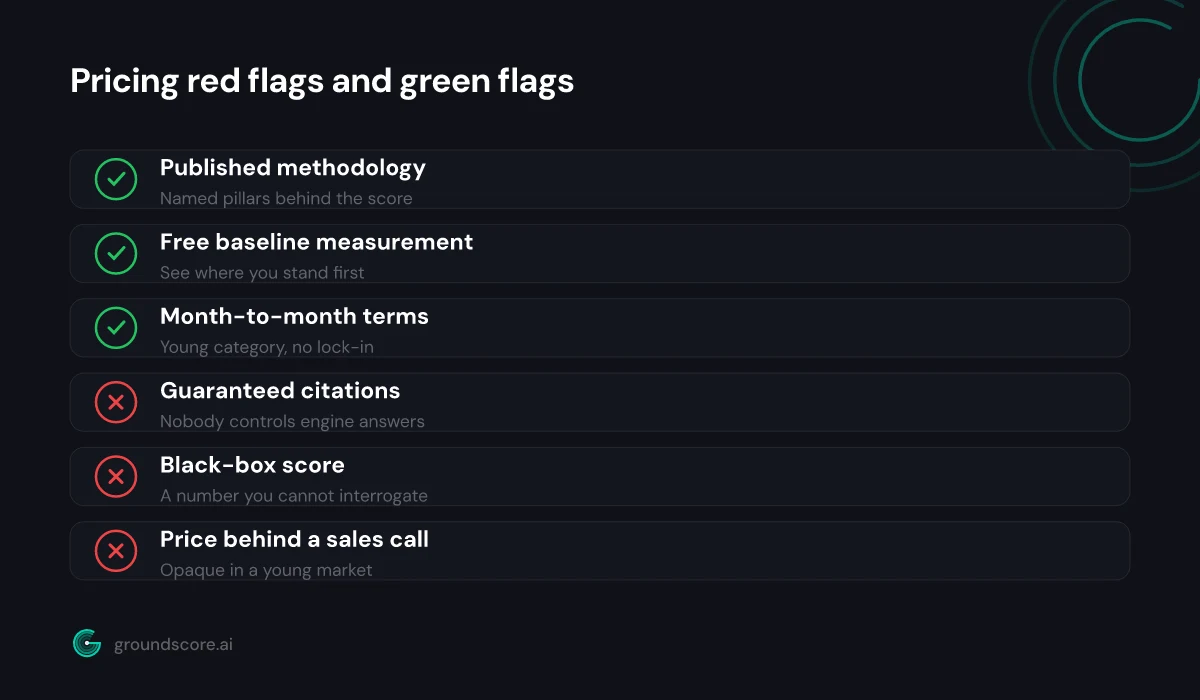
Direct answer: Walk away from black-box scores with no published methodology, guaranteed citations or rankings, monitoring that never discloses which engines it queries or how often, one-time audit fees dressed as ongoing value, and prices that only exist behind a sales call. Each one signals the vendor cannot show their work.
The black-box score is the most common offender. A visibility number is only as good as its methodology: which engines, which questions, how sampled, how scored. A vendor unwilling to explain the pillars behind their score is asking you to pay for a number you cannot interrogate — and when it moves, you will not know whether your site changed or their model did. (This cuts at any vendor, including us; GroundScore's score is 0 to 100 across three named pillars — Authority & Trust, Site Readiness, AI Presence — precisely so a customer can see what moved.)
Guarantees are the second offender. Nobody controls what a generative engine says — answers are assembled fresh, vary run to run, and depend on retrieval decisions no vendor influences. "Guaranteed citations" is either ignorance of how the systems work or a bet that you will not check. Related: beware before-and-after proof built on a single manual query, which is a coin flip presented as a result.
The subtler flags are structural. Per-report fees for data your subscription already collected. Contracts with long lock-ins in a category that is months, not decades, old. A "monitoring" price that turns out to be quarterly scans. And missing baseline measurement — any serious vendor should be willing to show you where you stand before charging you to improve it. That last one doubles as your best verification tool: measure independently before and after, and vendors' claims become checkable.
Frequently asked questions
Why does AI search monitoring cost more than rank tracking?
Rank trackers scrape result pages, which is cheap at scale. Citation monitoring asks generative engines real questions and pays inference costs on every query, multiplied by engines, question volume, repetitions, and cadence. The workload is heavier per data point, and honest pricing reflects that — cheap "AI monitoring" usually is not querying engines at all.
Is a free AI visibility check actually useful, or just a lead magnet?
Both can be true. A good free check runs real measurement and gives you a scored baseline plus a fix list you can act on without paying — GroundScore's requires no account. It is also, obviously, how vendors introduce themselves. Judge it by whether the output is actionable, not by the motive.
Should price scale with the number of questions tracked?
Yes, at least loosely — questions multiplied by engines and cadence is the vendor's real workload, so pricing that ignores volume entirely is either subsidized or not running real queries. That said, most single-site buyers fit comfortably in a standard question set, so per-site pricing with a sane default volume is a reasonable simplification.
What should an agency charge clients for monitoring they buy for $60 per site?
Do not bill the tooling with a markup; bill the service it powers. Monitoring plus interpretation, fixes, and reporting is a deliverable worth a meaningful monthly line item — the tool cost is your smallest input next to labor. Clients pay for outcomes and accountability, not for reselling a subscription.
Do prices in this category change often?
Expect movement. The category is young, vendors are still finding sustainable models, and underlying inference costs keep shifting. That argues for month-to-month terms over annual lock-ins right now, and for re-checking the market when you renew. Transparent public pricing — like GroundScore's on the pricing page — makes that comparison shopping cheap.
How do I verify a monitoring vendor's claims before paying?
Get an independent baseline first — a free check or your own disciplined spot checks across a fixed question list. Then ask the vendor which engines they query, how often, and how the score is computed. Run the free tier if one exists. Any vendor who resists baseline measurement before purchase is telling you something.
The bottom line
Price in this category is not mysterious once you see the anatomy: real engine queries, question volume, scan cadence, sites covered, and agency reporting are what cost money, and a fair price scales with them. For a small business, that lands in the low hundreds per month for one site; for an agency, mid hundreds and up across a roster, judged per site. Free covers the baseline; paid earns its keep when you need to prove change over time; and any vendor who cannot show their methodology has answered your question already.
Start where the cost is zero: run a free AI visibility check, see your baseline, and decide what ongoing monitoring is worth from a position of knowledge.
How visible is your site in AI search?
Check your AI visibility score in seconds. Free, no account needed.
Check your score