How to Choose an AI Visibility Monitoring Tool in 2026
By Joe Della Mora, Founder, GroundScore
Choosing an AI visibility monitoring tool in 2026 is harder than it should be, because the category is young and the marketing is loud. Every vendor promises to show you how AI engines see your site; far fewer will tell you how they measure it.
Full disclosure before anything else: I built GroundScore, which is one of the tools in this category. Rather than pretend neutrality, this guide names the criteria any buyer should press on, tells you plainly what GroundScore does for each one, and leaves the comparing to you — no competitor takedowns, no rigged scorecard. We will work through six questions: whether the tool queries engines for real, whether the scoring is transparent, whether it tells you what to fix, how often it checks, whether you need agency features, and what a fair price looks like.
Does the tool query the engines for real?
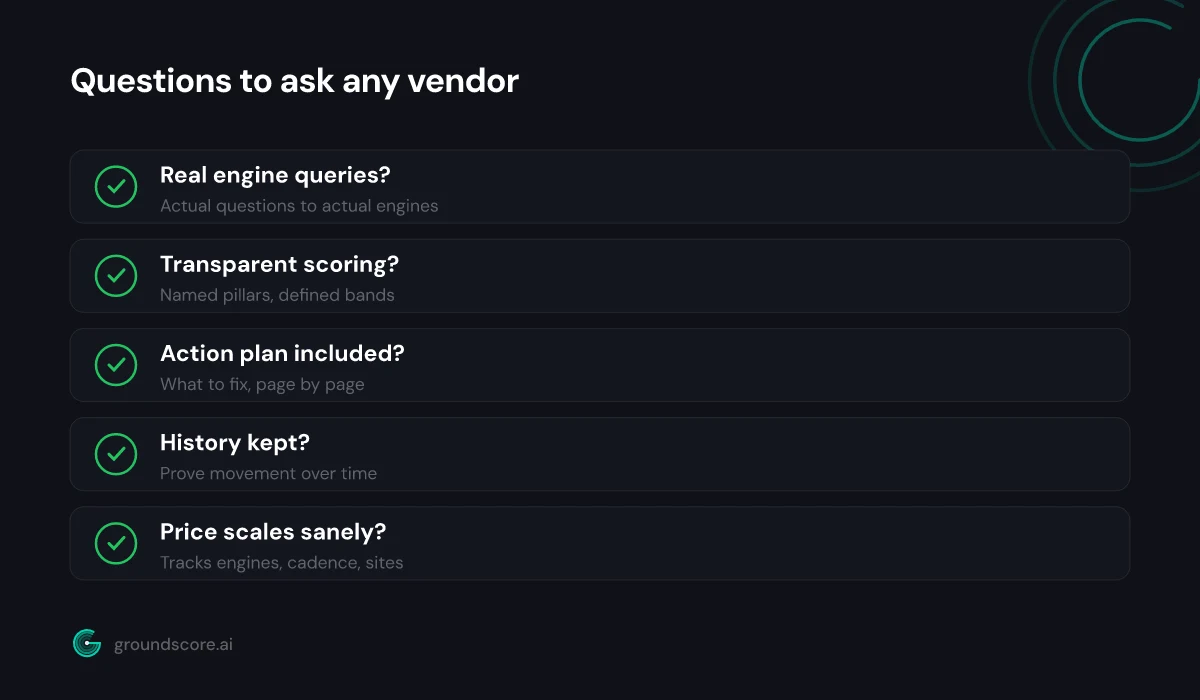
Direct answer: The first question to ask any AI visibility monitoring tool: does it actually send questions to ChatGPT, Claude, Perplexity, and the rest, and record what comes back — or does it estimate visibility from proxy signals like rankings and backlinks? Real queries are the product. Estimates are a guess wearing a dashboard.
This criterion sorts the category faster than any other. AI visibility only means one thing: when someone asks an AI engine a question in your space, do you appear in the answer? The only way to know is to ask the engines and look. A tool that infers your AI visibility from your Google rankings, domain authority, or mention counts is measuring something else and relabeling it.
How to press on it: ask the vendor which engines they query, whether the questions are visible to you, and whether you can see the raw answers that came back — not just a score derived from them. If the answer to that last one is no, walk. The raw answers are the evidence; a score without evidence is a vibe.
What GroundScore does here: we send real buyer questions to ChatGPT, Claude, and Perplexity and record whether your site shows up in the responses, and you can read the actual answers behind every result. Three engines, honestly queried — vendors covering more engines exist, and breadth is worth weighing against how real each engine's coverage is.
Can you see how the score is built?
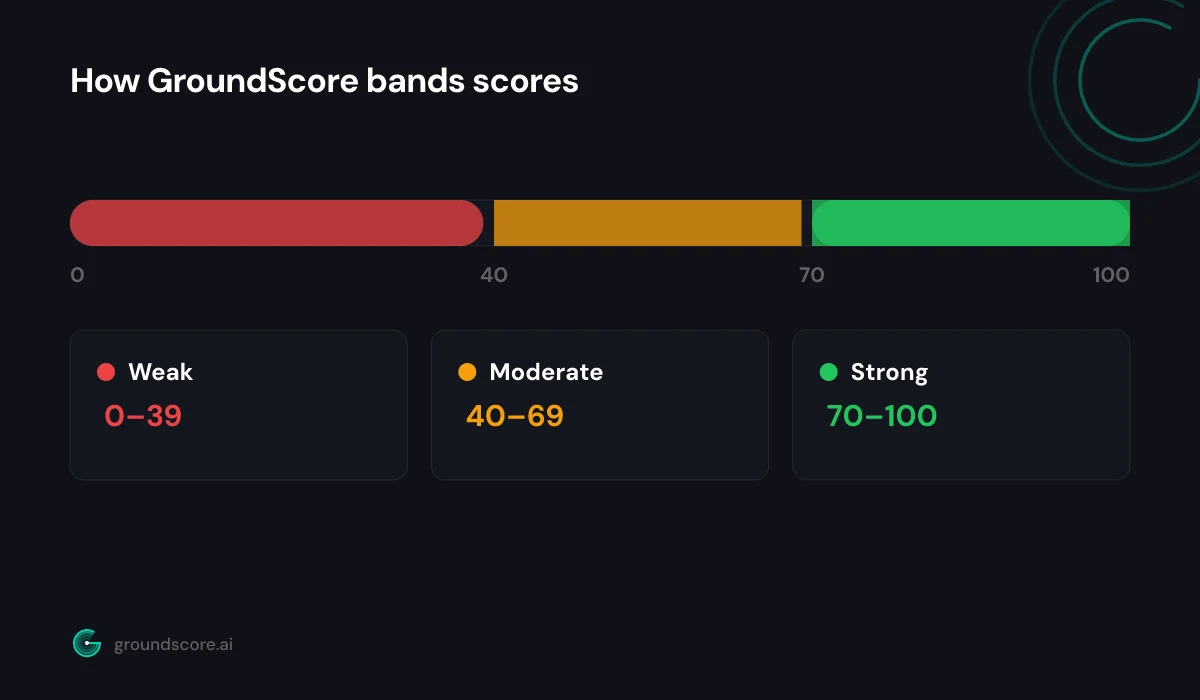
Direct answer: A trustworthy visibility score decomposes into named parts you can inspect. GroundScore, for example, scores 0–100 across three pillars — Authority & Trust, Site Readiness, and AI Presence — with defined bands: Strong is 70–100, Moderate is 40–69, Weak is 0–39. A score that cannot explain itself cannot guide work.
Scores exist to compress complexity, and compression is only trustworthy when you can unpack it. The failure mode in this category is the black-box number: a 61 that becomes a 64 with no account of why, no components to inspect, and no way to tell whether the change reflects your site or the vendor's algorithm shifting under you.
What to demand: named components with stated meanings, defined score bands so you know what counts as good, and per-component evidence — if a readiness component says crawlers are blocked, the tool should show you the robots.txt line it means. Methodology pages are a good sign; so is the vendor explaining what would move each component.
The pillar structure matters for a practical reason: it routes work. An access problem, a markup problem, and a presence problem are fixed by different people with different effort. A single undifferentiated number tells you that something is wrong; a decomposed one tells you what kind of wrong, which is the difference between a report and a plan.
Whatever tool you evaluate, run its free tier on your own site and try to explain the score to yourself afterward. If you cannot, the tool has not earned the subscription.
Does it tell you what to fix next?
Direct answer: Measurement without direction is trivia. A monitoring tool earns its subscription when every scan ends in a prioritized action plan: what is broken, why it matters for AI visibility, and what fixing it looks like on your actual pages. Look for page-level specifics, not a generic best-practices checklist recycled for every customer.
The test I would apply to any tool — ours included — is specificity. "Add structured data" is advice you could get from any blog post, this one included. "Your three service pages have no FAQ markup, and here is the JSON-LD drafted for each" is work you can hand to someone on Monday. The gap between those two sentences is most of the value in this category.
Building GroundScore, the pattern I keep seeing when we run free checks is that site owners mostly already know AI visibility matters — what they lack is a ranked list of what to do about it on their site. Generic checklists do not close that gap; they restate the category. So when you evaluate an action plan, check three things: does it reference your actual pages, does it explain why each item affects AI visibility, and does it order the items so the highest-impact work comes first?
One more thing worth checking: does the tool confirm fixes? An action plan that never re-checks its own recommendations leaves you wondering whether the work landed. The loop you want is measure, fix, re-measure — with the tool closing the loop, not you maintaining a spreadsheet of hope.
How often does it check, and does it keep history?
Direct answer: AI answers vary run to run, so one-off checks are a snapshot, not a signal. Weekly monitoring is a sensible default cadence for most sites: frequent enough to catch changes and confirm fixes, infrequent enough to show real movement. The tool should keep history so you can prove change over time.
Anyone who has asked ChatGPT the same question twice knows the answers move. That variance is why monitoring is a category at all: a single check tells you what one engine said once, and treating that as your visibility is like calling one poll an election. What you want is repeated sampling on a fixed cadence, so patterns separate from noise.
Cadence should fit how fast the underlying thing changes. Daily checks mostly re-measure noise and burn budget. Monthly checks leave you blind for weeks after a fix ships. Weekly sits in the useful middle — enough runs to see a trend within a quarter, granular enough to connect movement to the work you did. GroundScore runs weekly monitoring on paid plans for exactly this reason, with a free one-off check as the entry point.
History is the quieter half of this criterion, and buyers under-weigh it. The questions that matter in month six are longitudinal: were we cited for this question in March? Did the fix in April change anything? A tool that overwrites last week's results cannot answer them, and neither can you. Insist on a tracked timeline of results — it is the difference between monitoring and repeatedly glancing.
Do you need agency features?
Direct answer: If you manage AI visibility for clients rather than one site, you need a different feature set: multi-site management, client-facing reports, and pricing that scales per site instead of per seat. Buying a single-site tool five times is the expensive way to discover this. Solo site owners can skip agency tiers entirely.
This criterion is a fork, not a scale — you are on one side of it or the other, and the answer changes what to evaluate.
If you are a business owner monitoring your own site, ignore agency tiers completely. Evaluate the single-site experience: the score, the plan, the cadence, the price. Do not pay for white-label reports you will never send.
If you run an agency, the calculus inverts. The tool becomes part of your deliverable, so evaluate it as one: can you manage many client sites from one account, can you produce reports a client understands without you on the phone translating, and does per-site pricing leave margin at your retainer prices? A tool that is excellent for one site and priced per seat can quietly wreck agency economics at fifteen clients.
For agencies, GroundScore's answer is a plan built around that math: $499 per month with three client sites included and $149 per additional active site, with client-ready reporting as part of the offering. Details are at /agencies. Whether that fits your book of clients is arithmetic you can do in a minute, which is exactly how pricing should work.
What does a fair price look like?
Direct answer: Price should track the work the tool does: engines queried, scan frequency, and sites covered. For reference, GroundScore runs an unlimited free check with no account, Business at $199 per month for one site with weekly monitoring, and an Agency plan at $499 per month covering three client sites, then $149 per additional active site.
Here is the buyer's view of the whole category in one table:
| Criterion | What good looks like | Walk away when |
|---|---|---|
| Engine queries | Real questions, raw answers visible | Visibility inferred from proxies |
| Scoring | Named components, defined bands | Black-box number |
| Action plan | Page-level, prioritized, re-checked | Generic checklist |
| Cadence | Scheduled runs with kept history | One-off snapshots |
| Agency fit | Per-site pricing, client reports | Per-seat pricing at scale |
| Price | Tracks engines, frequency, sites | Opaque tiers, surprise overages |
On price specifically: what you are paying for is compute against real engines, on a schedule, with kept history and a maintained action plan. Those costs scale with sites and frequency, so honest pricing does too. Be suspicious in both directions — a price wildly below the category may mean the "monitoring" is estimates rather than queries, and a price wildly above it should come with visibly more engines, more depth, or more service.
The cheapest legitimate evaluation is the one vendors cannot argue with: run a free check, read the output, and decide whether a paid cadence of that output is worth the money for your site. Our pricing is public at /pricing; hold any vendor, us included, to the same transparency.
Frequently asked questions
What is an AI visibility monitoring tool?
Software that regularly asks AI engines the questions your buyers ask, records whether you appear in the answers, scores the result, and tracks change over time. Good ones add diagnostics — crawler access, structured data, content readiness — so you know not just where you stand but what to do next.
Can I just check ChatGPT myself instead of buying a tool?
You can, and it is a fine way to start. The limits show up fast: AI answers vary between runs, so a single ask proves little; you can only cover a few questions by hand; and without recorded history you cannot show whether anything improved. Monitoring exists to fix those three problems.
Which AI engines should a monitoring tool cover?
The ones your buyers actually use for research — today that means ChatGPT, Perplexity, and Claude at minimum, with more emerging. Breadth matters less than method: a few engines queried with real questions and kept history beats many engines estimated from proxy data.
How fast will monitoring show results?
Be suspicious of any tool that promises a timeline. What monitoring honestly gives you is a baseline, proof of whether fixes changed anything, and early warning when you drop out of answers. Movement after real fixes typically shows across weeks of scans, not overnight — anyone guaranteeing faster is selling.
Do I need white-label or client reports?
Only if you are an agency presenting results to clients. Client-ready reporting is the difference between a tool you use and a deliverable you can sell, and it justifies agency-tier pricing. Solo site owners should skip those tiers and put the budget toward a longer monitoring run instead.
Is a free check enough to evaluate a tool?
It is the right first move. A free check shows you the tool's scoring, evidence, and action plan on your own site before money changes hands — exactly the transparency this guide says to demand. Whatever tool you evaluate, insist on seeing real output on your own site first.
The bottom line
Six questions separate the tools in this category: real queries or estimates, transparent scores or black boxes, plans or checklists, cadence with history or snapshots, agency economics that work or do not, and pricing you can explain. Press every vendor on all six — the ones with good answers will not mind, and the ones who mind have answered anyway.
The grounded recommendation is the same one built into this guide: evaluate with evidence, starting free. Run a free AI visibility check on your site, read what comes back, and judge the category by output instead of promises.
How visible is your site in AI search?
Check your AI visibility score in seconds. Free, no account needed.
Check your score