The Agency Guide to Adding an AI Visibility Service Line
By Joe Della Mora, Founder, GroundScore
Clients have started asking their agencies a new question: why doesn't my business show up when someone asks ChatGPT? An agency AI visibility service line is how you answer it with a deliverable instead of a shrug. The case for having an answer is covered in why agencies need an AI visibility offering; this guide is about the buying decisions that come after you are convinced. Most advice on the topic stops at "add AEO to your menu." What is missing — and what this guide works through — are the five decisions that determine whether the service line makes money: positioning, deliverables, build versus buy, white-label needs, and the margin math at real retainer prices. Take them in order and the offer largely designs itself.
Should it be an add-on or a standalone retainer?
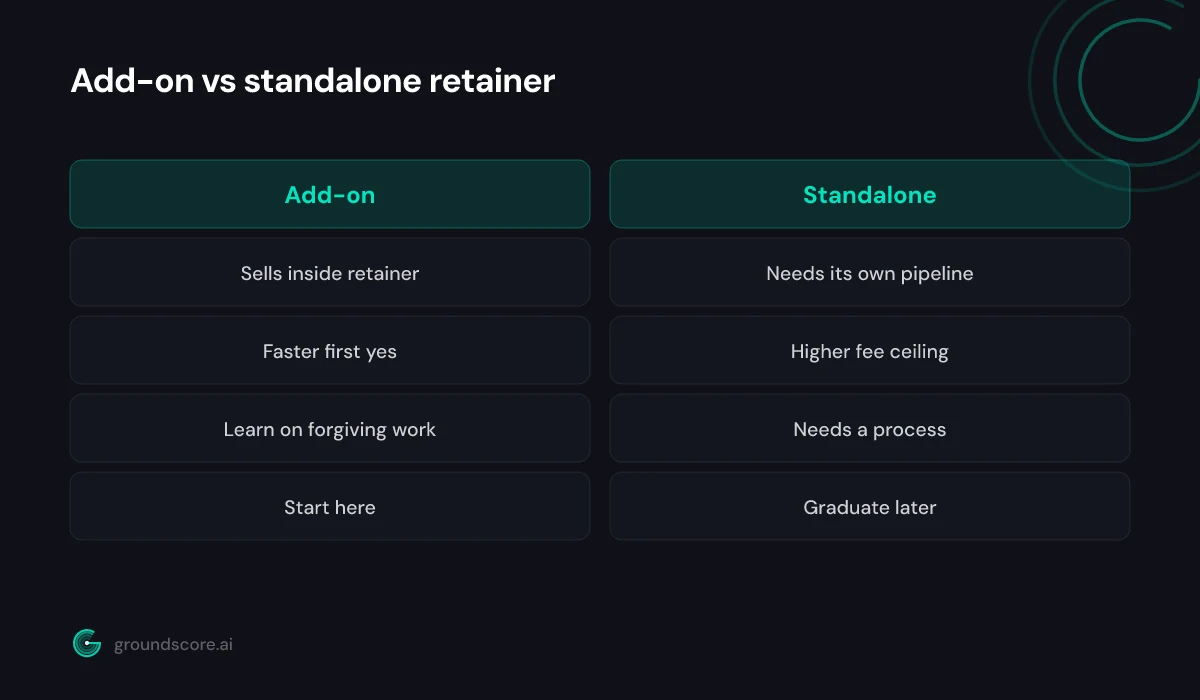
Direct answer: Start with an add-on to existing SEO retainers, then graduate to standalone once you have repeatable deliverables and internal fluency. Add-ons sell faster because trust already exists, price against work you already understand, and let you learn the service on clients who will forgive early rough edges.
The add-on path has a structural advantage: the conversation is already happening. Your SEO clients are the ones asking about ChatGPT, and "we now measure and improve that too" is a one-line upsell inside an existing relationship. You do not need new sales collateral, a new pipeline, or a new pitch — you need a scored report and a monthly line item.
The standalone path makes sense later, in two situations. First, when a prospect comes to you specifically for AI visibility — that demand is growing, and it deserves its own package rather than being buried inside an SEO proposal. Second, when your add-on work has produced enough internal process that a dedicated retainer does not depend on one person who happens to understand it.
There is a third option worth naming so you can reject it: the one-off audit. Audits feel safe — small commitment, easy yes — but AI visibility is a moving target. Engines change, competitors publish, answers shift. A point-in-time PDF ages badly, and it anchors the client to project pricing when the real value, for them and for you, is in monitoring change over time. Sell the audit as the first month of a retainer, not as a product of its own.
Whichever position you choose, write down what is included before you sell it. Scope creep hits new service lines hardest, because neither you nor the client knows yet where the edges are.
What deliverables do clients actually understand?
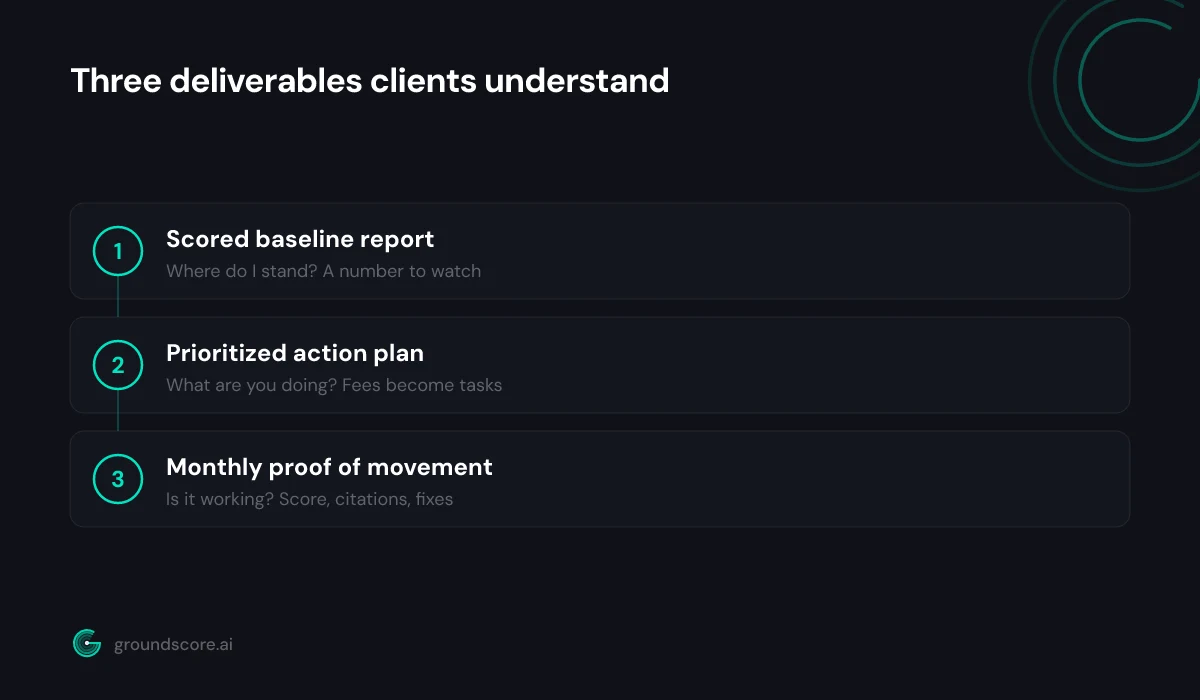
Direct answer: Three deliverables carry the service: a scored baseline report, a prioritized action plan, and a monthly proof of movement. Each one answers a question the client already has — where do I stand, what are you doing, and is it working — in language that does not require explaining how retrieval pipelines work.
The scored report comes first because a number is the fastest way to make an invisible problem legible. "Your AI visibility is weak" is an opinion; "you score 31 out of 100, and here are the three pillars behind that number" is a baseline the client can watch move. Scores also make the sales conversation honest — you are showing the prospect where they stand before asking them to pay you to improve it.
The action plan is what separates a service from a subscription to bad news. Every gap in the report should map to a task someone can do: unblock this crawler, add this schema type, rewrite this page opening so it answers the question directly. Clients do not need to understand JSON-LD; they need to see that the monthly fee converts into specific, finished work.
The monthly proof of movement is the deliverable that protects the retainer. Score changes, newly earned citations, fixes shipped — assembled into something a client can skim in two minutes. When we run free checks for agency owners evaluating GroundScore, the most common admission is that their client reporting is the part of the service they dread building from scratch. It is also the part clients judge them on.
Should you build the tooling or buy it?
Direct answer: Buy the measurement layer and keep the strategy layer in-house. Reliable citation monitoring means querying multiple engines on a schedule, storing history, and scoring consistently — infrastructure that is expensive to build and maintain, cheap to rent, and invisible to clients, who judge you on interpretation and results.
The build temptation is real: querying an AI engine looks like an afternoon of scripting. The production version is not. You need repeated sampling because answers vary run to run, parsing that survives interface and API changes, history storage, a scoring model you can defend when a client asks why the number dropped, and upkeep for all of it — forever, across every engine you claim to cover. That is a product, and building a product is a different business than running an agency.
What should stay in-house is everything the tool cannot do: knowing the client's market, choosing which questions matter, writing content worth citing, and turning a gap report into a plan the client approves. That is where your margin lives, and no tool replaces it.
| Factor | Build in-house | Buy a tool |
|---|---|---|
| Upfront cost | High — engineering time | Low — monthly fee |
| Ongoing maintenance | Yours, permanently | Vendor's problem |
| Scoring credibility | You must defend it | Documented methodology |
| Time to first client report | Weeks to months | Same day |
| Differentiation | Invisible to clients | Also invisible — results differentiate |
For reference on the buy side: GroundScore's agency plan is $499 per month with three client sites included and $149 per additional active site, and it checks how client sites show up in ChatGPT, Claude, and Perplexity with weekly monitoring. Full detail is on the agency page. Whatever tool you choose, the criteria are the same: real engine queries rather than estimates, transparent scoring, and reports you can hand a client without rewriting them.
Do you need white-label reporting?
Direct answer: You need client-facing reports; whether they must carry your logo depends on how you position the service. Agencies selling proprietary expertise usually want their own branding front and center. Agencies positioned as trusted operators can present tool-branded reports the way they already present analytics dashboards — as evidence, not identity.
Be honest about which agency you are. If your pitch is "we have a methodology no one else has," then a third-party tool's name on your core deliverable undercuts the story, and white-labeling belongs on your requirements list. If your pitch is "we run this discipline well and show you receipts," a recognizable measurement source can actually help — the same way citing Google Search Console lends weight rather than taking it away.
There is a middle path most agencies land on in practice: the tool's report becomes an appendix, and your own two-page summary sits on top. The summary is where your voice, your recommendations, and your branding live; the tool output underneath is the evidence base. This costs you an hour a month per client and neatly sidesteps the question of whose logo is on the charts, because the document the client actually reads is unmistakably yours.
Whatever you choose, test the deliverable path before you sell it. Generate a real report for a real site — your own is fine — and walk through exactly what the client would receive. Agencies get burned less by missing features than by discovering, one week before the first client review, that the export they assumed existed does not look how they imagined. The dry run costs nothing and settles the white-label question with evidence instead of guesswork.
Does the margin math work at retainer prices?
Direct answer: Work the math per client: tooling cost divided across sites, plus the hours you will actually spend, against the monthly fee you can charge. With shared tooling in the low hundreds per month across five or more clients, the tool cost per client is small; hours are the number that decides your margin.
Run the exercise before setting a price, with your own numbers. The structure is simple. Tooling: on GroundScore's agency plan, $499 covers three client sites, so a three-client roster carries about $166 of tooling per client per month, and each site beyond that adds $149. Labor: estimate hours honestly: reviewing the monthly scan, adjusting the action plan, executing or delegating fixes, and presenting results. For most single-site clients that is a handful of hours once the first-month setup is done.
Now price against value, not cost. The client is not buying your hours; they are buying presence in the place their customers increasingly ask first. An AI visibility add-on priced as a modest fraction of an existing SEO retainer clears healthy margin at almost any realistic hourly load — and if it does not, the fix is usually scope, not price. Trim the deliverable to the three items from earlier rather than discounting.
Two mistakes show up repeatedly in this math. First, pricing the first client as if the learning curve were free — your first month on any new service line costs double the hours, so anchor pricing to the steady state but expect the ramp. Second, forgetting that monitoring scales and fixes do not: adding a sixth client barely moves your tooling bill, but if every client needs heavy content work, hours grow linearly and your margin story lives or dies on how much of that work the retainer actually includes.
Frequently asked questions
What should an agency charge for AI visibility services?
Price it relative to your existing retainers rather than from a universal rate card. As an add-on to SEO work, a modest monthly increment is an easy yes; as a standalone retainer, price against the deliverables — baseline report, action plan, monthly proof — and the hours they honestly take you.
Can we sell this if nobody on the team is an AI expert?
Yes. The measurement layer comes from tooling, and the fixes — robots.txt rules, schema markup, content that answers questions directly — are skills SEO teams already have. What you need is fluency, not research credentials: enough understanding to explain to a client why each fix matters and what moved.
How is this different from what we already do for SEO?
The work overlaps heavily; the measurement does not. SEO optimizes for ranked links and is measured in positions. AI visibility optimizes for being cited inside generated answers and is measured by presence in those answers across engines. Clients experience them as different questions, which is why it deserves its own line item.
Should we wait until AI search is bigger before investing?
Waiting costs you the window where an answer differentiates you. Client questions about ChatGPT are already arriving, and the agency with a scored report wins that conversation over the agency promising to look into it. Starting small — one add-on client, one tool subscription — makes the bet cheap to place now.
How do we prove the service is working month to month?
Track three things against the first month's baseline: the visibility score, citations earned on questions that matter to the client, and fixes shipped. Presented together, they show effort and effect side by side. Honest reporting matters — some months move slowly, and clients keep retainers when the reporting never overclaims.
The bottom line
An AI visibility service line is five decisions, not a leap: position it as an add-on first, anchor it to three deliverables clients understand, buy the measurement and keep the judgment, put your branding on the summary rather than fighting over the charts, and check the margin math per client before you set a price. Agencies that work through those decisions now will own the conversation their clients are already starting.
If you want to see what the tooling side looks like in practice, the GroundScore agency plan covers three client sites for $499 a month. Run your own site through it first and judge the deliverables yourself.
How visible is your site in AI search?
Check your AI visibility score in seconds. Free, no account needed.
Check your score