Manual AI Spot Checks vs Automated Citation Monitoring
By Joe Della Mora, Founder, GroundScore
Every site owner's first act of AI citation monitoring is the same: open ChatGPT, ask the question a customer would ask, and see if you appear. That instinct is right, and this post will not talk you out of it. But a spot check and a monitoring practice are different tools, and the difference is not "one is a paid product." It comes down to four dimensions most comparisons never spell out: coverage, consistency, memory, and the honest cost of your hours. Spot checks fail on each of these in a specific, predictable way — and knowing exactly where they break tells you when they are still the right choice. This post walks through what a spot check really tells you, the four dimensions in turn, and a plain rule for when to switch.
What does a manual spot check actually tell you?
Direct answer: A manual spot check answers one narrow question: did this engine include your site in its answer to this phrasing, at this moment, for this account. That is a real data point. It is not a measurement of your AI visibility, any more than one customer conversation is market research.
The value of a spot check is immediacy and texture. You see the actual answer a user would see: how the engine describes your business, who it recommends instead of you, what sources it leans on. Reading three or four full answers in your market teaches you things a dashboard summary never will — the vocabulary engines use for your category, the competitor that keeps appearing, the outdated fact about you that some directory is still feeding into answers.
The limits are just as concrete. The answer you got was shaped by variables you did not control: the exact phrasing, whether the engine decided to search the web at all for this query, and the randomness inherent in generation. Change any of them and the answer can change with you still standing in the same place.
Building GroundScore, the thing that originally pushed us toward scheduled, repeated runs was watching a site appear in an answer on Tuesday and vanish from the same question on Thursday — with nothing about the site having changed. A single spot check would have called that site visible, or invisible, depending on which day you happened to ask.
So treat the spot check as what it is: a qualitative glimpse. The three dimensions that follow are where a glimpse and a measurement part ways.
Coverage: one question vs a question set
Direct answer: Your customers ask dozens of differently phrased questions across several engines; a manual session samples two or three phrasings on one engine. Monitoring runs a standing question set across engines on every scan, so you learn where you appear across the demand you care about, not just its most obvious phrasing.
When you spot-check, you ask the question that is most obvious to you — usually your own category plus your city, or your brand name. Buyers do not stop there. They ask comparison questions, problem questions, "is it worth it" questions, and questions that never mention your category by name. Being cited for the flagship phrasing and invisible for the other twenty is a common shape, and it is exactly the shape a manual check cannot see.
Engines multiply the problem. ChatGPT, Claude, and Perplexity retrieve and cite differently, and presence on one says little about the others. Checking all of them by hand, across even a modest question list, turns the afternoon experiment into a recurring chore — which is why manual coverage in practice collapses back to one engine and a couple of questions.
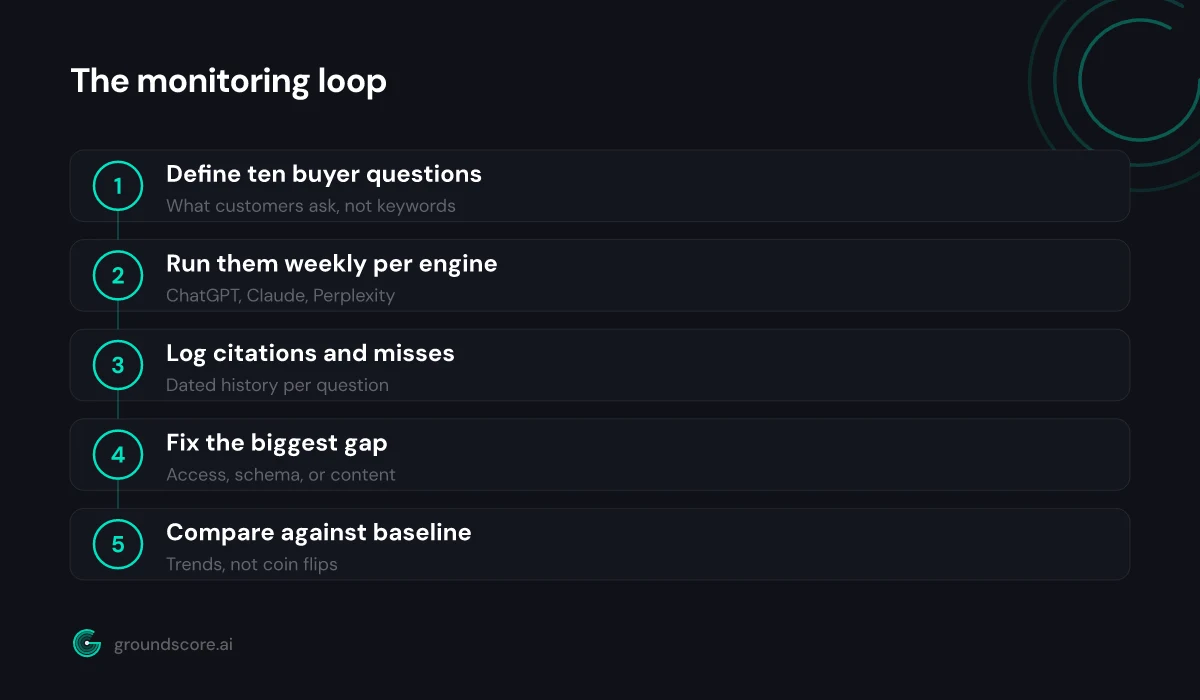
A workable middle ground, if you are staying manual for now: write down a fixed list of ten questions a real buyer would ask, and ask the same list every time. You will still hit the consistency problem in the next section, but at least you are sampling the same territory rather than whatever phrasing occurs to you that day. The question-set idea is the single most valuable thing to steal from monitoring tools, and it costs nothing.
Consistency: why a single answer proves nothing
Direct answer: AI answers vary run to run — same question, same engine, different response. One appearance does not mean you reliably appear, and one absence does not mean you are invisible. Confidence requires repeated sampling of the same questions over time, which is tedious by hand and trivial for automation.
This is the dimension that surprises people most, because it has no equivalent in traditional rank tracking. A Google position might move daily, but at any given moment there is one answer to "where do I rank." Generated answers do not work that way. The engine may or may not trigger retrieval, may pull different sources, and assembles each response fresh — so your business can be cited in three answers out of five to the identical question.
The practical consequence: a single spot check is one coin flip presented as a verdict. If you check once a month by hand, your "trend" is three coin flips, and the swings you think you see may be noise. This cuts both ways — panic after a missing citation is as unjustified as celebration after one appearance.
Repeated sampling is the only honest fix. Ask the same question set on a schedule, record every result, and let the pattern emerge: cited consistently, cited sometimes, never cited. Those three states — not the binary of one lucky run — are the real measurement, and the middle state is where most improvable sites actually live. This is the structural reason monitoring is scheduled and repeated rather than clever: GroundScore's paid plans run weekly not because more data is always better, but because a weekly cadence across a fixed question set is roughly the minimum that separates signal from generation noise.
Memory and hours: spreadsheets vs tracked history
Direct answer: Spot checks live in screenshots and memory; monitoring keeps a queryable history of every question, answer, and citation over time. History is what turns checking into knowing — did the schema work help, when did we lose that citation — and it is also where the manual approach quietly consumes the most hours.
Suppose you do the disciplined manual version: ten questions, three engines, logged in a spreadsheet with dates and screenshots. You have now committed to an hour or two of careful clerical work per session — asking, reading, judging whether a mention counts as a citation, pasting, repeat. Do it weekly for the sampling reasons above and you have invented a part-time chore, done monthly it degrades into the three-coin-flip problem. Most people who start this spreadsheet stop by the third session; the discipline requirement, not the difficulty, is what kills it.
And the spreadsheet still cannot answer the questions that matter, because those questions are about change. Did the fixes you shipped in May move anything? Which question flipped from never-cited to sometimes-cited, and when? When a citation disappears, did it vanish this week or has it been gone for a month? Answer-by-answer history is what makes before-and-after claims honest — and it is the thing a tool gives you for free, since storing and diffing results is exactly what software is for.
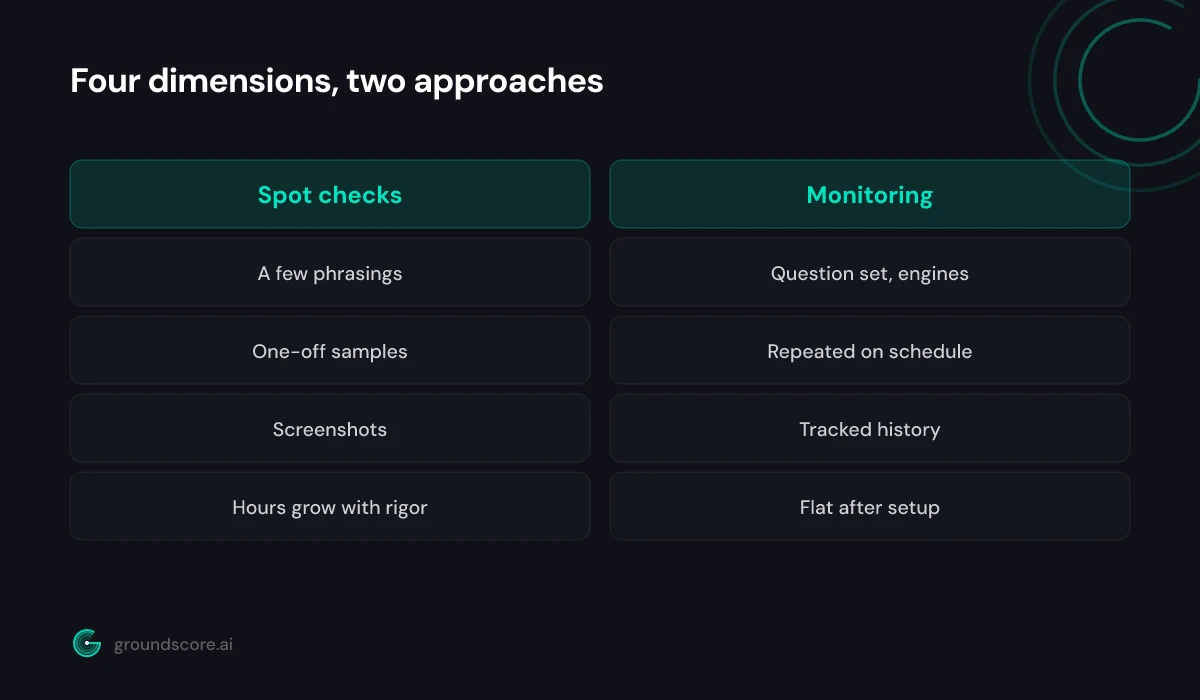
Here is the comparison in one place:
| Dimension | Manual spot checks | Automated monitoring |
|---|---|---|
| Coverage | 1 engine, a few phrasings | Question set across engines |
| Consistency | One-off samples | Repeated runs on schedule |
| Memory | Screenshots, spreadsheets | Tracked history with dates |
| Your hours | Grows with rigor | Flat after setup |
| Texture of answers | High — you read everything | Lower — summarized |
| Cost | Free | Subscription |
| Best for | First look, qualitative feel | Trends, proof, accountability |
When is each approach the right choice?
Direct answer: Spot-check when you are exploring: before investing anything, while learning your market's vocabulary, or when digging into one specific answer. Switch to automated monitoring the moment results have consequences — you are spending money on fixes, reporting to a client, or making decisions you will need to defend later.
The honest rule is that spot checks are a starting point with a natural expiration. If you have never looked, spend an afternoon asking real buyer questions across ChatGPT and Perplexity, and read every word. Note the two rows in the table where manual wins — cost and texture — and use them fully: nothing beats reading whole answers for understanding how engines talk about your market.
The expiration arrives when you act on what you saw. The moment you fix your robots.txt, add schema, or rewrite pages, you have created a before-and-after question that spot checks cannot answer credibly — you need the same questions, sampled repeatedly, on both sides of the change. The same threshold applies with more force when someone else is paying: an agency telling a client "you now appear for these questions" on the strength of one manual run is making a claim it cannot support.
If you are in between — curious, but not ready for a subscription — a free AI visibility check is the no-cost middle step: one measured scan, scored 0 to 100, no account needed, and it doubles as the baseline if you later start monitoring. And when you do evaluate tools, the criteria that matter — real engine queries, transparent scoring, useful action plans — are covered in how to choose an AI visibility monitoring tool.
Frequently asked questions
Are manual AI spot checks a waste of time?
No — they are the right first move. Reading full answers teaches you how engines describe your market, which competitors recur, and what facts about you are stale. Spot checks only become a problem when one-off samples get treated as measurement, or when the manual routine's hours quietly exceed a tool's price.
How often do AI engine answers actually change?
There is no fixed rhythm — answers can differ between two runs minutes apart, because engines assemble each response fresh and may retrieve different sources. Beyond that noise, answers genuinely shift as pages get recrawled and competitors publish. That is why trends need repeated sampling on a schedule rather than occasional glances.
Can I just automate my own spot checks with a script?
You can, and it is more work than it looks: repeated sampling per question, parsing responses that change format, deciding what counts as a citation, storing history, and maintaining all of it across engines. For a developer it is a fun project; for a business it is usually cheaper to rent than to babysit.
What does automated AI citation monitoring typically include?
A standing set of buyer questions run against multiple engines on a schedule, with results scored and stored over time. GroundScore, for example, checks how sites show up in ChatGPT, Claude, and Perplexity, scores visibility from 0 to 100 across three pillars, and runs weekly on paid plans so changes show up as trends.
Which questions should I track for my business?
Track what buyers ask, not what you would search. Include your category with your city or niche, comparison questions, problem questions your service solves, and "best" or "recommended" phrasings. Ten to twenty questions is plenty to start — a fixed list sampled consistently beats a long list sampled once.
The bottom line
Manual spot checks and automated citation monitoring are not competitors; they are stages. The spot check gives you texture and costs nothing — use it to learn your market's answers before you spend a dollar. Monitoring gives you coverage, repeated sampling, and history — the three things that turn "I think we show up more now" into a claim you can defend. Move from one to the other when your results start having consequences.
The free middle step takes about a minute: run a free AI visibility check and get a measured baseline before you decide anything else.
How visible is your site in AI search?
Check your AI visibility score in seconds. Free, no account needed.
Check your score