7 Writing Mistakes That Keep AI From Quoting Your Pages
By Joe Della Mora, Founder, GroundScore
Your page can be crawlable, well-structured, and packed with expertise, and still never get quoted in an AI answer. The reason is usually the writing itself. Engines quote passages, not pages, and most passages are written in a way that makes them hard to lift cleanly. Writing for AI citations is a specific craft: say the answer plainly, early, and in a self-contained way an engine can drop into a response without editing. Building GroundScore, the pattern we keep seeing is strong sites whose content buries every answer three paragraphs deep, hedges it into mush, or never states it outright at all. This post walks through seven writing mistakes that quietly block citations, each with the fix. Fixing these does not require new pages, only rewriting the ones you have so the answers are quotable.
Mistake 1: You bury the answer below the fold
Direct answer: Burying the answer means making the reader, and the engine, scroll through backstory before you state the point. Engines favor passages that answer the question up front, so an answer sitting in paragraph five often loses to a competitor who put theirs in the first line. Lead with the answer.
Most business writing warms up. It sets context, tells a story, explains why the topic matters, and eventually gets to the point. Human readers tolerate this; engines penalize it. When an engine scans your page for a passage to quote, it rewards the one that states the answer cleanly and early, because that passage is the easiest to lift into a response.
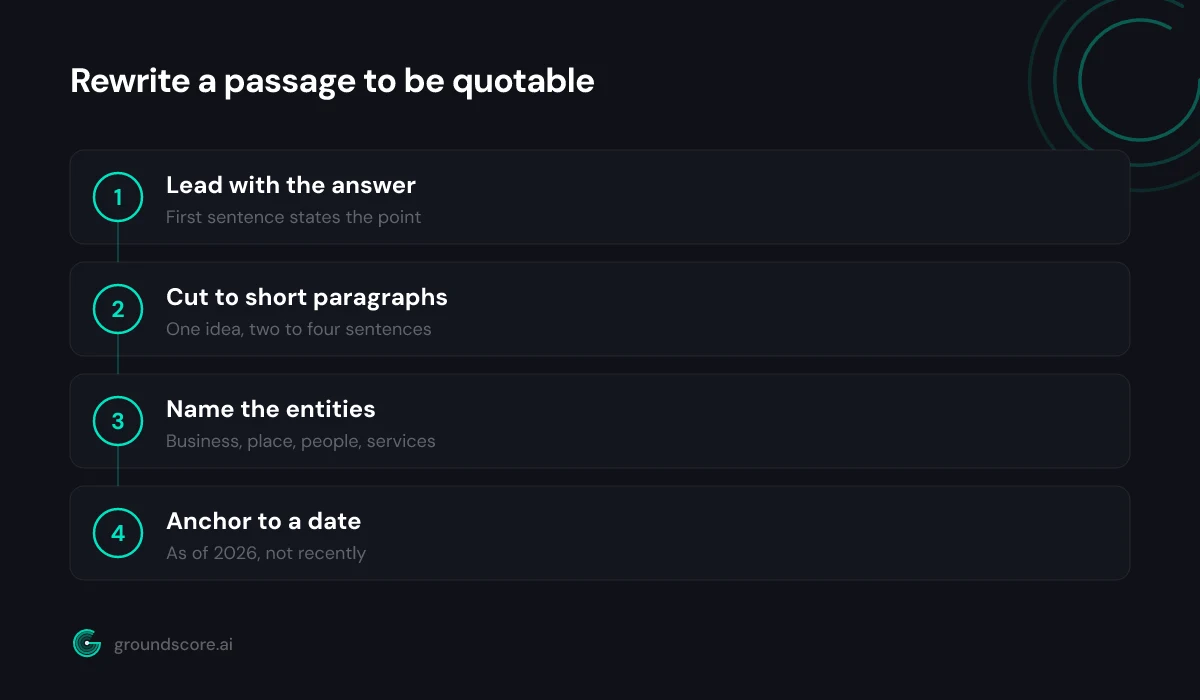
The fix is a structural habit, not a style change. Under every heading that poses a question, make the first sentence the answer. Everything else, the caveats, the context, the examples, comes after. This is exactly the direct-answer pattern this blog uses under each heading, and it is the single highest-leverage change most sites can make.
You lose nothing by front-loading. A reader who wants the full story keeps reading; a reader who wants the answer gets it; and an engine gets a clean, quotable passage. Warming up serves none of those three.
Watch for the softer version of this mistake too. Even pages that eventually answer often open with a throat-clearing sentence, "In this article, we will explore," "Before we get into it," that pushes the real answer down a line or two. Cut those openers entirely. The first sentence under a heading is prime real estate, and an engine reads it first. Spend it on the answer, not on announcing that an answer is coming.
Mistake 2: The page never actually answers the question
Direct answer: Some pages circle a question without ever answering it, describing the topic, listing considerations, and gesturing at complexity while stating nothing an engine can quote. If a page never commits to a direct claim, there is no passage to lift, so the engine cites a competitor who was willing to say something concrete.
This is subtler than burying the answer, because the page can look thorough. It has headings, paragraphs, maybe a list. But read closely and it never says "here is the answer." A page about pricing that discusses factors affecting cost without ever naming a number. A page about a process that describes its importance without stating the steps. There is nothing to quote.
The fix is to commit. For every question your page raises, write one sentence that answers it plainly, even if the honest answer is "it depends, and here is what it depends on." Engines can quote a conditional answer; they cannot quote an evasion.
A useful test: read each section and ask, "If someone quoted one sentence from this to answer the question, which sentence would it be?" If you cannot point to one, neither can the engine, and it will move on to a page where it can.
Mistakes 3 and 4: walls of text and vague hedging
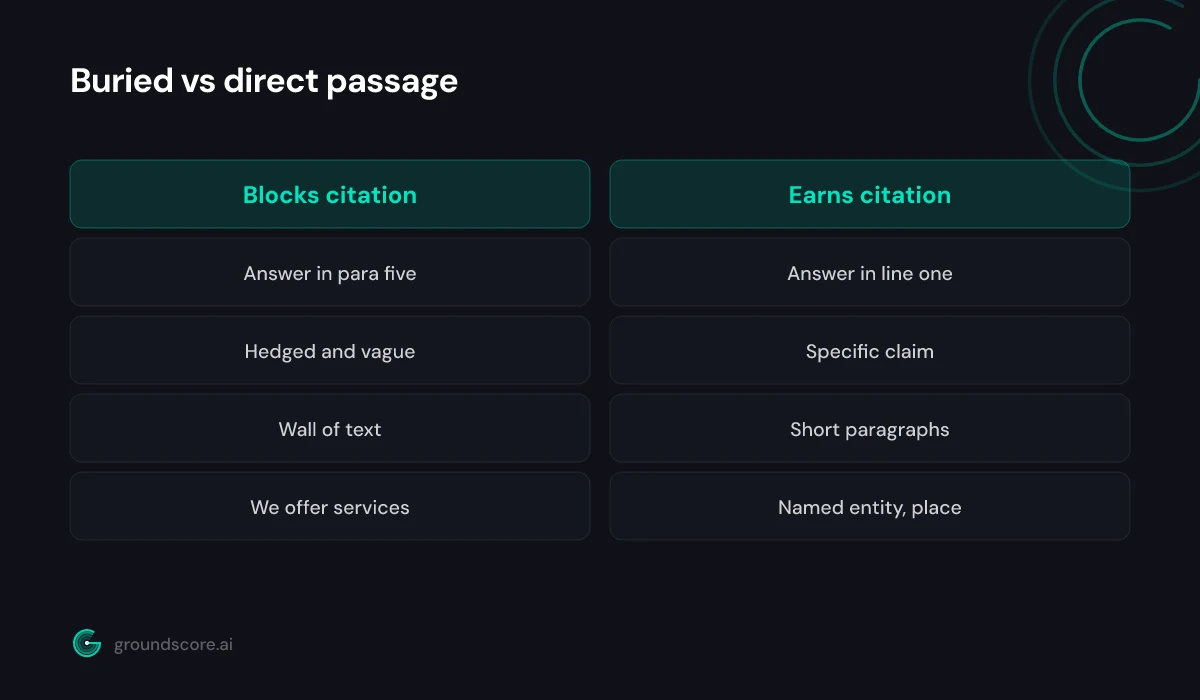
Direct answer: Walls of text hide the quotable sentence inside a dense block an engine struggles to isolate, and vague hedging drains the sentence of any claim worth quoting. Both make passages hard to lift: one by structure, one by substance. Short paragraphs with committed claims fix both at once.
Mistake 3: walls of text. A single paragraph running four hundred words gives an engine no clean seam to cut. Even if the answer is in there, it is fused to unrelated sentences, and lifting it means guessing where the relevant part starts and stops. Engines prefer passages they can quote whole.
The fix is whitespace. Break ideas into short paragraphs, two to four sentences each, one idea per paragraph. Use lists where the content is genuinely a list. The goal is that any single paragraph can stand alone as a quotable unit, because that is how engines treat it.
Mistake 4: vague hedging. "There are many factors to consider, and results may vary depending on your situation." That sentence commits to nothing, so there is nothing to quote. Excessive hedging is the enemy of citation because engines quote claims, and a hedge is the absence of a claim.
The fix is not false certainty; it is specific honesty. Replace "results vary" with the actual variables: "cost depends on square footage, material grade, and permit requirements." That is still honest, but now it says something an engine can use. We go deeper on quotable writing in how to write content AI engines cite.
Mistakes 5 and 6: keyword stuffing and unnamed entities
Direct answer: Keyword stuffing repeats a phrase to please an old ranking model and reads as spam to a modern engine, while leaving entities unnamed forces the engine to guess who or what you mean. Engines reason about specific, named entities in natural language, so write for recognition, not repetition.
Mistake 5: keyword stuffing. Repeating "best emergency plumber Denver" a dozen times does not help an AI engine and may hurt you. Engines evaluate whether a passage genuinely answers a question, and unnatural repetition signals low-quality content. It also makes passages awkward to quote, because no clean sentence survives the stuffing.
The fix is to write naturally and once. State your service, location, and specialty in plain language, then move on. Say it clearly a single time rather than clumsily ten times.
Mistake 6: unnamed entities. Pages that lean on "we," "our team," and "the company" without ever naming the actual business, people, or places give the engine nothing concrete to attach a citation to. Engines reason about named entities, covered in what entities are and why AI search relies on them, so vagueness about identity is a direct citation blocker.
The fix is to name things. Name your business, your location, your services, your authors. A passage that says "Summit Dental Care, a family practice in Portland, offers same-day crowns" is far more citable than "we provide a range of dental services," because it is anchored to real, recognizable entities.
Mistake 7: stale, undated claims that engines cannot trust
Direct answer: Undated, aging claims make an engine unsure whether your information is current, and engines hesitate to quote facts they cannot date. A page that says "the latest guidelines" with no year, or cites conditions that have since changed, reads as unreliable. Date your claims and keep them current.
Freshness is a trust signal, and stale content quietly erodes it. A page claiming to cover "this year's" rules without saying which year, statistics with no date, or advice that references outdated conditions all give an engine reason to doubt the passage is still accurate. When an engine is unsure whether a fact is current, the safe move is not to quote it.
The fix has two parts. First, anchor time-sensitive claims to explicit dates rather than relative words: "as of 2026" beats "recently." Second, actually maintain the pages, revisiting the ones that make dated claims and updating them when reality shifts. A page that is visibly current is a page an engine can quote with confidence.
This mistake compounds with the others. A stale page that also buries its answer and hedges its claims fails on multiple fronts, which is why a rewrite pass tends to fix several problems together.
One caution: do not fake freshness. Slapping a current year onto a page you did not actually review is the kind of shortcut engines and readers eventually catch, and it costs more trust than it buys. The point is not a fresh-looking date; it is content that is genuinely current and dated honestly. When you revisit a page, update the substance first, then the date, so the two always agree.
Here are the seven mistakes and their fixes in one view:
| # | Mistake | The fix |
|---|---|---|
| 1 | Burying the answer | Lead each section with the answer |
| 2 | Never answering directly | Commit to one plain claim |
| 3 | Walls of text | Short, standalone paragraphs |
| 4 | Vague hedging | Name the specific variables |
| 5 | Keyword stuffing | State it clearly once |
| 6 | Unnamed entities | Name business, place, and people |
| 7 | Stale, undated claims | Anchor to dates and maintain |
Frequently asked questions
Which writing mistake blocks citations the most?
Burying the answer is the most common and the most costly. Engines reward passages that state the answer early, so content that warms up for several paragraphs loses to a competitor who led with the point. Front-loading the answer under every heading is the single highest-leverage rewrite most pages can make.
Does keyword stuffing still hurt in AI search?
Yes. Modern engines evaluate whether a passage genuinely answers a question, and unnatural repetition signals low-quality content. Stuffing also ruins quotability, because no clean sentence survives the repetition. State your service, location, and specialty clearly one time in natural language, then move on rather than repeating the phrase.
How short should paragraphs be for AI citations?
Aim for two to four sentences, one idea per paragraph. The goal is that any single paragraph can stand alone as a quotable unit, because engines lift passages, not whole pages. Dense four-hundred-word blocks give an engine no clean seam to cut, so the answer inside them often goes unquoted.
Why does naming entities matter in my writing?
Engines reason about specific, named entities, not vague pronouns. A passage that names your business, location, services, and people gives the engine something concrete to attach a citation to. "We offer services" is not citable; "Summit Dental Care in Portland offers same-day crowns" is, because it is anchored to recognizable entities.
Do I need to date every claim on a page?
Not every claim, but every time-sensitive one. Undated facts, guidelines, or statistics make an engine unsure whether your information is current, and it hesitates to quote what it cannot date. Anchor time-sensitive claims to explicit years, "as of 2026" rather than "recently," and revisit those pages as conditions change.
Will fixing these mistakes require new pages?
No. These are rewrites of pages you already have, not new content. Most sites already cover the right topics; they just phrase the answers in ways engines cannot lift. Leading with the answer, breaking up walls of text, and naming entities are editing tasks, which makes them some of the fastest citation wins available.
The bottom line
Getting quoted is a writing problem more often than a technical one. Engines lift clean, direct, self-contained passages, and most business writing hides its answers behind warm-ups, hedges, and walls of text. The seven fixes here are all edits to existing pages: lead with the answer, commit to a claim, keep paragraphs short, name your entities, write naturally, and date what you say.
Not sure which pages are costing you citations? Run a free AI visibility check to see where your site stands and what to rewrite first.
How visible is your site in AI search?
Check your AI visibility score in seconds. Free, no account needed.
Check your score