What Entities Are and Why AI Search Relies on Them
By Joe Della Mora, Founder, GroundScore
Ask an AI engine about a plumber in Denver, a project management tool for remote designers, or a family law firm near you, and it does not scan a page for matching keywords. It reasons about entities: the specific people, places, organizations, and concepts your business maps to. Entities in AI search are the named things an engine recognizes, connects, and decides whether to trust before it cites anyone. Building GroundScore, the pattern we keep seeing is sites that rank fine on keywords yet stay invisible in answers, because the engine never resolved them into a clear, trusted entity. This guide explains what an entity is, why engines reason in entities rather than strings of text, what turns your business into a trusted one, and how that clarity earns citations.
What is an entity in AI search?
Direct answer: An entity in AI search is a distinct, identifiable thing an engine recognizes and reasons about: a person, place, organization, product, or concept. Rather than matching the exact words on your page, the engine resolves those words to a known entity, then decides how much it trusts that entity before citing it.
Think of the difference between a word and a thing. "Apple" is a string of five letters. The fruit and the company are two different entities that the same string can point to, and a competent engine keeps them apart using context. When someone asks about laptops, it reasons about the company; when someone asks about pie, it reasons about the fruit. The words are identical; the entities are not.
Your business is an entity too. It has a name, a location or service area, an owner, a set of services, and relationships to other entities, your city, your industry, your customers. An AI engine builds an internal picture of that entity from everything it can find: your website, your listings, mentions elsewhere, structured data on your pages. The clearer and more consistent that picture, the more confidently the engine can reason about you.
The failure case is an entity the engine cannot pin down. If your business name appears three different ways across the web, your address does not match your listings, and no page states plainly what you do, the engine has a blurry entity with low confidence. Blurry entities do not get cited, because the engine will not stake an answer on a thing it is unsure about.
Why do AI engines reason in entities, not keywords?
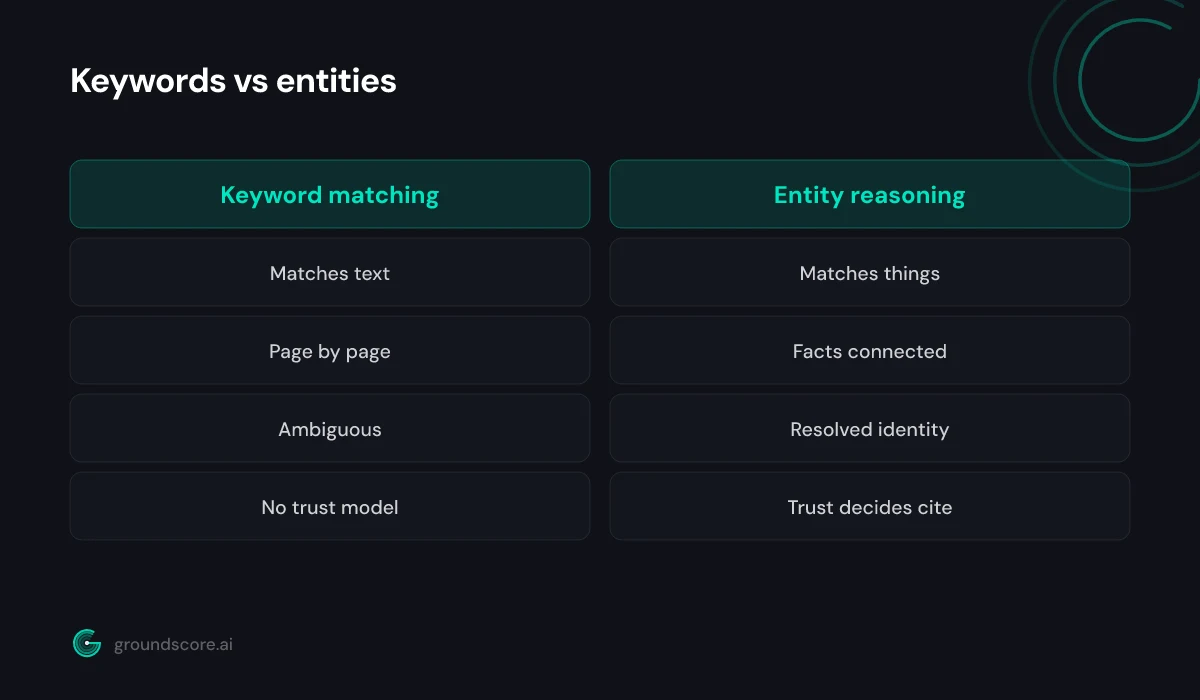
Direct answer: Engines reason in entities because language is ambiguous and users ask questions, not keyword strings. Resolving words to known entities lets an engine understand intent, connect related facts, and answer confidently. Keyword matching cannot tell two businesses apart or link a company to its location, services, and reputation.
Traditional search leaned heavily on matching query words to page words. That worked when people typed short phrases and scanned a list. AI engines answer full questions in natural language, and natural language is full of synonyms, pronouns, and implied context. "Who does bathroom remodels near the stadium?" has almost no keyword overlap with a page titled "Kitchen and Bath Renovation Services." An entity-aware engine still connects them, because it has resolved the business to a home-remodeling entity with a known service area.
Entities also let engines connect facts that live in different places. Your services are on one page, your location on another, a review on a third site entirely. Reasoning about the underlying entity lets the engine assemble those scattered facts into a single, coherent answer. Keyword matching treats each page as an island.
This is the same shift Google made years ago with its knowledge graph, and AI engines take it further. We walk through the full retrieval process in how AI engines decide which websites to cite. The short version: recognition comes before citation. An engine cites an entity it understands, not a page that happens to contain the right words.
What makes your business a trusted entity?
Direct answer: A trusted entity is one an engine can identify confidently and corroborate independently. That means a clear, consistent name and identity across the web, machine-readable facts through schema markup, a named owner or author, and mentions on sources beyond your own domain that agree with what your site claims.
Trust is not a single switch; it is an accumulation of signals that all point the same direction. Break it into a few components.
Identity clarity. One name, spelled and formatted the same way everywhere. One address or service area. One phone number. When these agree across your site, your listings, and third-party mentions, the engine's confidence in the entity rises. When they conflict, confidence drops.
Machine-readable facts. Schema markup states your identity in a format an engine does not have to guess at. Organization or LocalBusiness schema declares your name, location, and contact details explicitly. We cover this in Organization and Article schema for E-E-A-T. It is the difference between hoping the engine infers who you are and telling it directly.
Accountable authorship. Entities that look like real, named people and organizations earn more trust than anonymous pages. A named author with a title, a real about page, and consistent organizational details all signal an accountable entity rather than a faceless site.
Independent corroboration. An engine trusts a fact more when several sources agree on it. If your site says you are a Denver plumber and your listings, reviews, and local mentions say the same, the entity is corroborated. If only your own site makes the claim, it is unverified.
These signals map directly onto the Authority and Trust pillar in how GroundScore scores sites, because they are exactly what engines weigh when deciding whether an entity is worth citing.
How do consistent identity signals build entity clarity?
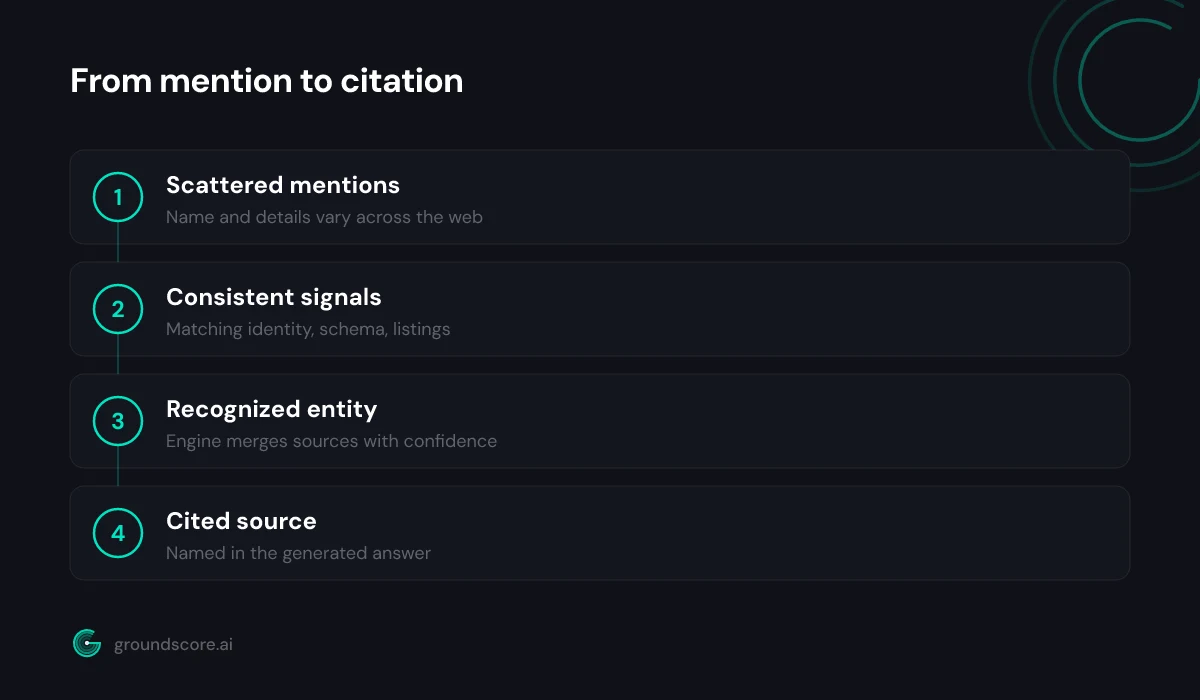
Direct answer: Consistent identity signals build clarity by giving an engine the same answer no matter where it looks. Matching name, address, and details across your site, schema, and external listings let the engine merge those sources into one high-confidence entity instead of several fuzzy, possibly-different ones it cannot safely combine.
The mechanism is worth understanding because it explains why small inconsistencies do real damage. When an engine encounters your business in several places, it has to decide whether those mentions describe the same entity. It does this by comparing identifying details. Matching details are evidence they are the same; conflicting details are evidence they might not be.
Say your website lists "Summit Dental Care" at one address, your Google listing says "Summit Dental" at a slightly different suite number, and an old directory has a former phone number. A human reads all three as obviously the same practice. An engine sees three imperfectly-matching records and has to hedge, which lowers its confidence in every fact attached to them.
Now make them identical. Same legal name, same address down to the suite, same phone, same categories, reinforced by LocalBusiness schema on the site. The engine merges the records into one entity it is sure about, and every corroborated fact strengthens the whole picture.
| Signal | Blurry entity | Clear entity |
|---|---|---|
| Business name | Varies by source | Identical everywhere |
| Address | Conflicting details | Matches all listings |
| Owner or author | Anonymous | Named, with a title |
| Schema markup | None | Organization or LocalBusiness |
| External mentions | Absent or contradict | Present and agree |
The practical takeaway: entity clarity is mostly cleanup, not creation. Most businesses do not need new signals so much as they need their existing ones to stop contradicting each other.
How does entity clarity feed citations?
Direct answer: Entity clarity feeds citations by raising the engine's confidence to the point where it will name you in an answer. Engines cite sources they can identify and trust. A clear, corroborated entity clears that bar; a blurry one gets left out even when its content is relevant, because uncertainty is disqualifying.
Citation is a confidence decision. When an engine drafts an answer, it has to attach specific claims to specific sources it is willing to stand behind. A well-defined entity is a safe source to stand behind: the engine knows who you are, what you do, and that other sources agree. A poorly-defined entity is a risk, and engines resolve risk by leaving it out.
This is why two sites with equally good content can get opposite results. The one the engine has resolved into a trusted entity gets named. The one it cannot pin down gets skipped, and the owner never learns why, because absence looks the same regardless of cause.
Entity clarity also compounds. Every consistent mention, every corroborating source, every piece of schema adds to a picture that gets easier to trust over time. This is slower than a robots.txt fix and more durable, because a well-established entity keeps earning citations across many different questions, not just the one page you optimized.
The order of operations matters. Fix identity consistency before you pour effort into new content, because content attached to a blurry entity underperforms content attached to a clear one. Get the engine to recognize you first; then give it more reasons to cite you.
Frequently asked questions
Is an entity the same as a keyword?
No. A keyword is a string of text a page might match. An entity is a specific thing, a person, place, organization, product, or concept, that an engine recognizes and reasons about. Engines resolve keywords to entities, then decide whether to trust the entity enough to cite it in an answer.
How do AI engines figure out what entity my business is?
They assemble a picture from everything they can find: your website content, schema markup, business listings, and mentions on other sites. Matching, consistent details across those sources let the engine merge them into one confident entity. Conflicting details force it to hedge, which lowers confidence and reduces the odds of a citation.
Does schema markup make my business an entity?
Schema does not create the entity, but it states your identity in a format engines do not have to guess at. Organization and LocalBusiness schema declare your name, location, and details explicitly. That reduces ambiguity and raises confidence, which is why schema is one of the strongest levers for entity clarity you control directly.
Why do my rankings not translate into AI citations?
Rankings measure keyword and page performance; citations measure whether an engine trusts you as an entity. You can rank well on words while remaining a blurry entity the engine will not name. Inconsistent identity details, missing schema, and no external corroboration all block citations without touching your Google position.
How long does it take to become a trusted entity?
Longer than a technical fix and shorter than building domain authority. Identity cleanup, matching your name and details everywhere and adding schema, can raise confidence within weeks as engines re-crawl. Independent corroboration through listings and mentions accumulates over months. Entity trust is durable once built, because it earns citations across many questions.
Can a small local business be a strong entity?
Yes, and often more easily than a large one. Small businesses have fewer records to keep consistent and a tighter identity: one name, one location, one owner. Nail those, add LocalBusiness schema, and align your listings, and a small business can become a clearer entity than a sprawling brand with contradictory data everywhere.
The bottom line
AI engines do not cite pages; they cite entities they recognize and trust. Your job is to make your business easy to resolve into one confident, corroborated thing, consistent name and details, machine-readable identity, a named owner, and outside sources that agree. That clarity is what turns relevant content into a named citation, and it is mostly cleanup you already have the pieces for.
See how clearly engines resolve your business today. Run a free AI visibility check and get your score across Authority and Trust, Site Readiness, and AI Presence.
How visible is your site in AI search?
Check your AI visibility score in seconds. Free, no account needed.
Check your score