How to Write Content AI Engines Actually Cite and Quote
By Joe Della Mora, Founder, GroundScore
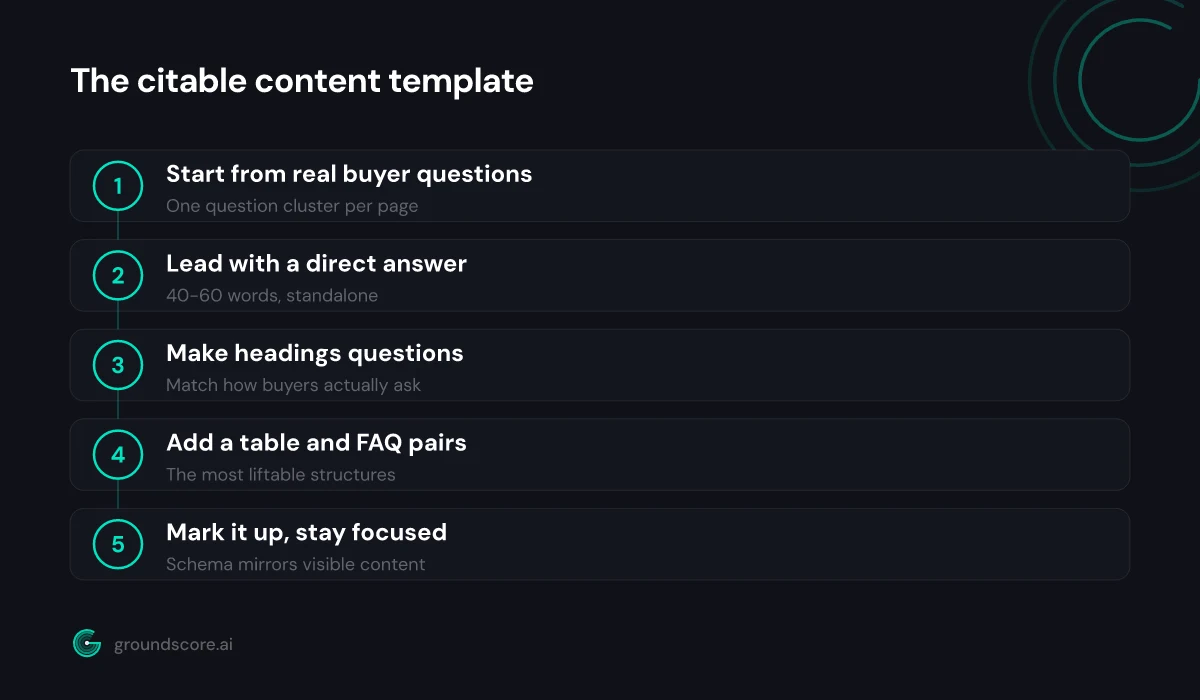
There is a repeatable template for writing content AI engines cite, and this post is written in it. Every GroundScore blog post — including this one — follows the same pattern our content engine enforces for customer sites: question headings, direct answers up front, a table, FAQ pairs, schema underneath. Practice what we preach. What you need before starting: a topic tied to a question your buyers genuinely ask, edit access to your site, and roughly an afternoon per page. Difficulty is low — this is writing discipline, not code, apart from an optional schema step at the end. What this guide adds beyond the usual "write quality content" advice is a concrete, checkable structure you can apply today. Here are the five steps, in the order you should do them.
Step 1: Start from real buyer questions
Direct answer: Pick the questions your buyers actually type into ChatGPT or Perplexity, not the keywords you wish you ranked for. One page covers one question cluster: a primary question plus the handful of follow-ups a real person would ask next. If you cannot phrase the page as a question, it will struggle to be an answer.
AI engines answer questions. That sounds obvious, but most business content is not written to answer anything — it is written to describe services, announce features, or fill a keyword slot. Retrieval systems matching a user's question to candidate passages will pass over a page that never engages the question directly.
Finding real questions does not require tooling. Listen to sales calls and support tickets for the phrasing customers actually use. Type your topic into an AI engine and read the follow-up questions it suggests. Ask yourself what someone would need to know just before buying what you sell — those "which one," "how much," "is it worth it" questions are the commercially valuable ones.
Then scope the cluster. A question cluster is one primary question plus its natural follow-ups. "How do I write content AI engines cite?" clusters with "how long should answers be?" and "does schema matter?" It does not cluster with "what is AI search?" — that is a different page. Keep a list of the follow-ups you exclude; each one is a future page, and together they build the topical depth engines read as authority.
Write the primary question at the top of your draft before anything else. Every section you outline next should serve someone who asked exactly that.
Step 2: Lead every section with a direct answer
Direct answer: Open each section with a 40-to-60-word paragraph that answers the section's question completely and stands alone. An AI engine should be able to lift that paragraph, drop it into an answer, and have it make sense with no surrounding context. Everything after it is supporting detail, not the answer itself.
This is the single highest-leverage change you can make to existing content, and it is exactly what the bolded paragraph above this one is doing. Retrieval systems select passages, not pages. When an engine scans your page for something quotable, a self-contained opening answer is the easiest possible passage to select. A conclusion buried after eight paragraphs of wind-up is the hardest.
The 40-to-60-word range is not arbitrary. Shorter than that and the answer usually lacks the specifics that make it worth citing over a competitor's. Longer and it stops being liftable — it becomes prose an engine has to summarize rather than quote. Count the words while editing. It feels mechanical the first few times; it becomes automatic.
The standalone test is the part most writers skip. Read your opening paragraph with the heading covered. Does it still make sense? Pronouns are the usual failure — "it does this by..." collapses without context. Name the subject. Say "FAQ schema tells engines..." rather than "it tells them...".
When we run free checks at GroundScore, the most common content problem I see is pages where the real answer exists but lives in the last third of the page, after the history, the philosophy, and the throat-clearing. The information was never the problem. The position was.
Step 3: Structure your headings as questions
Direct answer: Write H2 headings as the literal questions a user would ask, phrased in plain language. Retrieval systems match questions to passages, and a heading that mirrors the question is the strongest signal that the passage below it answers it. Sub-points can stay as statements; the section headings stay interrogative.
Look at the headings in any post on this blog — or in most pages that AI engines cite — and you will see questions, not labels. "How does Perplexity handle citations?" beats "Perplexity" as a heading for the same content, because the question form does work the label cannot: it declares exactly which query the section resolves.
A practical way to generate these: take the question cluster from Step 1 and turn each follow-up question into a heading, in the order a reader would naturally ask them. The page outline writes itself, and it inherits a logical arc — what is it, how does it work, what should I do — because that is the order people actually think in.
Two cautions. First, resist cleverness. "The citation game has changed" might feel like a stronger heading than "How do AI engines choose citations?" but it matches nothing anyone asks. Second, keep one question per section. If a section drifts into answering a second question, split it — you are hiding a citable passage inside an uncitable position.
How-to pages like this one are the exception to strict question form: ordered step headings ("Step 1: ...") carry the same clarity because they mirror how task queries get answered. The principle underneath is identical — a heading should tell a machine precisely what the section delivers.
Step 4: Add a comparison table and FAQ pairs
Direct answer: Tables and FAQs are the most liftable structures on a page. A comparison table gives engines clean, factual rows to quote; an FAQ section gives them prewritten question-and-answer pairs. Write each FAQ answer as a standalone 40-to-60-word paragraph, then mark the set up with FAQPage schema.
Prose forces an engine to extract facts; a table hands the facts over pre-extracted. Whenever your content compares options, lists criteria, or maps situations to recommendations, put that relationship in a table. Here is the difference between citable and hard-to-cite writing, in exactly that form:
| Page element | Hard to cite | Easy to cite |
|---|---|---|
| Opening | Warm-up, context, backstory first | Direct answer in the first paragraph |
| Headings | Clever labels ("Our philosophy") | Literal questions users ask |
| Sections | One long undivided essay | One question, one answer each |
| Facts | Buried mid-paragraph | Tables and bulleted lists |
| FAQs | Missing, or marketing copy | Standalone 40-to-60-word answers |
| Markup | None | Article plus FAQPage schema |
The FAQ section earns its place for a different reason: it catches the follow-up questions from Step 1 that were too small for their own H2 but too real to ignore. Each pair is a miniature version of the whole template — a question heading and a standalone answer — which is why FAQ content gets quoted so readily.
Write FAQ answers under the same discipline as your section openers: complete, self-contained, counted. An answer that says "see above" or leans on the question's wording is dead weight. We walked through the markup side in how to add FAQ schema AI engines can actually use; the writing side is the same rule applied five or six more times.
Step 5: Mark it up and keep the page focused
Direct answer: Finish with structured data that mirrors the visible content: Article schema for the page, FAQPage schema for the question pairs, and Organization or Person markup for authorship. Then resist scope creep. One question cluster per page beats a sprawling everything-guide, because retrieval selects passages, and focused pages produce sharper passages.
Schema is the machine-readable receipt for everything you just wrote. Article markup states who wrote the page, for which organization, and when it was last updated — the provenance signals engines weigh when deciding whether you are safe to cite. FAQPage markup turns your Step 4 answer pairs into structured data engines can consume without parsing your HTML at all. None of it rescues weak content, but it removes every excuse a machine has to misread strong content.
The rule that keeps schema honest: mark up only what is visible on the page. Markup that disagrees with rendered content is worse than no markup, because it reads as manipulation.
The second half of this step is restraint. After writing one good page, the temptation is to keep appending — more sections, more tangents, more keywords. Do not. A page that answers one question cluster completely is a set of sharp, selectable passages. A page that answers twelve questions partially is soup. When you find yourself adding a section that serves a different question, you have found the first heading of your next page.
Ship the page, then check your work from the outside: ask the engines your primary question and see what they cite. That loop — publish, ask, adjust — is the whole practice.
Frequently asked questions
How long should content be for AI search?
Long enough to answer the question cluster completely, and no longer. Depth on one question beats breadth across many. What matters more than total length is passage quality: every section should open with a standalone 40-to-60-word answer an engine can lift. A focused 1,500-word page routinely beats an unfocused 5,000-word one.
Do keywords still matter for AI engines?
Phrasing matters, but as questions rather than keyword density. Retrieval systems match the user's question to your passages, so using the natural language buyers use — in headings especially — helps. Repeating a keyword mechanically does not. Write the question the way a person asks it, then answer it plainly.
Will this template make my content feel robotic?
The structure is fixed; the voice is yours. Direct answers, question headings, and tables are constraints on organization, not on personality. Plenty of memorable writing is rigidly structured. In practice the template kills filler, and most business content reads better without its warm-up paragraphs than anyone expects it to.
Does this approach hurt traditional SEO?
No — the overlap is large. Clear headings, direct answers, structured data, and focused pages are long-standing SEO fundamentals too. Google's systems reward the same clarity that retrieval systems quote. You are not choosing between audiences; you are writing one page that machines of both kinds can parse and people can skim.
How fast will AI engines pick up a new page?
It varies by engine. Perplexity retrieves from the live web on every answer, so well-structured new pages can appear in citations quickly. ChatGPT's search mode depends on its index refreshing. Gemini follows your Google indexing. Expect weeks rather than hours, and re-ask your target questions periodically to check.
How do I know if the template is working?
Measure presence, not vibes. Ask ChatGPT and Perplexity your target questions before you publish and again a few weeks after, and log whether your site appears in the citations. Answers vary run to run, so ask repeatedly. A free AI visibility check runs this measurement for you across engines.
The bottom line
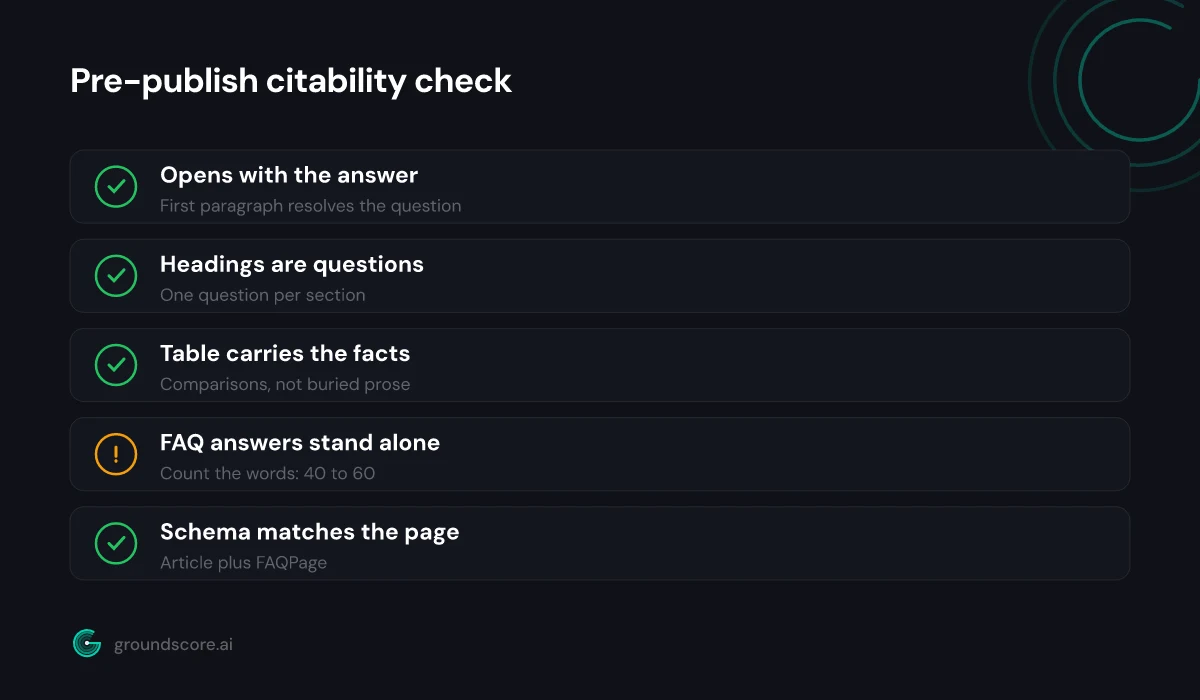
Content that AI engines cite is not a mystery and not a hack. It is a question worth answering, answered immediately, under a heading that names it, supported by a table, an FAQ, and schema that mirrors it all. This post followed the template it taught; steal the pattern for your own pages.
If you want to know whether your current content is getting cited before you rewrite anything, run a free AI visibility check — it takes about a minute and needs no account.
How visible is your site in AI search?
Check your AI visibility score in seconds. Free, no account needed.
Check your score