What Is Bing Copilot and How It Chooses Its Sources
By Joe Della Mora, Founder, GroundScore
Most conversations about AI search start and end with ChatGPT, but Bing Copilot is one of the answer engines quietly sitting in front of a very large audience, built into Bing and the Edge browser and reaching everyone who uses Windows search. Bing Copilot answers questions in plain language and, crucially for site owners, grounds those answers in live Bing search results and cites the pages it used. That grounding is the whole story: if you understand how Copilot picks sources, you understand how to be one. This guide explains what Bing Copilot is, how it selects and cites sources, how that differs from ChatGPT and Perplexity, why Bing indexation matters, and what a site owner should actually optimize.
What is Bing Copilot?
Direct answer: Bing Copilot is Microsoft's AI assistant built into Bing and the Edge browser. It answers questions in conversational language and grounds those answers in live Bing search results, then shows numbered citations linking to the sources it drew from. It is an answer engine sitting on top of a traditional search index.
Copilot began as the AI chat mode inside Bing and has since spread across Microsoft's products, but the core behavior is consistent: you ask a question, it retrieves relevant pages from Bing, and it composes an answer that quotes and links to those pages. The citations are not decoration; they are how Microsoft grounds the answer in real sources rather than the model's memory.
That design has a direct consequence for site owners. Because Copilot is anchored to Bing's index, your visibility in Copilot is downstream of your visibility in Bing. A page Bing knows well is a page Copilot can reach for; a page Bing has never seen might as well not exist.
It helps to separate Copilot the brand from Copilot the behavior. Microsoft has attached the Copilot name to many things across its products, but the piece that matters for a site owner is the web-grounded answer experience: ask a question, get a synthesized answer, see citations. That behavior is what competes for your visibility, wherever it happens to be surfaced.
Building GroundScore, the pattern I keep seeing is that owners obsess over ChatGPT and forget Bing entirely, even though Copilot rides on an index they can influence through channels that have existed for years. It is often the most winnable of the AI engines precisely because the levers are familiar.
How Bing Copilot chooses its sources
Direct answer: Copilot runs your question against the Bing index, retrieves a set of relevant pages, and generates an answer grounded in the passages it pulled, citing the pages it used. Selection favors content Bing already indexes and ranks well, that clearly answers the question, and that reads as credible and current.
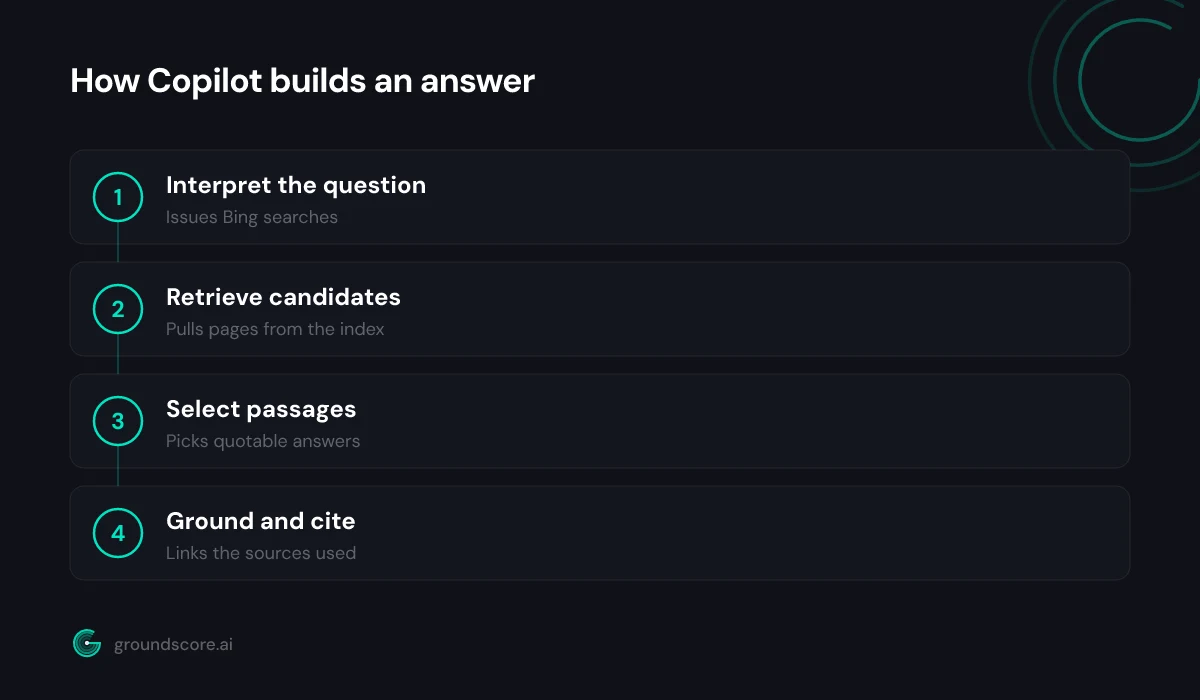
The pipeline is worth understanding because each stage is a place your page can get filtered out. First, Copilot interprets the question and issues one or more searches against Bing. Then it retrieves candidate pages and selects passages that appear to answer the question. Finally, it writes an answer grounded in those passages and attaches citations to the sources it leaned on.
Three properties push a page toward selection. It has to be in the index and rank reasonably for the underlying query, because retrieval starts from Bing's results. It has to contain a passage that plainly answers the question, since the engine is selecting quotable text, not whole pages. And it has to read as trustworthy and current, because grounding engines lean toward sources they can stand behind.
That last point matters more than people expect. A page can rank and still lose the citation to a source that answers the specific question more directly. This is the same passage-over-page dynamic that governs every answer engine, and the fix is the same: lead with the answer.
It is worth stressing that ranking well in Bing is necessary but not sufficient. Retrieval starts from Bing's results, so a page that does not rank rarely gets pulled, but among the pages that do rank, the one that answers the question most cleanly tends to win the citation. That is why passage-level work matters even after you have earned the ranking: being on the list gets you considered, and being the clearest answer gets you quoted.
How Copilot differs from ChatGPT and Perplexity
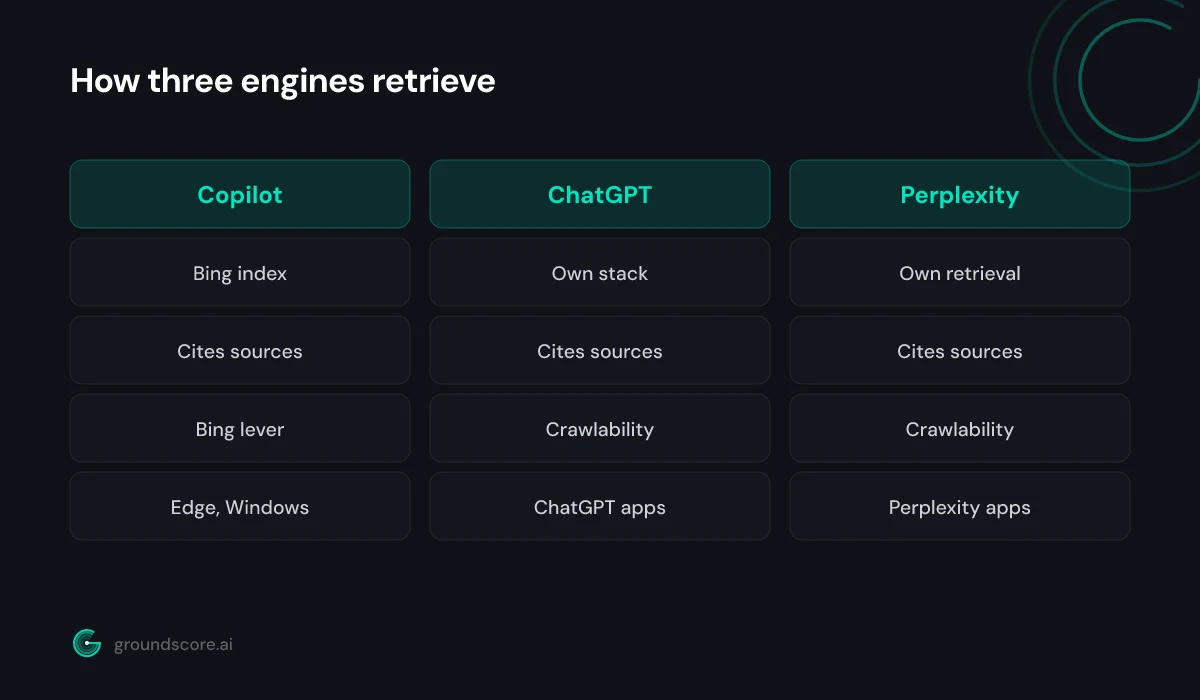
Direct answer: All three ground answers in web search and cite sources, but the index underneath differs. Copilot leans on Bing's index and ranking, so your standing in Bing matters directly. ChatGPT and Perplexity use their own retrieval stacks, which means a page can surface in one engine and be absent from another.
The engines look similar from the outside, a chat answer with numbered citations, but what they retrieve from is not identical. Copilot's tightest dependency is Bing itself. That makes it distinct in a useful way: you have a public, well-documented channel to influence what Bing knows about you, which is not equally true of every engine.
| Property | Bing Copilot | ChatGPT | Perplexity |
|---|---|---|---|
| Grounds in | Bing index | Own search stack | Own retrieval |
| Cites sources | Yes, numbered | Yes, when searching | Yes, prominent |
| Owner lever | Bing indexation | Broad crawlability | Broad crawlability |
| Where it lives | Bing, Edge, Windows | ChatGPT apps | Perplexity apps |
None of this makes the engines mutually exclusive to optimize for. Think of it as one shared foundation with engine-specific top layers. The foundation, crawlable pages, direct answers, clean schema, consistent identity, is what every engine draws on. The top layer for Copilot is Bing indexation; for the others it is broad crawlability across their own fetchers. Build the foundation once and you are most of the way to all of them.
The practical takeaway is not to chase each engine separately at first. Most of the work, being crawlable, answering questions directly, staying consistent as an entity, helps all of them. Copilot simply adds one concrete, ownable step on top: make sure Bing has you. We compare citation behavior more fully in ChatGPT vs Perplexity vs Gemini: how each cites sources.
Why Bing indexation and Bingbot access matter
Direct answer: Because Copilot grounds in Bing, a page Bing has not indexed effectively does not exist to Copilot. That makes Bingbot access and Bing indexation prerequisites: if robots.txt blocks Bingbot, or your pages never make it into Bing Webmaster Tools, no amount of on-page optimization will get you cited.
This is the step SEO teams skip because they optimized for Google and assumed Bing followed along. It often does not. Bing runs its own crawler, Bingbot, its own index, and its own ranking, and a site can be strong in Google while thin or absent in Bing.
So confirm the basics. Check that robots.txt does not disallow Bingbot, either directly or through a blanket rule. Verify your site in Bing Webmaster Tools, submit a sitemap there, and look at what Bing has actually indexed. These are not AI-specific tools, but because Copilot grounds in Bing, they are now the front door to an AI engine.
The order of operations is strict here. Writing perfect quotable answers on a page Bing has not indexed is effort spent in the wrong place. Access and indexation come first, exactly as they do for any crawler, a point we make generally in how to check if AI crawlers can access your website.
What a site owner should optimize for Copilot
Direct answer: Optimizing for Copilot looks a lot like optimizing for any answer engine, plus one Bing-specific layer. Confirm Bingbot can crawl you, verify the site in Bing Webmaster Tools, write pages that answer questions directly, add schema, and keep your entity details consistent so Bing recognizes you as a credible source.
Start with the Bing layer, because it is the part unique to Copilot and the part most owners have neglected. Get Bingbot unblocked, verified, and indexing your key pages. That single step often does more for Copilot visibility than any content change, because it moves you from invisible to eligible.
Then apply the shared answer-engine fundamentals. Lead pages with a direct, self-contained answer to the question a searcher would ask. Add schema, Organization, FAQPage, and the types relevant to your business, so Bing reads your facts cleanly. Keep your name, address, and description consistent everywhere, because entity consistency is what lets an engine merge scattered mentions into a source it trusts.
A reasonable sequence is: unblock and verify in Bing, submit a sitemap, confirm your priority pages are indexed, then work through those pages leading with direct answers and adding schema. Re-check indexation after major site changes, because a migration or redesign can quietly drop pages from Bing even when Google keeps them. Because Copilot only sees what Bing indexes, that periodic check is cheap insurance against going invisible without noticing.
None of this is Copilot-exclusive, and that is the good news: the work compounds across engines. Copilot just gives you a clearer, more measurable channel to act on than most, because Bing exposes the index you are trying to enter.
Frequently asked questions
Is Bing Copilot the same as ChatGPT?
No. Both are AI answer engines that cite sources, and both have used OpenAI models, but they are different products with different retrieval. Copilot is Microsoft's assistant grounded in the Bing search index and built into Bing, Edge, and Windows. ChatGPT is OpenAI's product with its own search stack. A page can appear in one and not the other.
Does Bing Copilot actually cite the websites it uses?
Yes. Copilot is a grounding engine, so it answers by retrieving real pages from Bing and attaching numbered citations that link to the sources it drew from. Those citations are how Microsoft anchors the answer in verifiable content rather than model memory, and they are the visibility that site owners are competing for.
How do I get my site to appear in Bing Copilot?
Start by making sure Bing itself has you: unblock Bingbot in robots.txt, verify the site in Bing Webmaster Tools, and submit a sitemap. Then write pages that answer real questions directly, add relevant schema, and keep your entity details consistent. Because Copilot grounds in Bing, indexation there is the prerequisite for everything else.
Do I need a separate strategy for Bing Copilot?
Mostly no. The core work, crawlability, direct answers, schema, and consistent identity, helps every answer engine at once. Copilot adds one Bing-specific layer on top: confirming Bingbot access and Bing indexation. Treat that as an extra step in a shared strategy, not a separate project, and the effort compounds across engines.
Why should I care about Bing if Google is bigger?
Because Bing powers Copilot, which is built into Edge and Windows search and reaches a large audience through Microsoft's ecosystem. Optimizing for Bing is also unusually tractable: it exposes public webmaster tools and a documented crawler, so you can directly influence the index an AI engine grounds in, which is not equally true of every engine.
The bottom line
Bing Copilot is easy to overlook and unusually winnable. It is an answer engine grounded in Bing search, which means the levers that control your Copilot visibility are the same public, documented channels that have controlled Bing visibility for years. Unblock Bingbot, verify in Bing Webmaster Tools, and then apply the answer-engine fundamentals every engine rewards. The Bing dependency that looks like a quirk is actually your clearest way in, because it hands you a measurable index to work against instead of a black box.
Want to know where you stand across the engines right now? Run a free AI visibility check and see how your site shows up before you start optimizing for Copilot.
How visible is your site in AI search?
Check your AI visibility score in seconds. Free, no account needed.
Check your score