ChatGPT vs Perplexity vs Gemini: How Each Cites Sources
By Joe Della Mora, Founder, GroundScore
Ask ChatGPT, Perplexity, and Gemini the same question and you get three different answers with three different citation styles. Perplexity pins numbered citations to every answer. ChatGPT cites only when it searches. Gemini grounds its answers in Google Search — when it grounds them at all. If you want your site cited, those differences matter: they determine which crawlers need access, which content shapes get quoted, and where your existing Google equity still counts. Most write-ups flatten "AI citations" into one thing. This guide separates the three engines' actual mechanics — qualitative behavior you can verify yourself by asking each engine your own buyer questions, with no invented market-share numbers. Here is how each engine handles citations, how they compare side by side, and what to do about each one.
How does ChatGPT handle citations?
Direct answer: ChatGPT cites sources only when it searches the live web. In search mode it retrieves pages, composes an answer, and attaches link citations to the passages it used. In plain conversation mode it answers from training data and cites nothing, so a page can shape answers without ever earning a visible link.
The two modes are worth keeping separate in your head. Conversational ChatGPT is a model answering from what it learned during training. There is no retrieval step, so there is nothing to cite. Your influence on those answers comes from being part of the broader web record the model was trained on — slow, indirect, and impossible to attribute.
Search mode is different. When ChatGPT decides a question needs current information — or the user forces it — it runs a live retrieval step, reads a handful of pages, and writes an answer with linked citations. Those links are the visibility that matters to a site owner, because they are attributable and clickable.
Three OpenAI crawlers are involved, and they do different jobs. GPTBot collects content for model training. OAI-SearchBot builds the index behind search mode. ChatGPT-User fetches a page on demand when a user's request triggers it. The practical consequence: blocking GPTBot in robots.txt keeps you out of training data but does not remove you from search-mode citations, while blocking OAI-SearchBot quietly removes you from the answers that carry links. We covered each agent's role in more depth in GPTBot, ClaudeBot, PerplexityBot: AI crawlers explained, and OpenAI documents the agents at platform.openai.com/docs/bots.
For content shape, search-mode ChatGPT behaves like a reader in a hurry. It favors pages where the answer is stated plainly and early, then paraphrases with a link.
How does Perplexity handle citations?
Direct answer: Perplexity is retrieval-first: every answer is built from live search results and carries numbered citations that map statements back to sources. There is no uncited mode. That makes Perplexity the most transparent of the three engines about where its answers come from, and the easiest to audit as a site owner.
Perplexity works more like a search engine that writes prose than a chatbot that sometimes searches. Retrieval is not an optional step it decides to take; it is the whole pipeline. Ask a question, and it pulls sources, synthesizes an answer, and footnotes the claims with numbered references you can click through.
For a site owner, this has two useful consequences. First, auditability: you can ask Perplexity the questions your buyers ask and see, immediately and explicitly, whether you are one of the numbered sources. No guessing about whether retrieval happened. Second, responsiveness: because answers are assembled from current retrieval rather than frozen training data, changes you make to a page can show up in answers without waiting for a model update.
The crawler to know is PerplexityBot. If your robots.txt or your CDN's bot rules block it, you are not in the running for any Perplexity answer, full stop — there is no conversational fallback where you might still influence the output.
Building GroundScore, I run the same set of buyer questions across ChatGPT, Claude, and Perplexity every week, and Perplexity is consistently the engine where a site's citation status is easiest to read — the numbered references remove all ambiguity about whether you were used. It rewards tightly scoped pages where one passage cleanly answers one question, because those passages are easy to attach a footnote to.
How does Gemini handle citations?
Direct answer: Gemini grounds answers in Google Search. When grounding kicks in, it shows supporting links drawn from Google's index, so your visibility in Gemini rides on your presence in Google's crawl. Google-Extended controls whether your content trains Gemini models; it does not remove your pages from Search or from its results.
Gemini is the engine where your existing SEO work carries over most directly. It does not run an independent crawler ecosystem for retrieval the way OpenAI and Perplexity do. When Gemini decides a question benefits from grounding, it consults Google Search and attaches supporting links from the results. If your pages are indexed and rank for the underlying queries, you are a candidate. If they are not, no Gemini-specific trick fixes that.
The control surface is different too. Google-Extended is not a crawler you will see in your logs; it is a robots.txt token that tells Google not to use your content to train and improve Gemini models. Blocking it is a training opt-out, not a search opt-out — Google states it does not affect your inclusion or ranking in Search. Meanwhile the fetching is done by Googlebot, which almost nobody blocks, because doing so removes you from Google entirely.
Like ChatGPT, Gemini does not ground every answer. Conversational and creative queries often come back with no links at all. The queries most likely to trigger grounding are the ones with factual, current, checkable answers — which happen to be the buyer-style questions that matter commercially.
The practical takeaway: for Gemini, keep doing competent SEO. Indexable pages, clear structure, healthy Search presence. The grounding layer sits on top of that.
How do the three engines compare side by side?
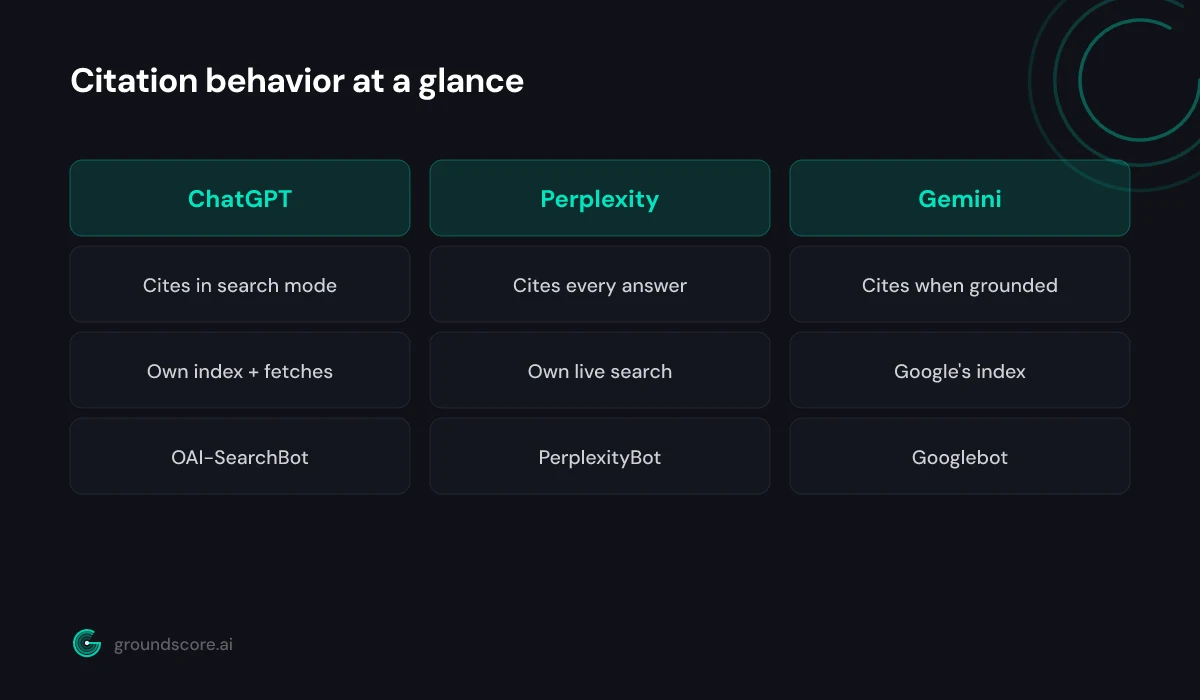
Direct answer: The short version: Perplexity always cites, ChatGPT cites when it searches, and Gemini cites when it grounds an answer in Google Search. Retrieval sources differ as well, since Perplexity and OpenAI run their own fetchers while Gemini leans on Google's existing index. Each difference changes which optimization work pays off.
Here is the whole picture in one table:
| ChatGPT | Perplexity | Gemini | |
|---|---|---|---|
| When citations appear | Search mode only | Every answer | When grounding runs |
| Retrieval source | Own index + live fetches | Own index + live search | Google Search's index |
| Citation style | Inline links, source list | Numbered references | Supporting links |
| Crawler to allow | OAI-SearchBot | PerplexityBot | Googlebot (already allowed) |
| Training opt-out | GPTBot | (same crawler) | Google-Extended token |
| Cost of blocking retrieval | Out of search answers | Out of all answers | Out of Google entirely |
Two patterns in that table deserve emphasis. First, the access story is asymmetric. OpenAI splits training and search across different user agents, so you can opt out of one without the other. Perplexity concentrates everything in PerplexityBot. Google separates training (Google-Extended) from retrieval (Googlebot) so cleanly that blocking the training token costs you nothing in visibility.
Second, the audit story is asymmetric too. Perplexity shows its sources every time; ChatGPT shows them only in search mode; Gemini shows them only when grounding fires. When you check where you stand, ask each engine the same questions several times — answers vary run to run, and a single query proves little either way.
What should you do differently for each engine?
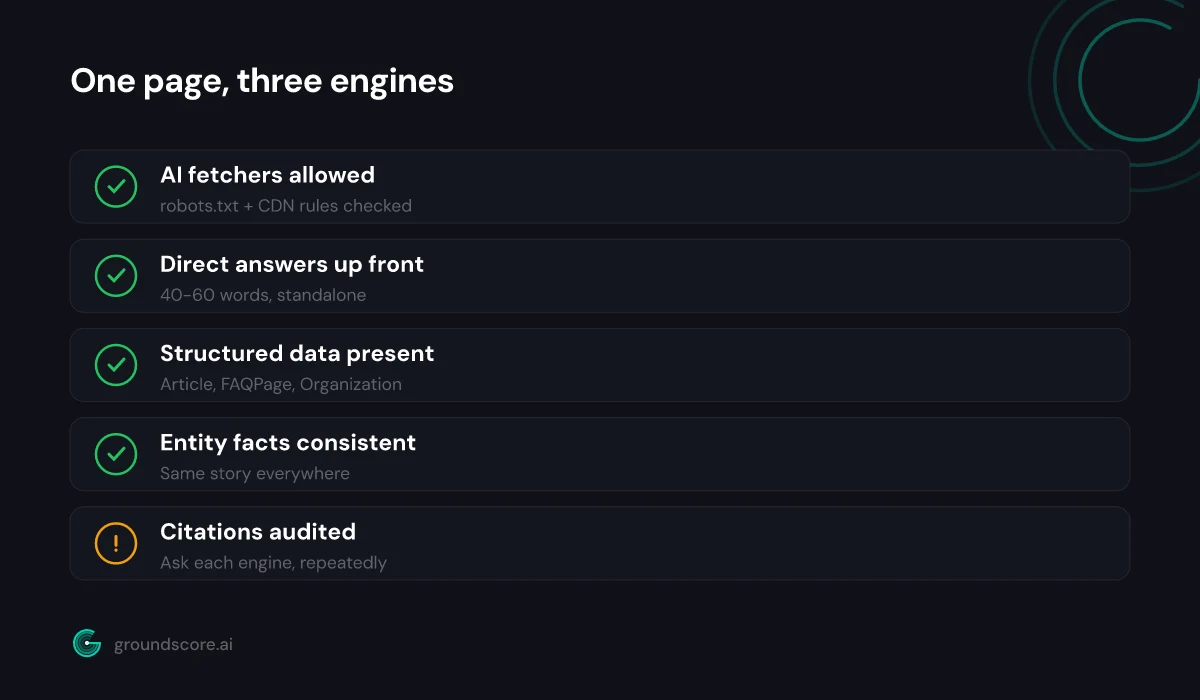
Direct answer: Less than you might think. All three engines reward the same fundamentals: crawlable pages, direct answers, structured data, and consistent entity information. The engine-specific work is mostly access: allow OAI-SearchBot and PerplexityBot in robots.txt, keep your Google indexing healthy, and check where you already appear before optimizing further.
Start with the shared fundamentals, because they compound across all three engines at once. Pages that open with a plain, complete answer get quoted everywhere. Structured data helps every system that parses your pages. Consistent organization facts — same name, same offering, same locations everywhere — make you safer to cite regardless of which retrieval pipeline found you.
Then do the short engine-specific list:
- For ChatGPT: confirm OAI-SearchBot and ChatGPT-User are not blocked in robots.txt or by your CDN's bot protection. Decide separately, and deliberately, whether you want GPTBot (training) allowed.
- For Perplexity: confirm PerplexityBot access, then favor tightly scoped pages. One question answered completely beats a sprawling page that touches ten topics shallowly.
- For Gemini: treat it as SEO. If your pages are indexed and rank for buyer queries, you are in the grounding pool. Leave Google-Extended decisions out of your visibility math — that token is about training, not retrieval.
When we run free checks at GroundScore, the most common blocker I see is not sophisticated at all: a bot-protection rule or a copied robots.txt template silently turning away AI fetchers the owner never decided to block. Check access first. It is the cheapest fix on this list and it gates everything else.
Frequently asked questions
Does ChatGPT always cite its sources?
No. ChatGPT only cites sources when it uses search mode to retrieve live pages. In ordinary conversation it answers from training data with no citations at all. The same question can produce a cited answer one time and an uncited one the next, depending on whether retrieval was triggered.
Why does Perplexity cite more sources than ChatGPT?
Because retrieval is Perplexity's entire architecture, not an optional step. Every answer is synthesized from live search results, and every answer carries numbered references back to them. ChatGPT retrieves only when it judges a question needs current information, so a large share of its answers never involve sources to cite.
Does blocking Google-Extended remove my site from Gemini answers?
Blocking Google-Extended stops Google from using your content to train and improve Gemini models. It does not remove your pages from Google Search, where Gemini's grounding links come from. Retrieval is handled by Googlebot, so a Google-Extended block is a training decision, not a visibility decision.
Which engine is easiest to get cited in first?
Perplexity, in most cases. It retrieves on every answer, refreshes from the live web, and shows numbered sources, so a well-structured page can appear quickly and you can verify it immediately. ChatGPT search mode follows similar logic but cites less consistently. Gemini depends on your existing Google indexing and rankings.
Do I need separate pages for each AI engine?
No. All three engines reward the same page: crawlable, plainly written, opening with a direct answer, backed by structured data and consistent organization facts. The per-engine differences are access rules and retrieval sources, not content preferences. Build one strong page and confirm each engine's crawler can reach it.
How do I find out whether AI engines cite my site today?
Ask each engine the questions your buyers actually ask, several times each, and note whether your site appears in the citations. Answers vary between runs, so repeat the queries before concluding anything. A free AI visibility check automates this measurement across ChatGPT, Claude, and Perplexity in about a minute.
The bottom line
ChatGPT, Perplexity, and Gemini cite sources through three different pipelines: optional search, always-on retrieval, and Google-backed grounding. The differences decide which crawlers you must allow and where to look when auditing yourself — but the page that wins citations is the same page in all three: reachable, direct, structured, and consistent.
Before optimizing anything, find out where you stand. Run a free AI visibility check and see which engines already cite your site — and which ones can't even reach it.
How visible is your site in AI search?
Check your AI visibility score in seconds. Free, no account needed.
Check your score