A Small Business Guide to Buying AEO Services Safely
By Joe Della Mora, Founder, GroundScore
Answer engine optimization is young, demand is rising, and that combination always attracts two kinds of sellers: people doing genuinely useful work, and people repackaging old SEO retainers with "AI" stapled to the invoice. If you are buying AEO services for a small business, your problem is not finding a vendor — it is telling those two apart before the contract starts.
This guide is built for that moment. Not a pitch for any particular provider, but the questions that expose weak vendors, the red flags that should end a conversation, the shape of a fair engagement, and — the part most buying guides skip — how to verify claims yourself with a measured baseline, whether or not you can read code. Here is how to walk in prepared.
What are you actually buying when you buy AEO?
Direct answer: Legitimate AEO services cover three things: making sure AI engines can access and crawl your site, structuring your content so engines can parse and quote it, and measuring whether AI answers actually mention you. Any offer that cannot be mapped to access, structure, or measurement deserves skepticism.
Strip the acronyms and AEO work is concrete. Access work means auditing and fixing robots.txt rules, firewall and CDN settings, and JavaScript rendering problems that keep crawlers like GPTBot, ClaudeBot, and PerplexityBot from fetching your pages. Structure work means schema markup, an llms.txt file, and — the biggest lever — rewriting pages so each one answers a real buyer question directly and quotably. Measurement work means asking the engines the questions your buyers ask, on a schedule, and tracking whether you appear in the answers.
That is the whole map. It is genuinely valuable work, and it is also work with no secret ingredients — which matters for how you buy it. When a proposal lands on your desk, sort every line item into access, structure, or measurement. Line items that fit are evaluable: you can ask what gets fixed, on which pages, verified how. Line items that do not fit — "AI entity infusion," "LLM authority signaling," proprietary submissions to unnamed systems — are where the repackaging hides.
One more calibration: AEO overlaps heavily with good technical SEO and good writing. That is not a scam signal; it is the nature of the work. The scam signal is mystique.
The questions to ask any vendor before signing
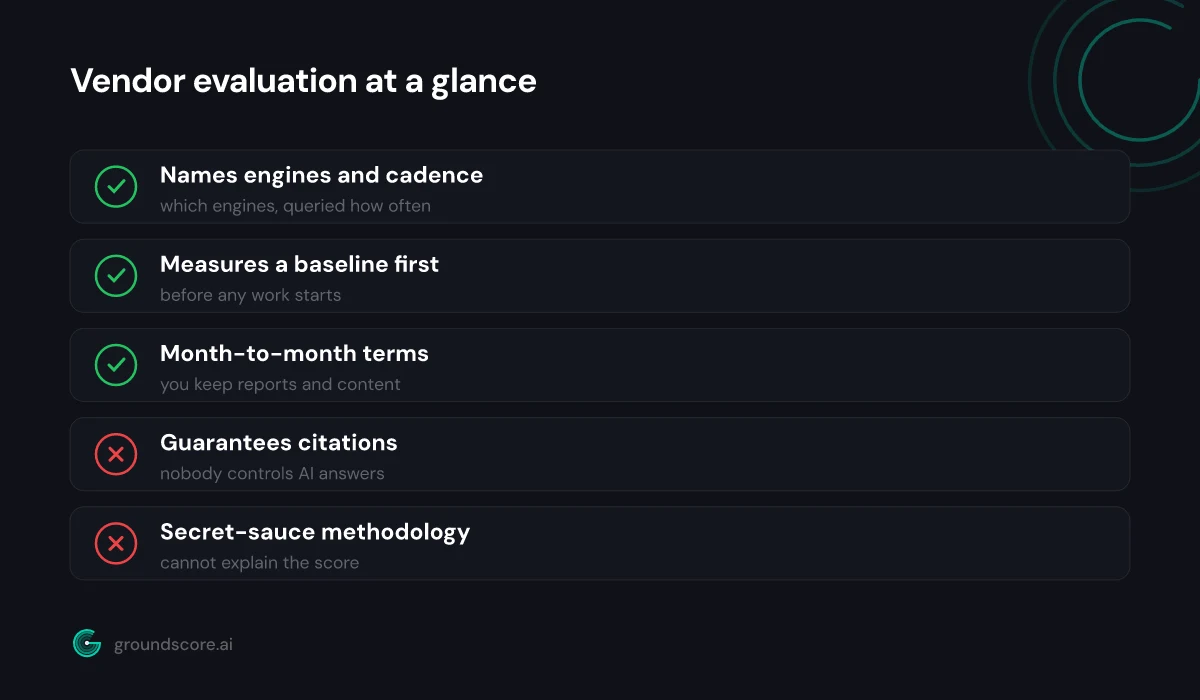
Direct answer: Ask four questions: Which AI engines do you actually query, and how often? Can I see the methodology behind your scores and reports? What do I own — reports, content, markup — if we part ways? And how will you show me movement month over month? Vague answers to any of these are answers.
Each question has a job.
"Which engines do you query, and how often?" separates measurement from theater. A real vendor names engines — ChatGPT, Claude, Perplexity, Gemini — and a sampling cadence, and can explain why repeated sampling matters when answers vary run to run. A weak vendor says "our system monitors all major AI platforms" and changes the subject.
"Show me the methodology" tests whether their score means anything. You do not need to audit the math. You need them to explain, in plain language, what goes into the number and what would make it move. If the person selling it cannot explain it, the monthly report will be a decoration.
"What do I own if we leave?" matters more in AEO than in most services, because the deliverables — schema on your pages, content on your site, your question set and its history — should live with you. The wrong answer is any flavor of "the optimizations live in our platform."
"How will you show me movement?" sets the accountability contract before money moves. The right answer involves a baseline, a fixed question set, and the same measurements repeated monthly. Get the answers in writing; honest vendors will not mind, and the other kind will negotiate with themselves right there in the email.
Red flags that should end the conversation
Direct answer: Walk away from guaranteed citations, secret-sauce methodologies, engagements that skip a baseline measurement, and pressure to sign long contracts before you have seen any data. Nobody controls what an AI engine says. A vendor promising specific placements is promising something they do not control and cannot deliver.
The guarantee is the brightest flag. AI answers are generated fresh per request by systems the vendor has no hand on. "We will get you cited in ChatGPT" is structurally identical to the old "we will get you to #1 on Google" pitch — and it fails the same test: if they truly controlled the outcome, they would not be selling it to you for a few hundred dollars a month.
The others cluster around the same theme — avoiding measurement:
| Red flag | What honest looks like |
|---|---|
| "Guaranteed citations in 30 days" | Measured movement on a fixed question set, no guarantees |
| "Proprietary methods we can't share" | Methodology explained in plain language |
| Work starts without a baseline | Baseline measured and shared before any changes |
| Annual contract, upfront payment | Month-to-month, or a short pilot with an exit |
| Reports full of activity, empty of outcomes | Same questions tracked every month, answers shown |
The no-baseline engagement deserves special contempt because it makes the vendor unfalsifiable: whatever your visibility looks like in month three, they will claim credit or blame "the algorithms" as needed. And long lock-ins in a field this young transfer all the risk to you — the buyer who cannot yet know whether the work is working.
None of these flags means the person is malicious. Some are just winging it. From your side of the table, the difference does not matter.
What does a fair engagement look like?
Direct answer: A fair AEO engagement starts with a measured baseline, names the specific fixes it will ship, reports against the same question set every month, and lets you leave with your data, your content, and your markup. Month-to-month terms are reasonable in a field this young; multi-year lock-ins are not.
A well-run engagement has a recognizable rhythm. It opens with measurement: where do you appear today when engines answer your buyers' questions, and what is blocking you at the access and structure level. It proceeds with named work: these robots.txt and firewall fixes, schema on these pages, these five pages rewritten to answer these five questions. And it reports with continuity: the same questions, the same engines, sampled the same way, so month-over-month comparison means something.
Expectations should be set honestly in the proposal itself. Access and structure fixes are fast and verifiable within weeks. Presence in answers moves slower and noisier — a vendor who says "expect the needle to move over a quarter, not a fortnight" is showing you they understand the medium. A vendor who promises fireworks by week two is showing you something else.
On price: know what the measurement layer costs on its own before you evaluate a service quote. Monitoring tools run from tens of dollars a month into the low hundreds, and GroundScore is $199 a month for one site as one transparent reference, so a service retainer is justified by the labor on top: the audits, the fixes, the writing. Our guide to what AI search monitoring should cost breaks down the cost anatomy in detail. A retainer that is all monitoring and no labor is a subscription with a markup.
How to verify claims yourself, before and after
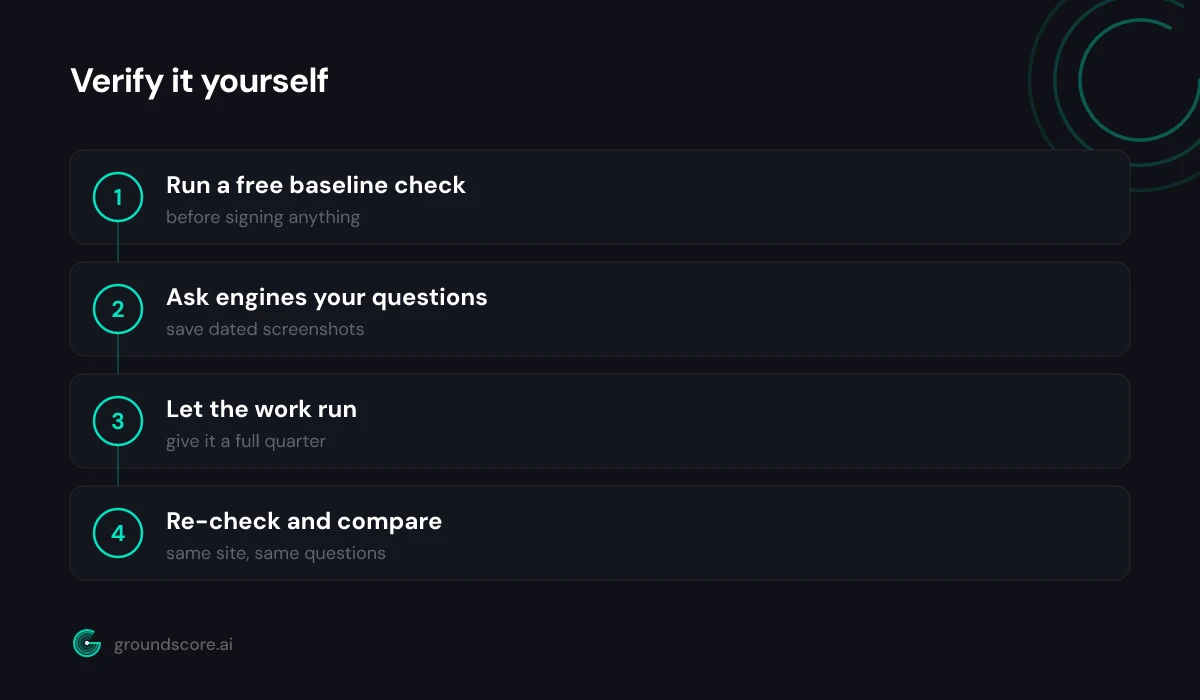
Direct answer: Before signing, run a free check on your site and ask the AI engines your top buyer questions yourself. Save the results with a date. After a quarter of work, repeat both and compare. If the vendor's reports and your own observations tell different stories, believe your observations.
You do not need technical skills to hold a vendor accountable. You need a dated "before" picture, and the discipline to take the same picture later.
The manual version costs an hour. Write down ten questions your customers actually ask before choosing a business like yours. Ask each one in ChatGPT, Perplexity, and Claude. Screenshot the answers and note whether you were named, whether you were linked, and which competitors appeared. Date the file. That is your baseline, and the fact that you have one changes the entire dynamic of the engagement — the vendor now reports into a room where the truth is already written down.
The automated version costs a minute: a free AI visibility check runs your site against ChatGPT, Claude, and Perplexity with no account needed, and returns a 0–100 score you can re-run later for a like-for-like comparison.
Then, at the quarter mark, repeat whichever version you ran — same questions, same engines. Building GroundScore, I have talked with owners who spent months on retainers, and the pattern I keep seeing is a monthly PDF full of activity — pages "optimized," signals "strengthened" — that nobody in the business could connect to a single AI answer. A before-and-after you took yourself is the antidote. Weigh a DIY-versus-tool-versus-agency decision properly with our guide to buying AI search help the right way.
Frequently asked questions
How much should AEO services cost for a small business?
Anchor on the parts: measurement tooling runs from tens of dollars monthly into the low hundreds (GroundScore is $199 a month for one site, as a reference), and the rest of a retainer should buy visible labor: audits, fixes, writing. Quotes in the mid hundreds monthly can be honest for one site once the tooling sits inside them; quotes in the thousands should itemize substantial hands-on work.
Are guaranteed AI citations ever legitimate?
No. Answers are generated per request by systems no vendor controls, and the same question can cite different sources on different runs. A vendor can honestly promise process — fixes shipped, pages restructured, presence measured on a schedule. Promising a specific citation outcome is promising weather. Treat the guarantee itself as the disqualifier.
What should I receive from an AEO engagement each month?
Three things: evidence of work (which fixes shipped, on which pages), measurement against the same fixed question set as last month with the underlying answers available, and a plain-language read on movement and next steps. Activity reports without repeated measurement are the classic substitute for results — that pattern is worth ending a contract over.
Can I verify AEO results without any technical skills?
Yes. The whole verification loop is asking questions in chat tools and saving dated screenshots: ten buyer questions, three engines, before and after a quarter of work. A free automated check adds a scored baseline in about a minute. If your own observations and the vendor's reports disagree, your observations win.
What should I own when the engagement ends?
Everything that touched your business: the schema and content on your site, the audit findings, the question set, and the full measurement history. Because the fixes live on your pages, they keep working after the vendor leaves. Any arrangement where visibility "lives in the platform" and dies with the contract is a leash, not a service.
Is AEO worth buying at all right now?
The work is worth doing — access, structure, and answer-shaped content pay off wherever buyers ask AI engines about businesses like yours, and early movers face less competition for citations. Whether to buy it or do it yourself depends on time and stakes. Measure first, for free; spend second, with a baseline to hold against the invoice.
The bottom line
Buying AEO services safely comes down to one discipline: never buy what you have not measured. A vendor worth hiring will name the engines they query, explain their methodology in plain words, start from a baseline, report against the same questions every month, and let you walk away with everything. A vendor worth avoiding will guarantee citations, guard their secret sauce, and sell you a lock-in before showing you a single data point.
Take the before picture now, while it costs nothing: run a free AI visibility check and walk into every sales conversation already knowing where you stand.
How visible is your site in AI search?
Check your AI visibility score in seconds. Free, no account needed.
Check your score