DIY, Tool, or Agency: Buying AI Search Help the Right Way
By Joe Della Mora, Founder, GroundScore
If you have decided your business needs AI search optimization help, you have three ways to buy it: do the work yourself, buy a tool that measures and guides you, or hire an agency to handle everything. Each path is right for somebody, and each is wrong for somebody, which is exactly what most advice on the subject skips. Vendors tell you to buy tools, agencies tell you to buy agencies, and DIY guides assume you have unlimited weekends. This guide lays out the honest decision criteria instead: what the work actually involves, what each path costs in money and hours, and where each one breaks down. One disclosure up front: GroundScore is a tool, so we are one of the three options being weighed. We will show our math either way. Here is how to decide.
What does AI search help actually involve?
Direct answer: AI search help covers three kinds of work: opening access so AI crawlers can reach your site, structuring content so engines can parse and quote it, and building presence so engines actually cite you. Any path you buy, from DIY to agency, is some bundle of those three jobs.
Before comparing prices, know what you are pricing. The work behind answer engine optimization sorts into three buckets.
Access is plumbing: robots.txt rules, CDN and firewall settings, anything that decides whether GPTBot, ClaudeBot, or PerplexityBot can fetch your pages at all. It is mostly one-time fixes with occasional maintenance.
Structure is how your content is packaged: schema markup, direct answers to real questions, an llms.txt file, pages organized so a machine can tell what each one is about. This is ongoing work that scales with how much content you have.
Presence is the outcome and the measurement: when someone asks an AI engine a question in your space, does your site appear in the answer? Tracking this takes repeated, systematic querying, because AI answers vary from run to run and from engine to engine.
The reason this framing matters for a buying decision: access is cheap to fix and expensive to ignore, structure is where most of the recurring labor lives, and presence is the part you cannot eyeball. Whichever path you pick has to cover all three, or you are buying a partial solution and calling it done.
The three buckets also explain why a generic SEO retainer rarely covers this by default. The access rules involved are AI-specific user agents most SEO audits never look at, and presence measurement means querying AI engines directly, which classic rank trackers do not do. When a vendor says AI search is included, ask which of the three buckets they mean.
When does DIY make sense?
Direct answer: DIY fits a small site with a technically comfortable owner and more time than budget. Robots.txt fixes, basic schema, and an llms.txt file are all learnable in a weekend. The tradeoff is measurement: without tooling you are guessing whether any of it changed how engines answer.
If your site is under a few dozen pages and you are the kind of owner who edits your own templates, most of the access and structure work is genuinely within reach. The specs are public: robots.txt semantics are documented, schema.org publishes every type, and llms.txt is a short markdown file. None of it requires an engineer.
What DIY covers well:
- One-time access fixes: unblocking AI crawlers, checking your CDN's bot settings
- Basic structure: Organization schema, FAQ schema on your top pages, an llms.txt file
- Content habits: opening pages with direct answers instead of throat-clearing
Where DIY breaks down is the presence bucket. You can ask ChatGPT about your business tonight, and you should. But one query is an anecdote, not a measurement. Answers shift between runs, engines differ from each other, and unless you log results over time you cannot tell whether last month's work moved anything. Manual spot checks also quietly stop happening around week three, in my experience, because they are tedious.
So an honest DIY plan is: do the fixes yourself, accept that your measurement is rough, and revisit in a quarter. For a lot of small sites, that is a perfectly rational place to start.
When is a tool the right buy?
Direct answer: A tool is the right buy when you want measurement and guided fixes without paying for someone else's hours. If you can spare a few hours a month and want to know your score, what is broken, and what to fix first, a monitoring tool covers that for a fraction of agency cost.
A monitoring tool splits the work with you: it handles the querying, scoring, and diagnosis, and you handle the fixes it points to. That trade suits owners who are willing to make changes but do not want to build their own measurement system or guess at priorities.
This is the category GroundScore is in, so weigh this section accordingly. What our tool does: checks how your site shows up in ChatGPT, Claude, and Perplexity, scores you 0 to 100 across three pillars, and gives you a ranked action plan. Business runs $199 per month for one site, and there is a free check that needs no account, which is a reasonable way to test whether the measurement is useful to you before paying anything. Full plan details are on the pricing page.
When we run free checks, the most common pattern I see is an owner who assumed they had a content problem when they actually had an access problem, or the reverse. That is the core argument for measuring before spending on either: a tool that tells you which bucket your problem is in can save you from months of fixing the wrong thing.
The honest limits: a tool does not write your content, negotiate your CDN settings, or do the work for you. If nobody at your business will act on the action plan, the subscription is a report nobody reads.
When should you hire an agency?
Direct answer: Hire an agency when you have budget but no time or in-house skill, when the site is large or the stakes are high, or when AI visibility is one piece of a bigger marketing engagement. You are paying for execution and judgment, not just information about what is wrong.
An agency is the only path where somebody else does the fixes. For a business with no technical staff, a site with hundreds of pages, or an owner whose hours are worth more elsewhere, that is not a luxury, it is the only version of this work that will actually happen.
Agencies also make sense when AI search is one thread in a larger engagement. If a firm already handles your SEO and content, having them fold AI visibility into the same retainer keeps the work coordinated instead of fragmented across vendors.
What to check before signing:
- Ask what they measure. A credible agency can show you which engines they query, how often, and what the baseline was. "Trust us, it's improving" is not a methodology.
- Ask what you keep. Reports, scan history, and access to any tooling should survive the relationship ending.
- Ask what they will change. The deliverable is fixed pages and new content, not a slide deck.
Cost is the obvious tradeoff. Agency retainers for this kind of work start in the hundreds of dollars per month and climb with scope, which is rational when real hours are being spent, and a waste if all you needed was a $199 diagnosis and three afternoons of fixes.
How do the three paths compare on cost and effort?
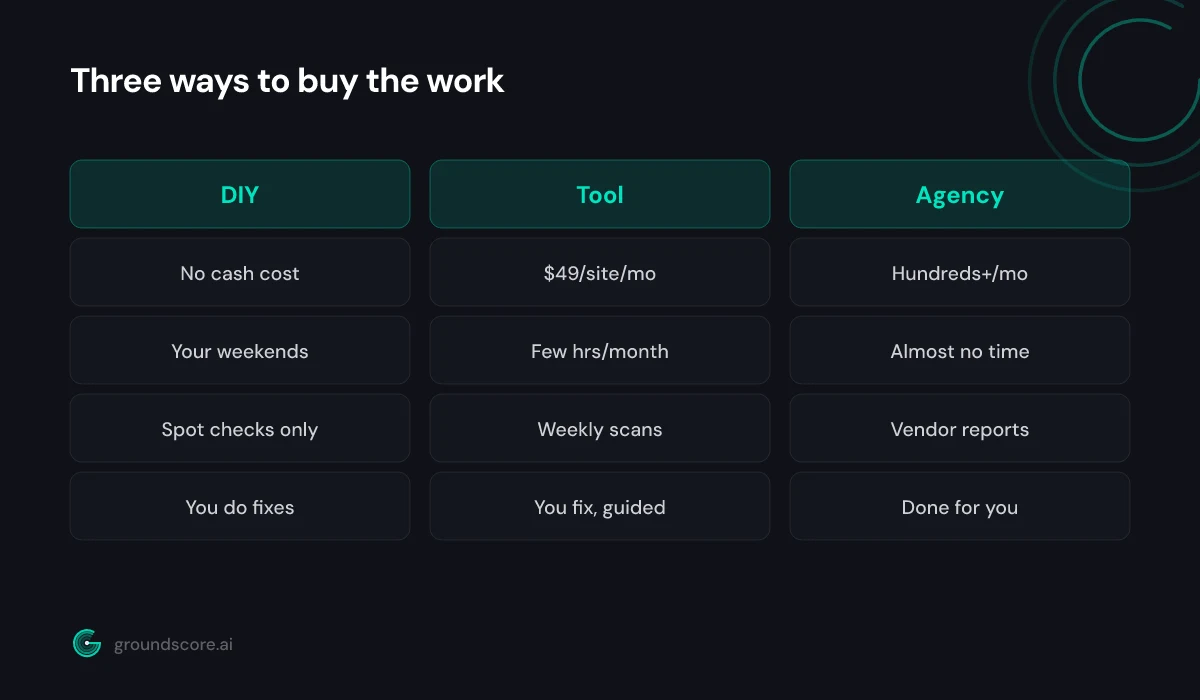
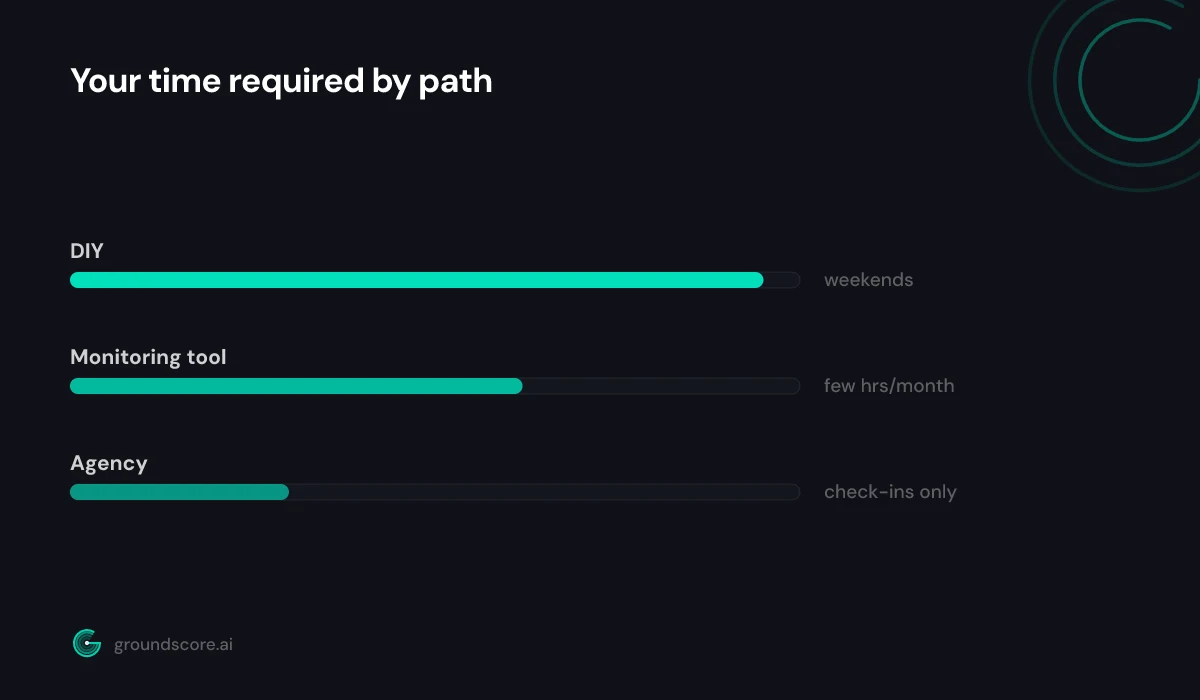
Direct answer: DIY costs your time, roughly a few focused weekends up front plus ongoing checks. A monitoring tool like GroundScore runs $199 per month for one site and needs a few hours monthly. An agency typically starts in the hundreds per month and scales with scope, but demands the least of you.
Here is the comparison in one place:
| Criterion | DIY | Monitoring tool | Agency |
|---|---|---|---|
| Cash cost | None | From $199 monthly | Hundreds per month and up |
| Your time | Highest | A few hours a month | Lowest |
| Skill needed | Willingness to learn | Basic site editing | None |
| Measurement | Manual spot checks | Automated weekly scans | Depends on the agency |
| Who does the fixes | You | You, with a ranked plan | The agency |
| Best for | Small site, technical owner | Owner who wants data and direction | No time, many pages, high stakes |
Two notes on reading the table honestly. First, the paths stack: plenty of businesses start DIY, add a tool when they want proof their work matters, and hire help when the workload outgrows them. Nothing about the choice is permanent. Second, the deciding variable is usually not budget, it is whether anyone at your business will actually do the fixes. If yes, DIY or a tool captures most of the value at a fraction of agency cost. If no, the cheaper options are false economies, because an unread action plan improves nothing.
One hybrid worth naming: agencies increasingly run tools under the hood and resell the output with their own judgment layered on, so the tool-versus-agency line blurs in practice. If you hire a firm, ask what tooling sits underneath and whether you get direct access to it. If the answer is proprietary and invisible, your measurement history leaves when the agency does, and that should factor into what you are willing to pay.
Frequently asked questions
Can I start with DIY and upgrade later?
Yes, and it is often the right sequence. Do the obvious access and structure fixes yourself, then add a tool when you want to know whether the work moved anything, and consider an agency only when the remaining work exceeds your available hours. Nothing in the DIY phase is wasted by upgrading.
Is a monitoring tool worth it for a very small site?
It depends on what a customer is worth to you. If AI engines send you even a handful of buyers a year, $199 a month pays for itself on one of them. If you are pre-launch or traffic barely matters to revenue, start with a free one-off check and revisit paid monitoring when the stakes grow.
How do I vet an agency's AI search claims?
Ask three questions: which engines do you query and how often, what does my baseline look like before we start, and what do I own if we part ways. Then verify independently by running your own free check before and after a few months of work. Guaranteed citations are a red flag; no one controls AI answers.
Do I still need traditional SEO if I buy AI search help?
Yes. AI engines lean heavily on the same crawlable, well-structured, authoritative content that ranks in traditional search, and several ground their answers in conventional search indexes. The two disciplines overlap far more than they conflict, so treat AI visibility as an extension of SEO, not a replacement for it.
How long until AI search work shows results?
Be suspicious of anyone quoting a precise timeline. Access fixes can show up as crawler visits in your logs within days, while presence in AI answers builds unevenly as engines refresh their indexes. The honest approach is baseline first, fix, then re-measure on a monthly cadence and judge the trend.
What is the biggest mistake buyers make here?
Buying the path that matches their self-image instead of their behavior. Technical owners buy tools and never open them; busy owners commit to DIY and never start. Be honest about which fixes will actually get done at your business, and by whom, before choosing. The right path is the one where the work happens.
The bottom line
There is no universally right way to buy AI search help. A technical owner with a small site and free weekends should DIY. An owner who wants measurement, priorities, and proof without agency prices should use a tool. A business with budget, scale, and no hours to spare should hire an agency and vet it hard. The only universally wrong move is deciding blind.
Whichever path you lean toward, get a baseline first: run a free AI visibility check and find out what actually needs fixing before you spend a dollar on it.
How visible is your site in AI search?
Check your AI visibility score in seconds. Free, no account needed.
Check your score