6 Local SEO Habits That Also Boost Your AI Visibility
By Joe Della Mora, Founder, GroundScore
The good news for local businesses is that the connection between local SEO and AI visibility is closer than almost anywhere else in search. The habits that have earned you Google Maps rankings for years, consistent listings, structured data, real reviews, are the same signals AI engines lean on when they decide whether to recommend you. You are not starting a second job; you are extending one you already do. This list covers six local SEO habits that double as AI visibility wins, and for each one, why it feeds AI recommendation, not just map rankings. It comes from what we see at GroundScore scanning local sites that rank fine on Google yet never get named by ChatGPT. Here are the six, numbered, with the AI payoff spelled out for each.
1. Keep your NAP consistent everywhere
Direct answer: Habit one is keeping your name, address, and phone number identical across your website, Google Business Profile, and every directory. Consistent NAP is a bedrock local ranking signal, and it is also how AI engines confirm you are one real, trustworthy entity rather than several conflicting listings they cannot resolve.
NAP consistency is the least glamorous habit and one of the highest-leverage. Local SEO has rewarded it forever because search engines gain confidence when many independent sources agree on the same business facts.
AI engines reason the same way. They think in entities, and an entity with a clean, consistent identity is easy to resolve and trust. When your address reads one way on your site, another on Yelp, and a third on an old directory, an engine cannot be sure those refer to the same business, so it hedges, and hedging means not recommending you.
Audit the basics: exact business name, one canonical address format, one phone number. Fix the conflicts at the source, starting with your own site and Business Profile. This single habit strengthens the Authority and Trust pillar that both map rankings and AI citations depend on.
2. Mark up your site with LocalBusiness schema
Direct answer: Habit two is adding LocalBusiness schema to your site. It hands search engines and AI systems a machine-readable version of your identity, hours, location, and service area, removing the guesswork. The same structured data that helps you qualify for rich local results also tells AI engines exactly what you are and where you operate.
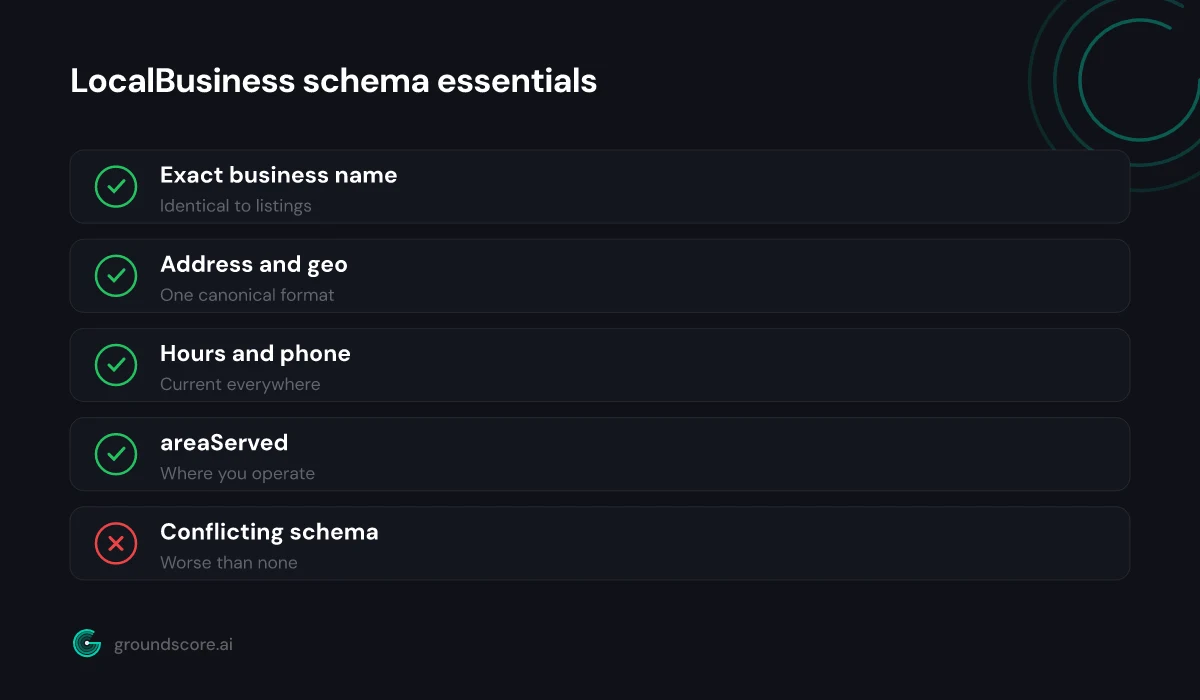
Schema is the difference between hoping a machine infers your details and telling it outright. LocalBusiness schema (and its subtypes like Restaurant or Dentist) declares your name, address, geo-coordinates, hours, and areaServed in a format both Google and AI engines parse without ambiguity.
For AI recommendation, this matters because engines answering "who does X near me" need to know two things with confidence: what you do and where you do it. Schema states both. Without it, an engine is reconstructing your service area from prose it may misread; with it, the facts are explicit.
We walk through the fields step by step in how to add LocalBusiness schema for AI search results. The key discipline is keeping the schema identical to your listings, conflicting structured data is worse than none, because it actively lowers an engine's confidence in your identity.
3. Generate reviews and keep answering them
Direct answer: Habit three is steadily earning genuine reviews and responding to them. Reviews are a proven local ranking factor, and they also serve as third-party corroboration that AI engines read as evidence you are a real, active, well-regarded business worth recommending when someone asks for the best option in your category.
Reviews do double duty. In local SEO, review volume, recency, and rating feed rankings and the prominence of your Business Profile. For AI visibility, reviews are corroboration, independent voices describing what you do and how well you do it, and corroboration is one of the signals engines weigh before naming a source.
The habit is consistency, not a one-time push. A steady flow of recent, genuine reviews signals an active business; a wall of reviews from two years ago signals a stale one. Responding to them, especially thoughtfully to criticism, adds fresh, on-topic text that reinforces what your business is about.
One honest caveat: never fabricate reviews or incentivize dishonest ones. Beyond the platform violations, fake reviews create exactly the inconsistency that erodes the entity trust you are trying to build. Earn them the real way, and they compound across both surfaces.
4. Build a real about and team page
Direct answer: Habit four is publishing a substantive about page with named people, credentials, and genuine history. Local SEO values the trust and E-E-A-T signals this creates, and AI engines specifically look for accountable, identifiable entities. A real about page gives them the named humans and experience markers that make your business citable.
A thin about page, a stock photo and two sentences, is a missed signal on both sides. Local search rewards demonstrable expertise and trust; AI engines are explicitly trying to decide whether you are an accountable entity rather than an anonymous page.
Give them something to work with. Name the people, state their roles and credentials, describe how long you have operated and what you actually do. First-hand experience markers, real history, real names, real specifics, are the E-E-A-T signals both systems read as evidence you are legitimate.
Building GroundScore, the pattern we keep seeing is that local sites with a genuine about page get named by AI engines more readily than competitors with more service pages but a faceless identity. The engine wants to point people at a real business, and a real about page is the clearest proof it can find.
5. Write pages that answer local questions directly
Direct answer: Habit five is building location and service pages that answer the specific questions local customers ask, each leading with a direct answer. Local SEO rewards relevant, intent-matched pages, and AI engines quote self-contained passages. An answer-first local page is both a ranking asset and a quotable source engines can lift.
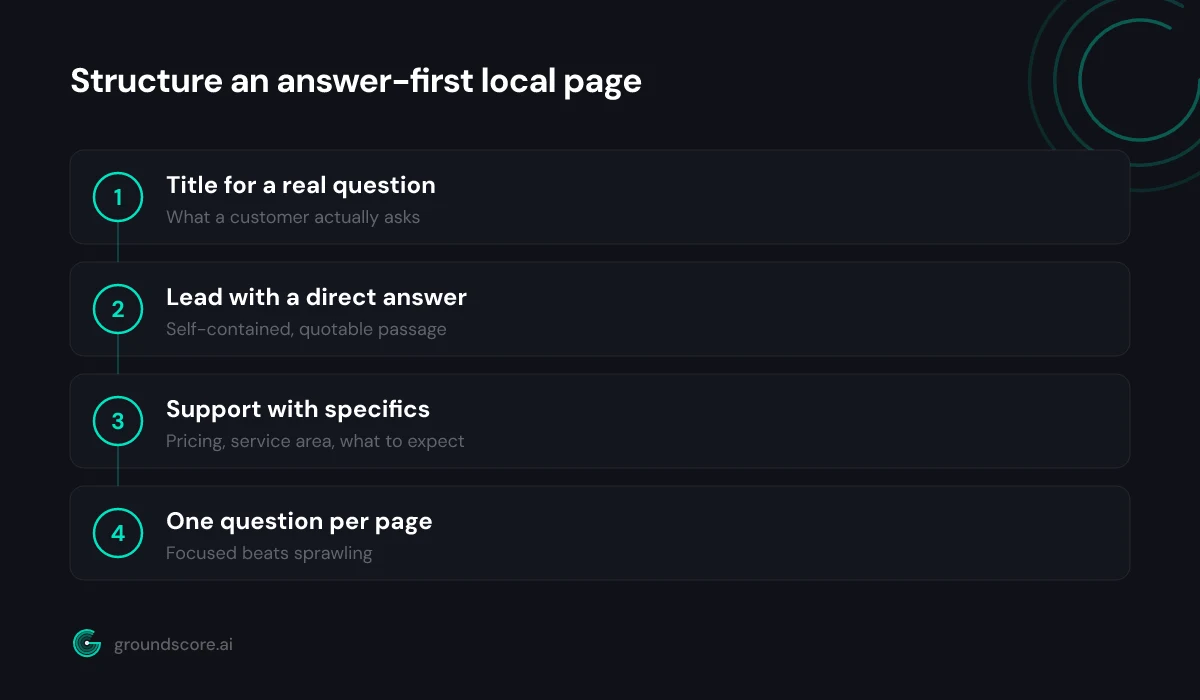
This is where local SEO and AEO converge most tightly. A page titled for a real question, "emergency plumbing in [city]", "how much does a roof inspection cost", that leads with a clear, self-contained answer serves both a searcher and an AI engine looking for a passage to quote.
The habit is to write for the question, not the keyword. Each service and location page should open by answering the thing a customer actually wants to know, then support it with specifics: pricing ranges, service areas, what to expect. Engines quote paragraphs, not pages, so one clean answering passage outperforms a page that circles the topic for ten scrolls.
For a fuller map of which pages to build, see 5 pages every local business website needs for AI search. The unifying principle: answer-first pages earn both rankings and citations.
6. Maintain your local citations and directory presence
Direct answer: Habit six is keeping your listings in trusted local directories accurate and current. Citation building has long anchored local SEO, and those same consistent third-party listings corroborate your identity for AI engines, giving them independent confirmation of who you are, what you do, and where, before they recommend you.
Local citations, your presence in directories like your Business Profile, industry directories, and reputable local listings, have always been a core local ranking input. Their value for AI visibility is corroboration again: many trusted sources describing the same business the same way.
The habit is maintenance, not just creation. Businesses move, change phone numbers, and adjust hours, and stale citations quietly reintroduce the inconsistency that undermines entity trust. Periodically audit your key listings and fix drift. Prune duplicates, which are a common and confusing source of conflicting information.
Quality beats quantity here. A handful of accurate, trusted, consistent citations does more for both rankings and AI confidence than dozens of low-quality listings that half-agree with each other. Consistency across a few authoritative sources is the signal; volume of noisy listings is not.
A simple maintenance rhythm keeps this from decaying. Once a quarter, search your business name, open the listings that surface, and check each against your canonical name, address, and phone. Fix drift immediately, and flag duplicates for removal or merging. It takes an hour and it protects every downstream signal, because a single wrong phone number on a trusted directory can quietly undercut the entity confidence the other five habits are building.
Here is how the six habits map across both surfaces:
| Habit | Local SEO payoff | AI visibility payoff |
|---|---|---|
| Consistent NAP | Ranking signal | Entity resolution |
| LocalBusiness schema | Rich results | Machine-readable identity |
| Reviews | Prominence | Corroboration |
| Real about page | Trust and E-E-A-T | Accountable entity |
| Answer-first pages | Intent match | Quotable passages |
| Local citations | Ranking anchor | Independent confirmation |
Frequently asked questions
Do I have to choose between local SEO and AI visibility?
No, and that is the point of this list. The six habits serve both at once because AI engines lean on the same signals local search always has: consistent identity, structured data, reviews, and corroboration. Doing the local SEO work well is most of the AI visibility work, so there is no trade-off to make.
Which habit should a local business start with?
Start with consistent NAP, because inconsistency undermines every other signal. If an engine cannot resolve you to one real business, better schema and more reviews cannot fully compensate. Once your name, address, and phone are identical everywhere, add LocalBusiness schema next, then build outward to reviews and answer-first pages.
Does LocalBusiness schema guarantee AI engines will recommend me?
No single change guarantees a recommendation. Schema removes guesswork about what you are and where you operate, which meaningfully improves an engine's confidence, but recommendation also depends on corroboration, reviews, and answer-first content. Schema is a strong, controllable lever, not a switch. Treat it as necessary groundwork rather than a promise.
How many local citations do I actually need?
Fewer, accurate, trusted citations beat many noisy ones. A handful of authoritative, consistent listings, your Business Profile plus reputable local and industry directories, does more for both rankings and AI confidence than dozens of low-quality entries. Focus on consistency and pruning duplicates rather than chasing citation count as a number to maximize.
Will these habits help me get named by ChatGPT specifically?
They improve your odds with ChatGPT, Claude, and Perplexity alike, because all three reason about entities and lean on corroboration. None can be guaranteed, and answers vary run to run. The reliable move is to strengthen the underlying signals these habits produce, then measure whether citations rise over time rather than expecting a fixed outcome.
How do I know if these habits are working?
Measure before and after. Record your visibility score and how many local questions currently cite your site, do the work, then re-check monthly. Because AI answers vary, watch the multi-month trend rather than a single result. A free check gives you the baseline and shows which pillar is holding you back.
The bottom line
For local businesses, AI visibility is not a separate discipline bolted onto local SEO, it is mostly the same discipline, measured on a new surface. Consistent identity, structured data, genuine reviews, a real about page, answer-first pages, and clean citations earn map rankings and AI recommendations at the same time, which makes local businesses unusually well positioned to win here.
See how your local signals translate into AI visibility today. Run a free AI visibility check to get your score and the specific gaps to fix first.
How visible is your site in AI search?
Check your AI visibility score in seconds. Free, no account needed.
Check your score