5 Pages Every Local Business Website Needs for AI Search
By Joe Della Mora, Founder, GroundScore
Ask ChatGPT or Perplexity to recommend a plumber, a dentist, or a wedding photographer in your town, and the engine names specific businesses. It builds those recommendations from what it can retrieve and verify — and for a local business, AI search visibility comes down to a surprisingly short list of pages. Most local sites are missing at least two of them.
This is not a generic content checklist. It is organized around what AI engines actually pull from when they vouch for a local business: entity facts, direct answers, structured question-and-answer pairs, verifiable location data, and corroboration. Each page below covers what it must contain, why engines lean on it, and the schema markup to add. Here are the five pages, in the order you should build them.
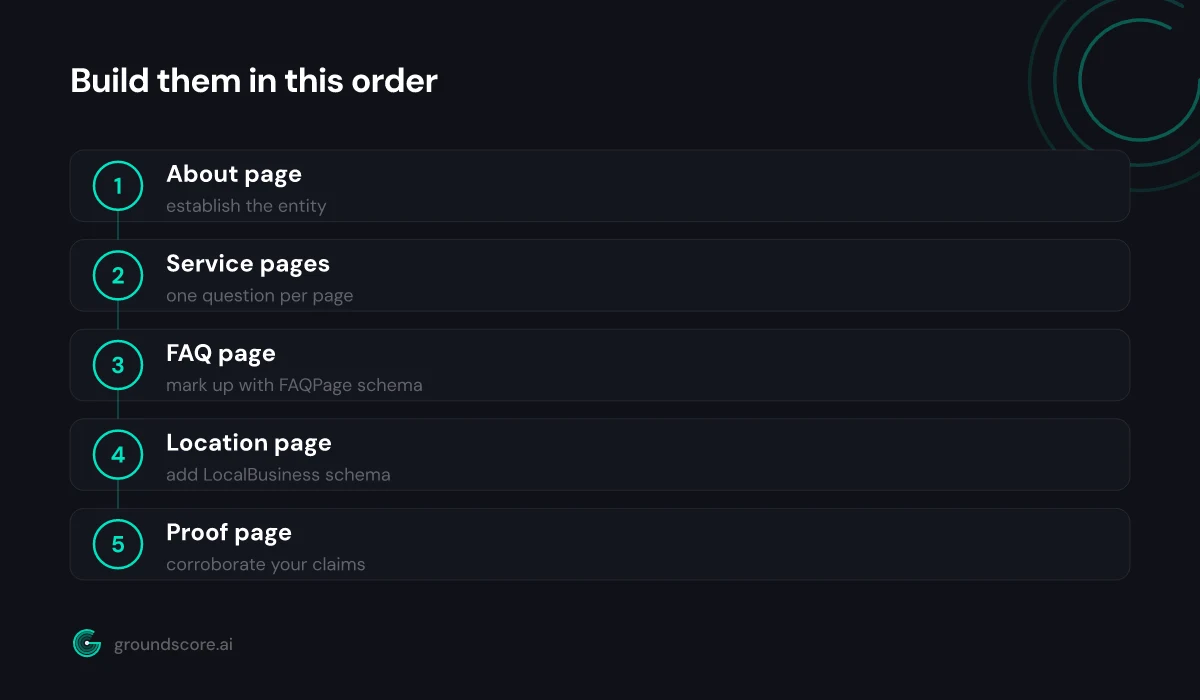
1. An about page with real entity facts
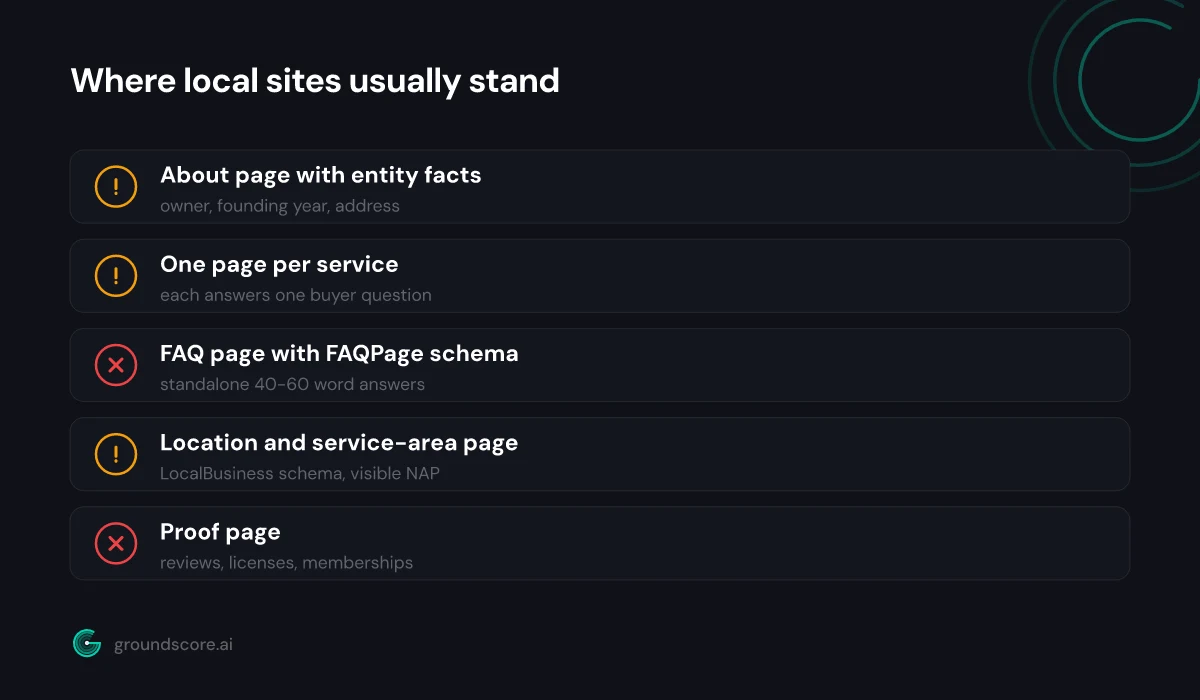
Direct answer: Your about page should state, in plain text, who owns the business, how long it has operated, where it is based, and what it specializes in. AI engines recommending local businesses lean on these entity facts to confirm you are real, established, and relevant to the question asked.
AI engines are cautious about recommending businesses they cannot verify. Before an engine vouches for you in an answer, it needs to resolve you as an entity: a specific business, run by specific people, in a specific place, doing a specific thing. The about page is where that resolution happens or fails.
When we run free checks on local business sites while building GroundScore, the about page is the most common weak spot I see: a paragraph of mission-statement filler with no owner name, no founding year, no address, no specifics at all. It reads fine to a human skimming, and it gives an AI engine nothing to hold onto.
Write it like a record, not a brochure:
- Who owns and runs the business, by name, with a sentence of background each.
- When it was founded and how the practice or trade developed.
- Where you are based and which areas you serve.
- What you specialize in, and just as usefully, what you do not do.
Back the visible text with Organization schema (or LocalBusiness — more on that below) and Person markup for the owner. The visible page and the markup must agree; machine-readable facts that contradict the page hurt more than they help. One honest, specific about page does more for entity trust than ten generic blog posts.
2. Service pages that each answer one question
Direct answer: Build one page per service, and open each page by directly answering the question a buyer would ask about that service: what it involves, how long it takes, what affects the price. A single services page that lists everything gives AI engines nothing quotable about any one service.
The classic local business site has one "Services" page: a bulleted list of everything the business does, each item getting a sentence. That page can never be the best answer to any specific question, because it answers none of them. AI engines select passages, not sites — they quote the paragraph that answers the question, from whatever page contains it.
Split the list. Each meaningful service gets its own page, and each page opens by answering the question a real buyer would ask an AI engine about that service. Not "we offer comprehensive drain solutions" but "Clearing a blocked drain usually takes under an hour; pricing depends on access and whether the blockage is in your line or the main." Specific, standalone, quotable.
A good service page covers, in plain language: what the work involves, how long it typically takes, what drives the cost up or down, when this service is the right call versus a related one, and what happens after you get in touch. Add Service schema, and if the page carries genuine questions and answers, FAQPage markup too.
One page per question cluster is the rule. If two services get asked about in genuinely different ways, they earn separate pages. If nobody would ever ask about them separately, keep them together.
3. An FAQ page marked up with schema
Direct answer: An FAQ page collects the questions customers ask before hiring you and answers each in a short, standalone paragraph. Mark it up with FAQPage structured data so engines can parse each question-and-answer pair cleanly. It is often the easiest page on a local site for an AI engine to quote.
The FAQ page works because its shape matches what answer engines are trying to produce: a question, then a direct answer. You are handing the engine pre-cut material in the exact format it needs.
The quality bar is the questions themselves. Skip the padding ("Why choose us?") and write down what people actually ask on the phone before booking: Do you charge for estimates? Are you licensed and insured? How far out are you booking? Do you handle emergency calls? What payment do you take? Your inbox and call history are the source of truth here — real questions, in the words customers use.
Each answer should be 40 to 60 words and stand completely alone, because an engine may lift it without any surrounding context. Name the business where it feels natural; an answer that says "we" fifteen times gives the engine an unattributable quote.
Then add FAQPage JSON-LD that mirrors the visible questions and answers exactly — mismatches between markup and page are the classic mistake. Our guide to FAQ schema AI engines can actually use walks through the markup step by step, including the validation pass.
4. A location and service-area page
Direct answer: A location page states your address, service area, hours, and contact details in visible text, backed by LocalBusiness schema in JSON-LD. When an AI engine answers a "near me" or "in my city" question, this page is where it confirms you actually serve the place the user asked about.
Local questions are location-bound by definition. An engine asked for "a roofer in Fort Collins" has to establish which businesses genuinely operate there, and it can only do that from location data it can retrieve and parse. If your address lives in a footer image or your service area is implied but never stated, you are asking the engine to guess — and engines that cannot verify tend not to recommend.
The page needs, in plain visible text: your full address (or your base city, if you work from home and serve an area), the specific towns and neighborhoods you serve, your hours, and your phone number. If you serve multiple distinct areas, say so explicitly rather than hoping "and surrounding areas" does the work.
Mark the page up with LocalBusiness schema — or the more specific subtype that fits, like Plumber, Dentist, or Attorney. Include name, address, telephone, opening hours, and the areas served. Then check consistency: the name, address, and phone number here must match your Google Business Profile, your directory listings, and your site footer exactly. Conflicting NAP data across the web is one of the quietest visibility killers, because engines resolve conflicts by trusting you less.
5. A proof page for reviews, credentials, and memberships
Direct answer: A proof page gathers your credentials in one place: licenses, certifications, insurance, industry association memberships, awards, and a representative sample of reviews. AI engines look for corroboration before recommending a business, and a single well-structured page of verifiable claims makes that corroboration easy to find and quote.
Recommendation is a trust act. When an engine names your business in an answer, it is implicitly vouching for you, so signals that you are legitimate and accountable carry real weight. Most local businesses have these signals — a license number, an insurance certificate, fifteen years of reviews — scattered across badge images, third-party platforms, and the owner's filing cabinet. Scattered proof is invisible proof.
Put it on one page, as text an engine can read:
- License numbers and the bodies that issued them.
- Certifications and manufacturer accreditations, with dates.
- Insurance and bonding status.
- Industry association memberships.
- A handful of representative review excerpts, with a link to the full profiles on the platforms where they live.
Resist the urge to pad. One verifiable license number outweighs a wall of self-awarded badges, and engines are better at telling the difference than most site owners expect. Link your review platform profiles rather than pasting hundreds of reviews — corroboration works because the claim can be checked somewhere you do not control.
Here is the full page set at a glance:
| Page | What AI engines pull from it | Schema to add |
|---|---|---|
| About | Owner, history, specialization | Organization, Person |
| Service pages | Direct answers about each service | Service, FAQPage |
| FAQ | Quotable question-and-answer pairs | FAQPage |
| Location | Address, hours, service area | LocalBusiness |
| Proof | Credentials and corroboration | Organization |
Frequently asked questions
Do AI engines really recommend specific local businesses?
Yes. Ask ChatGPT, Perplexity, or Claude for a service provider in a specific city and you get named businesses, often with reasons. The engines build those shortlists from what they can retrieve and verify — which is exactly why the five pages above, the ones that make you verifiable, matter so much.
Do I need all five pages if my site is tiny?
The about page and the location page are the floor: identity and geography are what engines must verify before recommending anyone. Add the FAQ next because it is the fastest to produce from real customer questions. Service pages and the proof page can follow one at a time — five focused pages beat twenty thin ones.
What is LocalBusiness schema, and do I need a developer to add it?
LocalBusiness schema is a small block of JSON-LD code describing your business — name, address, hours, service area — in a format machines parse reliably. Most site builders and WordPress SEO plugins can generate it from a form. The essential part is accuracy: the markup must match your visible page and your listings exactly.
Should my reviews live on my site or on review platforms?
Both, doing different jobs. Platform reviews provide corroboration, because engines weigh claims that can be checked on sites you do not control. Your proof page should carry a representative sample as text, with links to the full profiles. Excerpts on your site make the evidence readable; the platforms make it believable.
How is this different from regular local SEO?
The fundamentals overlap heavily — consistent NAP data, real service pages, and reviews help both. The difference is the unit of competition: AI engines quote passages, not rankings, so pages must answer questions directly in plain quotable text. Good local SEO gets you into the candidate pool; answer-shaped pages get you into the answer.
How do I know if these pages are working?
Measure before and after. Ask the engines the questions your buyers ask — "best [your trade] in [your town]," plus your service-specific questions — and log whether you are named. Rebuild the pages, give the engines a few weeks to recrawl, and ask again. Presence in answers is the ground truth; everything else is a proxy.
The bottom line
AI engines recommend local businesses they can verify and quote. The five pages — about, per-service, FAQ, location, and proof — are the verification surface: entity facts, direct answers, parseable question-and-answer pairs, confirmable geography, and checkable credentials. None of them require a redesign. They require specificity, honest text, and markup that matches the page.
Want to know how your site shows up before you start rebuilding? Run a free AI visibility check — it takes about a minute and shows where you stand in ChatGPT, Claude, and Perplexity today.
How visible is your site in AI search?
Check your AI visibility score in seconds. Free, no account needed.
Check your score