How to Get Your Local Business Recommended by ChatGPT
By Joe Della Mora, Founder, GroundScore
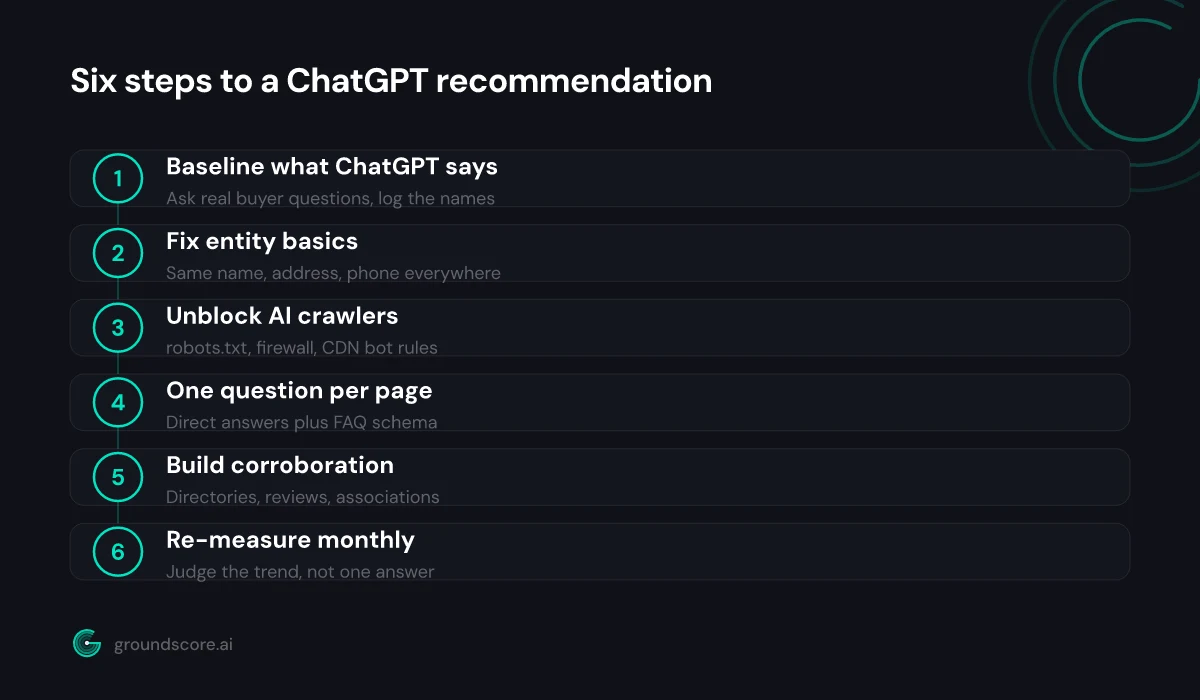
Ask ChatGPT for a good plumber, dentist, or accountant in your town and it names specific businesses. There is no ad slot and no shortcut to buy: to get recommended by ChatGPT, your business has to be easy to find, easy to verify, and easy to quote. This guide is the six-step version of that work, written for a local business owner doing it without an agency. Prerequisites: the ability to edit your website (or someone who can), a list of everywhere your business appears online, and a few hours a week for about a month. Difficulty is moderate — checking, writing, and fixing, not coding. One thing most guides skip: recommendation answers vary run to run, so the honest goal is raising your odds of being named, not guaranteeing a slot. Here are the six steps, in order.
Step 1: Baseline what ChatGPT says about your market
Direct answer: Before changing anything, ask ChatGPT the questions your buyers ask — "best [your service] in [your town]," "who should I call about [problem]" — and log which businesses it names. Repeat each question a few times, because answers vary between runs. This baseline is how you will know whether anything you fix later actually moved.
Write down ten to fifteen questions a real customer would type. Not questions about you — questions about the problem. "Best emergency electrician in Mesa." "How much does a kitchen remodel cost in Duluth?" "Who does same-day AC repair near Plano?" If you only test your own business name, you will learn nothing useful; buyers who already know your name were never the prize.
Ask each question in ChatGPT with search enabled, and write down three things: which businesses get named, which websites get cited, and whether you appear at all. Then ask the same question again on another day. The variation you see between runs is the single most important expectation-setter in this whole process. One appearance is not victory and one absence is not failure; the pattern across repeated runs is the real signal.
Pay attention to the competitors who show up consistently. They are your reference class. Later steps will make more sense when you can look at their sites and listings and see what the engine had to work with.
This measurement pass is the same presence audit we describe in the DIY AI visibility audit, boxed down to local recommendation queries. If spreadsheet logging is not your thing, GroundScore's free check runs the measurement side for you in about a minute. Either way: get the before picture. Everything else in this guide is pointless if you cannot tell whether it worked.
Step 2: Fix your entity basics everywhere your business appears
Direct answer: AI engines recommend businesses they can verify. Make your name, address, phone, and hours identical on your website and every listing, publish a real about page that says who runs the business, and add LocalBusiness schema so machines can read those facts without guessing. Inconsistent basics quietly disqualify you.
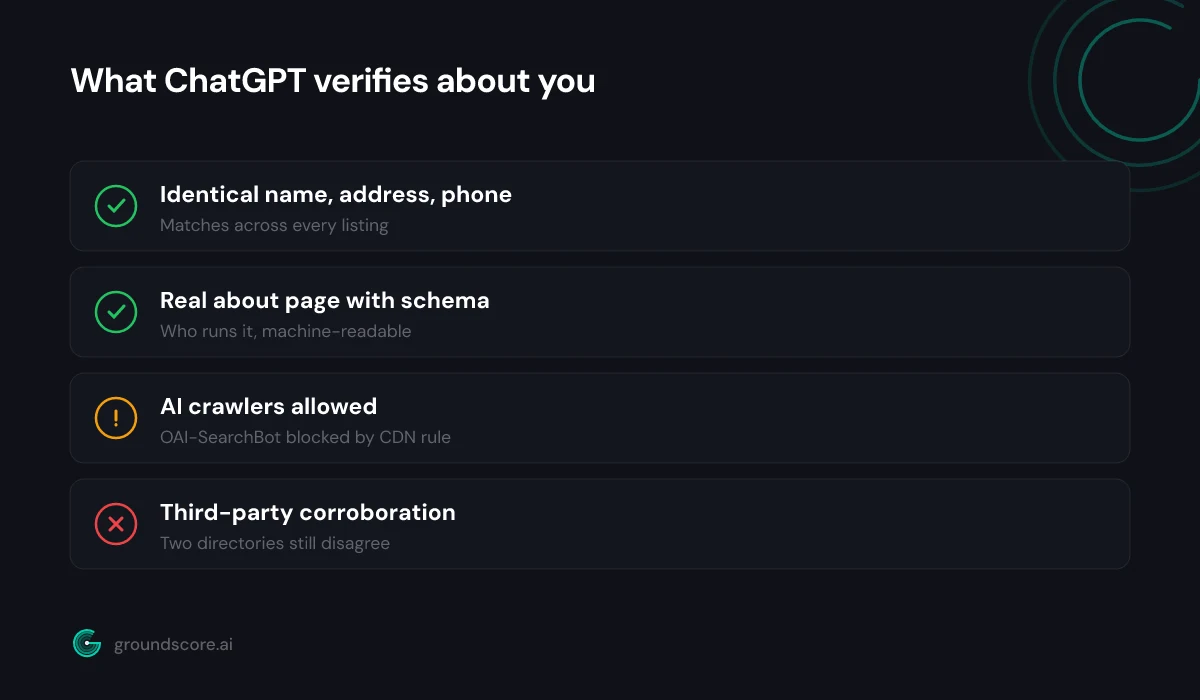
When we run free checks on local business sites at GroundScore, the most common blocker I see is not a weak website. It is a business whose own facts disagree with each other: one phone number on the site, another on a directory, a third on a review platform, plus an old address nobody remembered to retire. A human shrugs at that. A machine deciding whether to recommend you treats it as uncertainty, and uncertainty loses to the competitor whose facts line up.
The fix is unglamorous. List every place your business appears online — your site, directories, review platforms, social profiles, association pages — and make the name, address, and phone number character-for-character identical. Pick one canonical format and enforce it.
Then make your own site the strongest statement of who you are. A real about page: who owns the business, how long you have operated, what area you serve, what licenses or certifications you hold. Add LocalBusiness schema to your homepage or contact page carrying the same facts in machine-readable form — name, address, phone, hours, service area, and sameAs links to your major profiles. The schema does not need to be fancy; it needs to agree with everything else.
We cover the site side of this in 5 pages every local business website needs for AI search. The short version: engines cannot recommend an entity they cannot pin down.
Step 3: Unblock the AI crawlers that feed ChatGPT
Direct answer: Check your robots.txt and firewall rules for the three OpenAI crawlers: GPTBot (training), OAI-SearchBot (the search index behind ChatGPT's cited answers), and ChatGPT-User (live fetches when a user asks). If OAI-SearchBot is blocked, ChatGPT search cannot cite you, no matter how good your site is.
Open yourdomain.com/robots.txt in a browser and read it. You are looking for User-agent blocks naming AI crawlers, and for a blanket Disallow: / under User-agent: * that catches everything. Plenty of local business sites carry a block-everything template a past developer installed years ago, and the owner has no idea.
The three agents that matter for ChatGPT specifically:
| Crawler | What it does | What blocking costs you |
|---|---|---|
| GPTBot | Gathers training data for future models | Future models know less about you |
| OAI-SearchBot | Builds the search index ChatGPT cites | ChatGPT search cannot cite your pages |
| ChatGPT-User | Fetches a page when a user asks | Live lookups about your business fail |
OpenAI documents these agents and their IP ranges at platform.openai.com/docs/bots. While you are in there, apply the same pass to ClaudeBot and PerplexityBot — the fix is one edit, and the other engines answer local questions too.
robots.txt is only half the check. Firewalls and CDN bot protection can block these crawlers regardless of what robots.txt says, and this failure is invisible from your browser. If your site runs behind a CDN or a security plugin, look for a bot-blocking setting and confirm verified AI crawlers are allowed. Access is the floor: every later step assumes the engine can actually read your pages.
Step 4: Publish pages that answer one buyer question each
Direct answer: ChatGPT quotes passages, not homepages. Give every service its own page that opens with a direct, standalone answer to one buyer question, then supports it with specifics like service area, process, and pricing approach. Add FAQ schema so the question-and-answer structure is machine-readable as well as visible.
Go back to your Step 1 question list. Each question a buyer actually asks deserves one page that answers it head-on. Not a services mega-page listing everything you do in a wall of adjectives — one page per question, opening with the answer.
The opening matters more than anything below it. Engines select passages, so the first paragraph under your page's heading should stand alone: what you do, where, for whom, and the one or two facts a buyer needs first. Forty to sixty words, no throat-clearing. If someone read only that paragraph, they should know whether to call you.
Then earn the answer with specifics. What the process looks like. What affects the price, even if you cannot quote an exact number. What area you cover, by named towns and neighborhoods rather than a vague radius. Local specifics are your advantage over national content farms — no aggregator can say which neighborhoods you reach before noon.
Finish each page with a short FAQ section: real questions, one-paragraph answers, marked up with FAQPage schema that mirrors the visible text word for word. The schema does not create the answer; it removes doubt about what the answer is.
Resist the urge to publish ten thin pages in a weekend. Three pages that each answer one question completely beat ten that gesture at everything. Passage-level competition rewards the page that finishes the thought.
Step 5: Build corroboration beyond your own website
Direct answer: Recommendation answers lean heavily on third-party corroboration. Get your business listed, with identical facts, on the directories, review platforms, and local associations that cover your industry and area. When several independent sources say the same thing about you, engines can recommend you with far more confidence.
Your website says you are great. So does everyone else's. When an engine assembles a recommendation list, the sites it can cross-check against independent sources are the safe picks — which is why a business with a modest website and a deep review history often outranks a slick site that exists nowhere else online.
Work through the corroboration sources in rough order of weight. Review platforms buyers already use for your category come first: keep profiles complete, accurate, and actively maintained, and respond to reviews so the profile looks alive. Industry directories come next — the trade association, the licensing board, the "find a contractor" listings for your field. Then local sources: the chamber of commerce, the neighborhood business association, local news coverage if you can earn it.
Everywhere you appear, the facts must match what you standardized in Step 2. A directory listing with your old address is not neutral; it is a source that contradicts you.
Do not buy shortcuts here. Bulk citation-blasting services and review-buying schemes produce exactly the inconsistency and pattern-noise this step exists to remove. A dozen accurate, maintained listings beat two hundred sloppy ones. Corroboration is the slowest step in this guide and the one that compounds the longest — it is also the one your competitors are least likely to do properly.
Step 6: Re-measure monthly and judge the trend
Direct answer: Re-run your baseline questions once a month, several times each, and log who gets named. Judge the trend across months, not any single answer, because outputs vary run to run. Expect movement over weeks to months, not days, and treat each gap that persists as the next thing to fix.
Put a monthly hour on the calendar and re-run the exact question list from Step 1 — same questions, same logging, several runs per question. Consistency is what makes the comparison honest.
Progress usually shows up unevenly. Your site starts getting cited for one specific question while the broad "best in town" query still ignores you. That is normal and encouraging: specific, well-answered questions are where new sites break in first, because the passage competition is thinner. Broad recommendation queries have the most contenders and settle last.
If two or three months pass with no movement anywhere, the baseline data usually says why. Cited sources that are all directories? Your directory presence is thin — go back to Step 5. Competitors cited for their own service pages while you never are? Your pages are not answering cleanly enough — back to Step 4. Not appearing even when you ask about your business by name? Recheck access and entity basics, Steps 2 and 3.
Set expectations with anyone you report to, including yourself: this process raises the probability of being named, and the probability compounds as fixes stack. What it never does is guarantee a slot in a specific answer on a specific day. Anyone who promises that is selling something the engines do not offer.
Frequently asked questions
Can you pay ChatGPT to recommend your business?
No. There is no ad slot or paid placement inside ChatGPT's organic recommendations, and no vendor can guarantee you a spot. Recommendations come from what the engine can find, verify, and quote about your business across the open web. Anyone selling guaranteed ChatGPT placement is selling something that does not exist.
How long does it take to get recommended by ChatGPT?
Access fixes like robots.txt changes can register within days for live fetches, while index-based presence builds over weeks and corroboration compounds over months. Most businesses that do this work see movement on specific questions first, broad recommendation queries later. Judge monthly trends, not daily checks, and expect a season rather than a sprint.
Why does ChatGPT recommend my competitors but not me?
Usually because the engine can verify more about them. Compare their footprint to yours: consistent facts across listings, service pages that answer questions directly, deeper review history, more independent sources saying the same thing. Run your baseline questions, note who recurs, and audit what those businesses have that your site and listings lack.
Do reviews and directories really affect ChatGPT recommendations?
Yes, qualitatively. ChatGPT's search grounding draws on the open web, and review platforms and directories are heavily represented in the sources it can retrieve for local queries. They also corroborate your identity: when independent sites agree about your name, location, and quality, recommending you becomes a safer choice for the engine.
Do these six steps help with Claude and Perplexity too?
Almost entirely. Entity consistency, crawler access, direct-answer pages, and corroboration are shared fundamentals across AI engines — you would swap OAI-SearchBot checks for ClaudeBot and PerplexityBot and keep everything else. GroundScore checks all three engines for exactly that reason: the work overlaps far more than it diverges.
What if ChatGPT says something wrong about my business?
Fix the sources, because engines echo the web. Hunt down the stale listing, old address, or outdated page feeding the error, correct it, and make sure your own site states the current facts plainly with matching schema. Then re-check over the following weeks; corrections propagate as indexes and fetches refresh.
The bottom line
Getting recommended by ChatGPT is not a trick, and it is not a lottery. It is the compounding result of six unglamorous moves: measure, verify, unblock, answer, corroborate, re-measure. Local recommendation queries are competitive and the answers wobble run to run, but the businesses that show up consistently are the ones the engines can find, confirm, and quote — and every step above pushes you toward that description.
Start where the guide starts: with a baseline. Run a free AI visibility check to see where your business stands with ChatGPT, Claude, and Perplexity today, and let the gaps it finds set your order of work.
How visible is your site in AI search?
Check your AI visibility score in seconds. Free, no account needed.
Check your score