7 Types of Content That AI Engines Cite Most Often
By Joe Della Mora, Founder, GroundScore
Not all content is equally citable. When you look at which content types AI engines cite most often, a clear pattern shows up: engines quote pages that answer a specific question cleanly, in a form they can lift a passage from without rewriting it. Building GroundScore, the pattern we keep seeing is sites full of well-meaning content that never gets cited, not because it is wrong, but because its answers are buried, hedged, or smeared across ten scrolls. The format is doing the damage. This guide covers seven content types that reliably earn citations from ChatGPT, Claude, and Perplexity, grouped by what makes each one quotable. For each, you will get why engines reach for it and how to build yours so it competes.
Reference content engines can quote directly
Direct answer: Reference content earns citations because it answers a settled question in a stable, self-contained way. Definition pages and glossaries give an engine a clean passage to lift, phrased once and unlikely to change, which is exactly what a system wants when a user asks what something is or what a term means.
The most citable content is often the least glamorous: pages that simply explain what something is, clearly and completely.
1. Definition and explainer pages. When a user asks "what is X," an engine wants one crisp, correct passage it can quote. A page that opens with a direct, standalone definition, then unpacks it, gives the engine exactly that. The winning move is to lead with the answer, not bury it under three paragraphs of throat-clearing. The reference post this blog is built on, what is AI search visibility, is a definition page by design.
2. Glossary pages. A glossary is a dense cluster of short, self-contained definitions, and engines love the format because each entry is already a quotable unit. If your space has jargon buyers ask about, a well-structured glossary can become a source engines return to repeatedly. Keep each entry tight: term, one-sentence definition, a line of context.
Both formats share a trait: the answer is stable. Definitions do not change week to week, so the passage an engine quotes stays correct, which makes it a safe bet for the engine to keep citing. Stability compounds. Once an engine has quoted your definition and nothing has contradicted it, the incentive is to keep quoting the source it already trusts, because a settled answer carries no risk.
There is a discipline to writing them well. Resist the urge to be clever in the opening line, because the opening line is what gets lifted. State the plain, complete answer first, then earn the reader's attention with the depth underneath. A definition that hedges in its first sentence gives an engine nothing clean to quote, and it will move on to a page that committed to an answer.
Decision content that resolves a choice
Direct answer: Decision content earns citations because buyers ask engines to help them choose, and comparisons and honest reviews resolve exactly that. When an engine fields a "which is better" or "is X worth it" question, it reaches for pages that lay out options and trade-offs plainly rather than pages that sell one answer.
A huge share of buyer questions are really decisions in disguise: which tool, which approach, which product. Content that helps make the decision, honestly, is disproportionately citable.
3. Comparison pages. "X vs Y" content maps directly onto how people ask engines for help choosing. A comparison that is even-handed, uses a clear table, and names real trade-offs gives an engine a structured answer it can summarize. One-sided comparisons that exist only to push your product read as marketing and get skipped.
4. Honest reviews and assessments. Engines fielding "is X any good" questions look for content that weighs strengths against weaknesses. A review that admits limitations is more citable than a rave, because the balance signals the kind of trustworthiness an engine wants to stand behind.
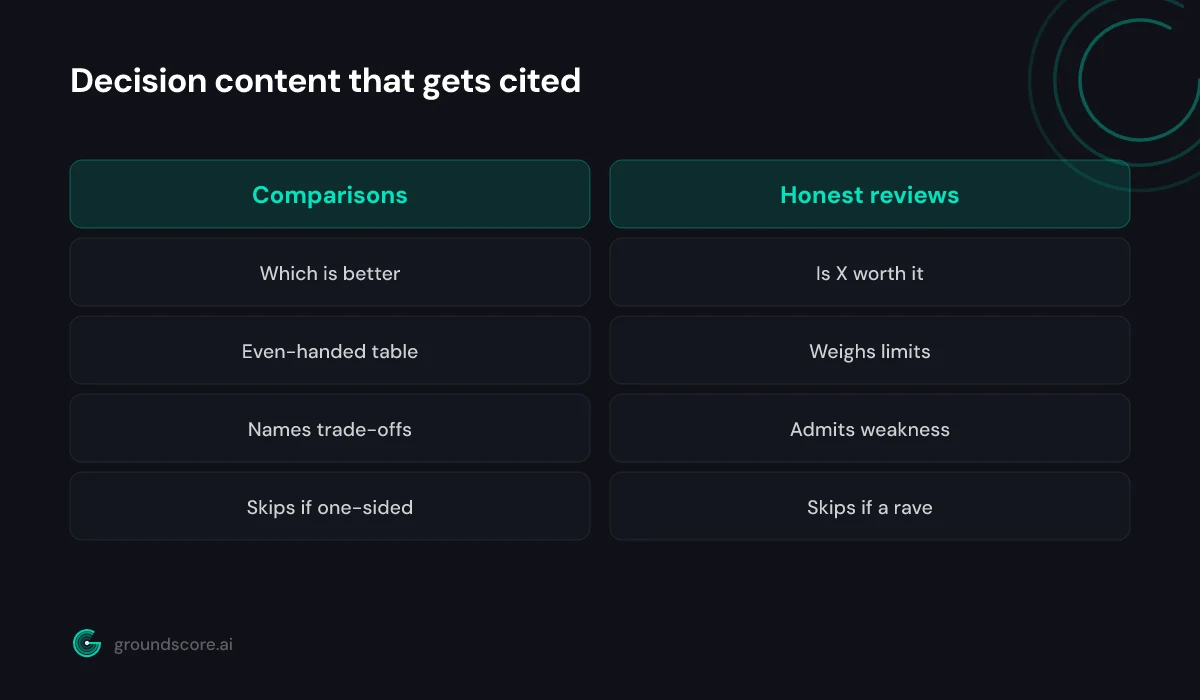
The through-line is honesty. Decision content earns citations by being genuinely useful for the decision, which means the trade-offs have to be real. An engine that detects a thumb on the scale has every reason to cite a more balanced source instead.
Instructional content with clear steps
Direct answer: Instructional content earns citations because how-to questions are among the most common things people ask engines, and step-based pages answer them in a structure a machine can follow. Ordered, named, self-contained steps let an engine extract the exact procedure a user needs without having to reconstruct it from prose.
When someone asks an engine how to do something, the engine wants a clear procedure it can relay.
5. How-to and tutorial pages. Step-based content is inherently structured, which is exactly what makes it quotable. Ordered steps with concrete, doable actions map onto the way engines format instructional answers. The best how-tos state prerequisites up front, number the steps, and make each step complete on its own, so an engine can lift one step or the whole sequence.
The craft details matter. Name your steps rather than leaving them as unlabeled paragraphs. Keep each step focused on a single action. Put the outcome or check at the end of a step so a reader, and an engine, knows it worked. We go deeper on the writing itself in how to write content AI engines cite.
A how-to that is really a wandering essay with the steps hidden inside will lose to a plainly structured one every time, even if the essay is more thorough. Structure is the feature here, not word count.
Original data and primary sources
Direct answer: Original data earns citations because it is genuinely uncitable from anywhere else. When you publish something only you could produce, an engine answering a factual question has one place to attribute it: you. Primary sources create citation pull that no amount of restating common knowledge ever can.
Most content on the web restates what is already known. That is fine, but it means engines have many interchangeable sources to choose from. Original content inverts the dynamic.
6. Original data and primary-source pages. If you publish something new, a finding, a methodology, a set of numbers only you have, an engine that needs that fact must cite you, because you are the source. This is the strongest citation pull there is, and it compounds: other pages reference your data, which raises your authority, which makes you more citable everywhere.
You do not need a research department to do this. Honest first-hand observations, a documented process, or data drawn from your own work all qualify, as long as it is genuine. The one rule that matters here is the no-fabrication rule: invented statistics are worse than no statistics, because a claim an engine cannot corroborate, or that turns out false, damages the trust the rest of your site is trying to build.
Primary content is more effort than restating the known. It is also the least replaceable thing you can put on your site.
Question-and-answer formats
Direct answer: Question-and-answer content earns citations because its structure mirrors how people query engines. An FAQ page pairs a real question with a short, standalone answer, which is nearly the exact unit an engine wants to return, and FAQPage schema makes that pairing machine-readable on top of it.
The final format is the most direct match between how content is written and how questions get asked.
7. FAQ pages. A good FAQ is a stack of real questions, each followed by a concise, self-contained answer of a few sentences. That question-answer pairing is almost precisely the shape of what an engine returns, which is why the format punches above its weight. Add FAQPage schema and the pairing becomes explicit to a machine.
Two cautions keep FAQ pages working. First, use real questions people actually ask, not keyword-stuffed fragments. Second, keep answers standalone: each should make sense lifted out of the page, because that is how it will be used. An answer that only makes sense in context is an answer an engine cannot safely quote.
A well-built FAQ also does double duty. The same page that helps a human scanning for a quick answer hands an engine a stack of ready-made question-answer units, and the schema tells the machine exactly where each pair begins and ends. Few formats serve both readers, the person and the machine, this efficiently, which is why FAQ pages remain one of the most reliable citation earners a site can add.
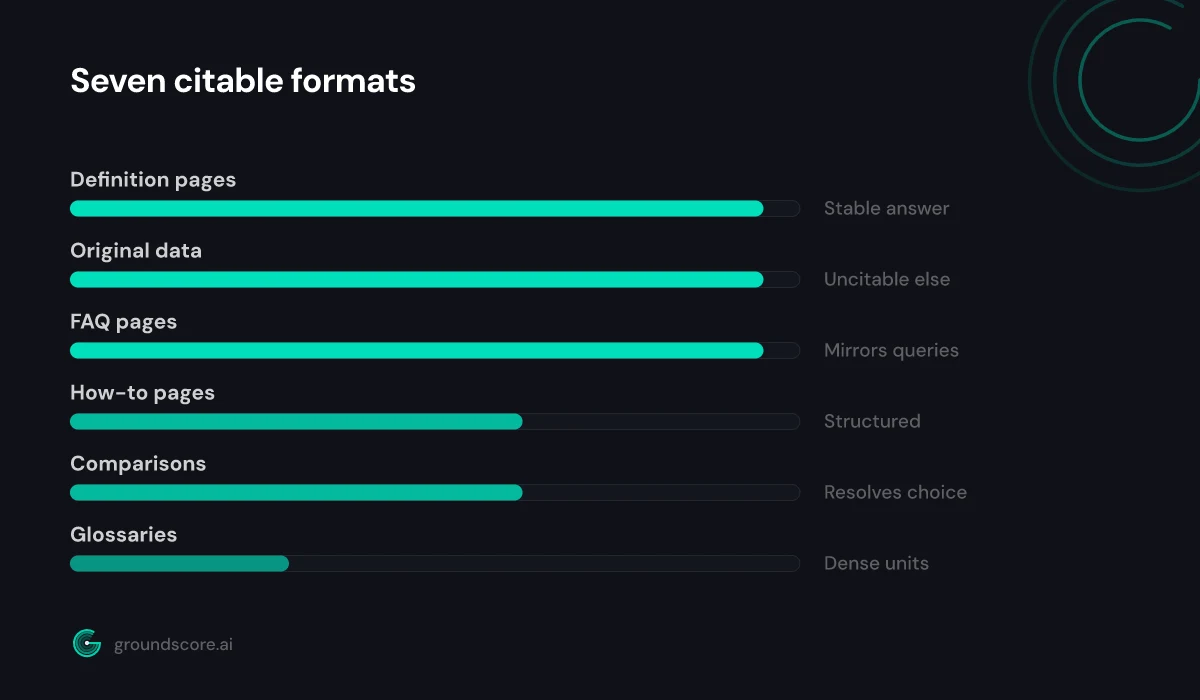
Here is how the seven formats stack up on what makes each citable:
| # | Content type | Why engines cite it |
|---|---|---|
| 1 | Definition pages | Clean, stable, quotable answer |
| 2 | Glossaries | Dense self-contained units |
| 3 | Comparisons | Resolves a buyer choice |
| 4 | Honest reviews | Balanced, trustworthy read |
| 5 | How-to pages | Structured, followable steps |
| 6 | Original data | Uniquely uncitable elsewhere |
| 7 | FAQ pages | Mirrors how users ask |
Frequently asked questions
What makes one content type more citable than another?
Citability comes down to whether an engine can lift a self-contained, correct passage that answers a specific question. Formats that lead with a direct answer and keep it stable, definitions, comparisons, how-tos, FAQs, do this naturally. Rambling or hedged content buries the quotable unit, so an engine reaches for a cleaner source instead.
Do I need all seven content types on my site?
No. Choose the formats that fit the questions your buyers actually ask an engine. A local service business leans on definitions, how-tos, and FAQs; a product company adds comparisons and honest reviews. Original data helps everyone but takes the most effort. Match the format to the question rather than collecting all seven for their own sake.
Does adding FAQ schema guarantee citations?
No. FAQ schema makes your question-answer pairs machine-readable, which helps an engine parse them, but the content still has to use real questions and genuinely standalone answers. Schema on weak content does not rescue it. The reliable combination is a well-written FAQ with real questions plus valid FAQPage schema describing it accurately.
How long should citable content be?
Long enough to answer the question completely and no longer. Engines quote passages, not word counts, so a focused page with one superb, self-contained answer can outperform a sprawling one. Lead with the direct answer, support it with concrete detail, and stop. Padding to hit a length target buries the very passage you want cited.
Can original data really move AI visibility that much?
Yes, because it is the one thing engines cannot source elsewhere. When you publish a genuine finding or first-hand observation only you could produce, an engine that needs it must attribute you. Just keep it honest: fabricated numbers are worse than none, since an uncorroborated or false claim erodes trust across your whole site.
Which content type should a new site start with?
Start with definition pages and FAQs for your core topics, then add how-tos for the tasks your buyers perform. These formats are the fastest to make citable and cover the most common question shapes. Layer in comparisons, reviews, and original data as you go, once the foundational answers are clean and in place.
The bottom line
The content types AI engines cite most are the ones that hand over a clean, correct, self-contained answer: definitions, glossaries, comparisons, honest reviews, how-tos, original data, and FAQs. What unites them is not subject or length but structure. Each leads with the answer and keeps it quotable, which is the entire job when the reader is a machine assembling a response.
Before you rewrite everything, see which of your pages engines already reach for and which they skip. Run a free AI visibility check to find out where you stand.
How visible is your site in AI search?
Check your AI visibility score in seconds. Free, no account needed.
Check your score