What Is AI Search Visibility and Why It Matters Now
By Joe Della Mora, Founder, GroundScore
Search is splitting in two. On one side, traditional search: Google, Bing, the ten blue links you have optimized for years. On the other, AI-powered engines like ChatGPT, Perplexity, and Claude that do not return a list of links. They return answers, and those answers either reference your site or they do not. AI search visibility is the degree to which AI systems can find, understand, and reference your content when users ask questions related to your business. This guide comes from what we see scanning real sites at GroundScore: strong Google presence sitting right next to total AI absence, usually for reasons the owner could fix in a week. Here is what AI search visibility is, why it behaves so differently from rankings, the three pillars it breaks into, and the five moves that actually improve it.
What is AI search visibility?
Direct answer: AI search visibility is the degree to which AI systems like ChatGPT, Claude, and Perplexity can find, understand, and reference your content when users ask questions related to your business. It covers crawler access, machine-readable structure, and actual presence in generated answers, not your position on a results page.
Unpack the definition and you get three verbs, each of which can fail independently.
Find. An AI system has to be able to fetch your pages, either through its own crawler building an index or through a live fetch when a user asks. If robots.txt, a firewall, or a CDN bot rule blocks the crawler, everything downstream is moot.
Understand. Fetching HTML is not the same as understanding it. Engines have to work out what your business is, what each page answers, and which passages are quotable. Structure, schema markup, and plainly written answers decide how well that goes.
Reference. The end state: when a user asks a question in your space, your site appears in the generated answer as a citation, a mention, or a recommendation. This is the part you can measure directly, and the part everything else exists to serve.
The phrase covers all three because sites fail at all three. A blocked crawler, a JavaScript-only page an engine cannot parse, and a perfectly readable site that engines simply never cite are three different problems with three different fixes, and they all present the same way to the owner: absence.
Why does AI search visibility matter now?
Direct answer: It matters because a growing share of buyers now start research in ChatGPT or Perplexity instead of Google, and those tools return answers, not link lists. If your site is absent from the answer, you get nothing: no impression, no click, no second chance on page two.
AI search usage is growing fast. People who used to open Google now ask ChatGPT which project management tool fits a remote team, or ask Perplexity for a plumber recommendation, and the engine responds with a short answer naming a handful of sources. The sites in that answer get the attention. The sites outside it get nothing at all.
That is the structural change worth taking seriously: not that traffic is shifting, but that the consolation prizes are gone. Traditional search degrades gracefully. Rank eighth and you still exist; rank on page two and a determined researcher can still find you. A generated answer has no page two. It names a few sources and stops.
There is an asymmetry worth noticing, too. A competitor outranking you in Google pushes you down a list you still appear on. A generated answer that names three competitors is not a list you appear lower on; it is a room you are not in, and the buyer never learns you exist.
The timing argument is just as practical. Most sites have never been checked against AI engines, most owners do not know whether they are visible, and the fixes are still cheap. That combination will not last. Early SEO rewarded people who took crawlability seriously before their competitors did, and the same window is open here, except this time the signals are documented and measurable from day one. Waiting until AI referrals show up as a line item in your analytics means starting the work after the answers in your category have already settled.
How is AI visibility different from SEO rankings?
Direct answer: Traditional SEO is graded on a curve: rank fifth and you still get traffic. AI visibility is binary. An engine either cites your site in its answer or it does not, and there is no page two. The unit of competition also shrinks from the page to the passage.
The binary nature is the difference that changes behavior, and it is worth sitting with. In SEO, improvement is incremental and visible: position twelve becomes position eight, traffic ticks up, you keep going. In AI search, you can be doing everything almost right and still be at zero, because almost right does not get quoted.
The comparison in one table:
| Dimension | Traditional search | AI search |
|---|---|---|
| What users see | A ranked list of links | One generated answer |
| Visibility model | Graded by position | Binary: cited or absent |
| Unit of competition | The page | The passage |
| Failure mode | Page two obscurity | Total absence |
| Core measurement | Rankings and clicks | Presence in answers |
The passage point deserves emphasis. Engines do not quote pages, they quote paragraphs, so a mediocre page with one superb, self-contained answer can outperform a strong page whose answer is smeared across ten scrolls. That inverts a lot of SEO instinct about comprehensiveness and word count.
None of this means SEO is dead; the overlap between the two disciplines is large, and much of what AI engines rely on is the same crawlable, authoritative content Google rewards. We cover the full side-by-side in SEO vs AEO: what actually changes. The short version: keep doing SEO, but stop assuming it automatically buys you AI visibility, because the failure modes are different.
What are the three pillars of AI visibility?
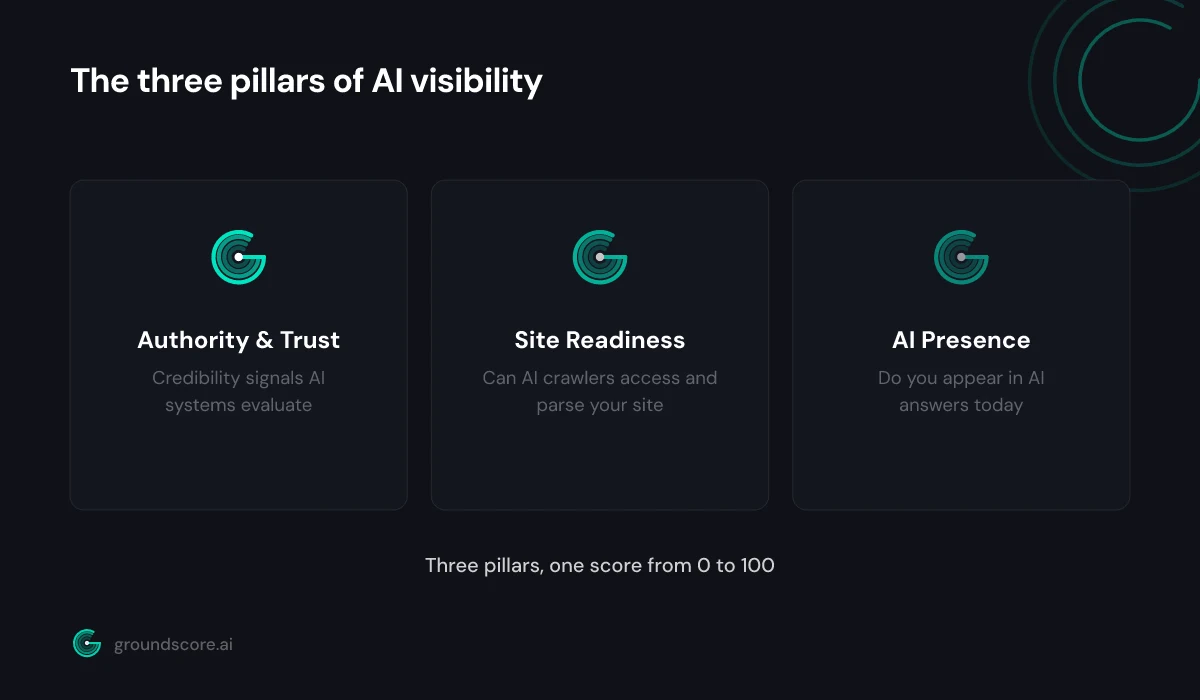
Direct answer: AI search visibility breaks into three measurable pillars: Authority and Trust, the credibility signals engines use to decide you are worth citing; Site Readiness, whether AI crawlers can access and parse your content; and AI Presence, whether engines actually mention your site when asked about your space.
This is how GroundScore scores sites, 0 to 100 across the three pillars, because the three fail independently and get fixed differently.
Authority & Trust. Does your site carry the structural signals AI systems use to evaluate credibility? Proper schema markup, consistent organization details everywhere your business is named, clear content attribution, an authority footprint beyond your own domain. Engines deciding what to cite lean toward sources that look like accountable entities rather than anonymous pages.
Site Readiness. Can AI crawlers actually reach and parse your content? Many sites block GPTBot, ClaudeBot, or PerplexityBot in robots.txt without realizing it, serve JavaScript-heavy pages that render as nearly empty documents to a fetcher, or lack the structured data that tells a machine what each page is. Readiness problems are the most common and the most fixable.
AI Presence. When engines are asked about topics in your domain, does your site appear in the responses? This is the direct measurement, the ground truth the other two pillars exist to produce. It is also the one you cannot assess by looking at your own site; you have to query the engines and log what comes back.
A score of 70 or above is what we band as strong; below 40 is weak. Most unscanned sites land in the middle, moderate on paper with one pillar quietly dragging.
The pillar framing also keeps effort honest. Owners tend to fix what they already understand: content people write more content, technical people polish more markup. Scoring the three separately shows where the actual floor is, and the floor is what engines see. A site that is excellent on structure cannot compensate for a blocked crawler, no matter how much more structure it adds.
What can you do to improve AI search visibility?
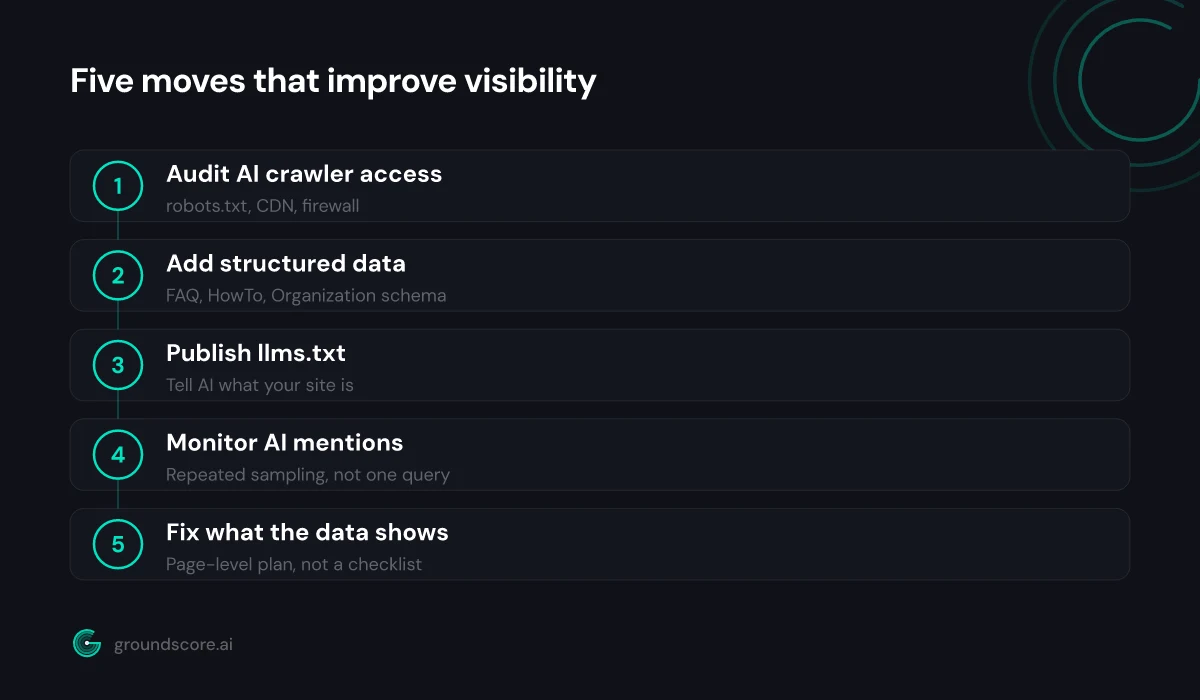
Direct answer: Five moves cover most of the ground: audit your robots.txt for blocked AI crawlers, add structured data to key pages, publish an llms.txt file, monitor whether engines cite you, and fix the specific gaps the data shows. Measure first; a page-level plan beats a generic checklist.
The good news is that AI visibility is measurable and improvable. Unlike early SEO, where you were guessing at what mattered, the signals here are concrete.
-
Audit your AI crawler access. Check robots.txt for AI-specific user agents. Many sites accidentally block GPTBot, ClaudeBot, or PerplexityBot, often via an old blanket rule nobody remembers writing.
-
Add structured data. Schema markup helps AI systems understand your content without guesswork. FAQ, HowTo, and Organization schema are the high-impact starting points for most sites.
-
Create an llms.txt file. This emerging standard tells AI systems what your site is about and which pages matter most, in plain markdown they can actually parse. Our free llms.txt generator builds one in a couple of minutes.
-
Monitor your mentions. Track whether AI engines cite your site when answering questions in your space. This is the ground-truth metric, and because answers vary run to run, it needs repeated sampling rather than a single spot check.
-
Fix what the data shows. Do not guess. Measure, then act on the specific gaps. A page-level action plan beats a generic checklist every time, because your blocker is probably not the average site's blocker.
Sequence matters: access before structure, structure before content polish, measurement wrapped around all of it. Fixing schema on pages crawlers cannot reach is effort spent in the wrong order.
Frequently asked questions
Is AI search visibility just SEO with a new name?
No, but they are related. The overlap is real: crawlable pages, structured data, and genuine authority help both. The differences are structural: AI visibility is binary rather than ranked, competition happens at the passage level rather than the page level, and measurement means checking generated answers, not tracking positions.
Which AI engines matter most for visibility right now?
Start with ChatGPT, Claude, and Perplexity, the three GroundScore checks. Between them they cover the major behaviors: search-grounded answers with citations, live page fetching on user request, and answer engines built around cited sources. Optimizing for these three covers most of what any AI engine needs from your site.
How is AI search visibility measured?
By asking the engines real questions and logging what they answer. GroundScore does this systematically: it queries ChatGPT, Claude, and Perplexity about your space, checks whether your site is found, parsed, and cited, and scores the result 0 to 100 across three pillars, with 70 and up banded as strong.
Will good Google rankings carry over to AI search?
Partially, and not automatically. Engines that ground answers in search indexes do inherit some of Google's judgment about your site, so authority carries. But rankings will not save you from a blocked AI crawler, an unparseable page, or content that never answers a question directly. Sites with excellent rankings fail those checks constantly.
Does blocking AI crawlers protect my content?
It keeps the documented crawlers from fetching your pages, which some publishers genuinely want for licensing reasons. But for most businesses the block is a leftover from 2023 that now works against them: the same rules keep your site out of the answers your buyers read. Re-decide old blocks deliberately rather than inheriting them.
How fast can AI search visibility change?
Faster than rankings, in both directions. A robots.txt fix can open access within days, and engines that fetch pages live reflect improvements quickly. Index-based engines refresh on their own schedules, so presence builds unevenly over weeks. The practical cadence is monthly: measure, fix, re-measure, and judge the trend rather than any single answer.
The bottom line
AI search visibility is not a future concern, it is a current one. The sites that understand and optimize for it now will hold a real advantage as AI search adoption accelerates; the ones that ignore it will wonder why their traffic keeps sliding while their Google rankings hold steady. The mechanics are knowable, the pillars are measurable, and the fixes are mostly unglamorous work anyone can schedule.
The first step is knowing where you stand. Run a free AI visibility check, get your score, and see exactly what is holding your site back.
How visible is your site in AI search?
Check your AI visibility score in seconds. Free, no account needed.
Check your score