Blocking vs Allowing AI Crawlers: The Real Trade-Off
By Joe Della Mora, Founder, GroundScore
"Should I block AI crawlers" is usually asked as one question when it is really two. Training crawlers collect text that may inform future model versions. Search and grounding crawlers build the index an engine consults when it answers a live question, and those are the bots that decide whether you appear in answers today. Blanket-blocking both is a common move that trades away present-day visibility to address a concern about the past. Building GroundScore, the blocked robots.txt rules we find are almost never deliberate policy; they are leftovers nobody has revisited. This post separates the two bot families, makes the honest case for each choice, puts them side by side, and explains the selective middle path.
What are you actually choosing between?
Direct answer: You are choosing between two distinct crawler families. Training crawlers gather content that may feed future model training. Search and grounding crawlers build or fetch the sources an engine cites when answering a question right now. Blocking the second removes you from answers.
The distinction is not marketing. It shows up directly in the user-agent strings the major providers publish.
Training-oriented crawlers. GPTBot is OpenAI's general web crawler. ClaudeBot is Anthropic's. Google-Extended is not a crawler at all but a robots.txt token that controls whether your content can be used by Google's generative AI products, separate from Google Search crawling. These are what people usually have in mind when they say "AI is scraping my site."
Search and grounding crawlers. OAI-SearchBot builds the index behind ChatGPT's search results. PerplexityBot indexes for Perplexity. These bots exist to find sources worth citing, and a citation is a link back to you.
User-initiated fetchers. ChatGPT-User and Claude-User fetch a page because a specific person asked about it in that moment. Blocking these means that when someone pastes your URL into an assistant and asks what your business offers, the assistant cannot see the page.
Those three groups carry different consequences, so treating them as one policy is where most of the damage happens. OpenAI documents its bots publicly at platform.openai.com/docs/bots, and the other providers publish similar references. We cover the full roster in the AI crawler explainer.
What is the honest case for blocking?
Direct answer: Blocking makes sense when your content is the product, when licensing is a live commercial option, or when legal and contractual obligations restrict redistribution. Publishers, paid research, and rights-encumbered archives have real reasons to close the door and accept the visibility cost.
Take the strongest version of the argument seriously, because it is not silly.
If people pay to read your words, an engine that summarizes them for free is substituting for your product. A recipe site, a paywalled analysis shop, or a reference publisher can reasonably conclude that being summarized costs more than being cited.
If you are negotiating licensing, an open door weakens your position. Several publishers have treated crawler access as a commercial asset rather than a default setting, and that is a coherent strategy for organizations with content valuable enough to license.
If you handle rights-encumbered material, the decision may not be yours. Photography, licensed data, client-confidential work, and syndicated content can come with contractual restrictions where the safe answer is no.
There is also a legitimate control argument. Some owners simply want to decide what happens to their work, and "because I choose to" is a valid reason even without a revenue model behind it.
What blocking does not do is worth stating plainly. It does not remove content from models already trained. It does not stop crawlers that ignore robots.txt, since compliance is voluntary. And it does not prevent an engine from describing your business using information it found elsewhere, which means you can end up absent from your own listing while a directory or a competitor's comparison page speaks for you.
What is the honest case for allowing?
Direct answer: Allowing makes sense when you sell something other than the content itself and use pages to be found. Service businesses, software companies, local operators, and most B2B sites give away descriptions of what they do, and citation in an answer is qualified attention.
For most businesses the content is a shop window, not the merchandise. A dental practice's service page exists to be read by prospective patients. A software company's documentation exists so people can evaluate and use the product. Nothing about that changes when the reader arrives via an AI answer instead of a search result.
The visibility argument has a compounding edge. Answers become the summary of your category. When an engine explains what options exist for a problem you solve, the sites in that answer become the shortlist, and the sites outside it are not lower down the page. They are absent from the conversation. Unlike a ranked list, there is no page two to be found on.
Allowing also protects accuracy. When a grounding crawler can read your current pages, the engine describes your actual services, hours, and positioning. When it cannot, it falls back on directories, reviews, aggregator profiles, and stale mentions. I have watched engines describe a business using details the owner changed years ago, purely because the authoritative source was closed and the outdated one was not.
And the user-initiated case is nearly always a mistake to block. Someone pasting your URL into an assistant is a person actively evaluating you. Refusing that fetch is refusing a prospect who is already at the door.
There is a measurement argument too, and it has gotten stronger. AI referrals are traceable: an engine that cites you sends visitors carrying identifiable referrer information, so allowing access is not a leap of faith. You can count the traffic it produces and revisit the decision with your own numbers instead of arguing from principle.
The asymmetry between the two cases is what settles it for most owners. If you allow crawlers and it turns out to be worthless, you have given away summaries of pages that were already public and free to read. If you block them and it turns out to matter, you have removed yourself from the surface where a growing share of buyers now start, and you will not see the loss in any report because absence does not generate a metric.
How do the two choices compare directly?
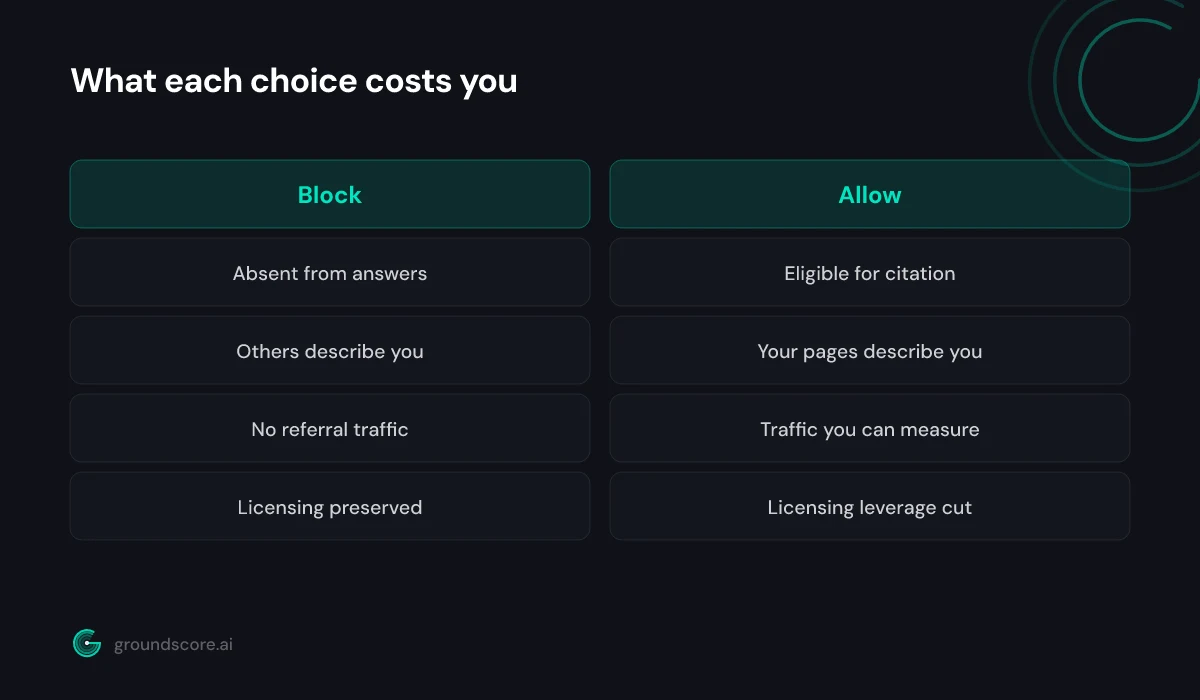
Direct answer: Blocking protects content you monetize directly and forfeits presence in generated answers. Allowing trades free summarization for eligibility to be cited and linked back to. The right choice depends almost entirely on one question: whether your content is the product you sell or the storefront that sells it.
Set the two side by side on the dimensions that actually differ.
| Dimension | Block AI crawlers | Allow AI crawlers |
|---|---|---|
| Best suited to | Paid or licensed content | Services, software, local |
| Answer presence | Absent from citations | Eligible to be cited |
| Referral traffic | Forfeited | Possible, measurable |
| Accuracy control | Third parties describe you | Your pages describe you |
| Licensing leverage | Preserved | Reduced |
| Reversibility | Immediate to undo | Immediate to undo |
Two rows deserve a note.
Reversibility cuts both ways and is the most underrated fact here. Editing robots.txt takes minutes, but the effect is not symmetrical in time. Unblocking does not restore you instantly; index-based engines have to re-crawl and rebuild, which takes days or weeks. Blocking, by contrast, starts taking effect on the next crawl. The downside arrives faster than the recovery.
Accuracy control is the row that changes people's minds most often. Owners tend to frame blocking as "nothing gets said about me." In practice, the engine still answers questions about your category and still names businesses. Blocking does not buy silence, it buys someone else's version.
Is there a middle path worth taking?
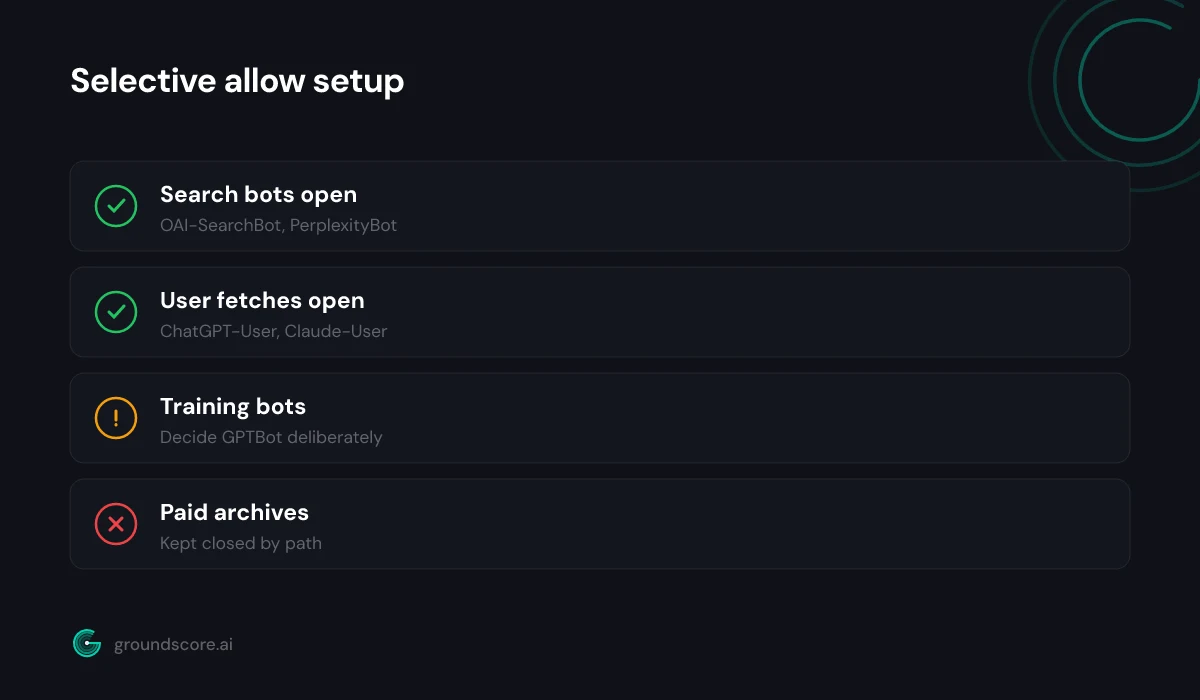
Direct answer: Yes. Selective allow means permitting the search and grounding crawlers that cite you while restricting the training crawlers that do not, and opening public marketing pages while keeping archives or paid material closed. Most businesses land here once they see the bot families separately.
Selective allow is the answer for the majority of sites, and it is straightforward to implement.
-
Inventory what you currently block. Read your robots.txt line by line, including inherited blanket rules and anything your CDN or security layer adds independently. Firewall bot rules block crawlers silently and are invisible in robots.txt, so check both.
-
Decide per bot family, not per vendor. A common resolution is to allow OAI-SearchBot, PerplexityBot, ChatGPT-User, and Claude-User while making a separate, deliberate decision about GPTBot, ClaudeBot, and Google-Extended.
-
Decide per directory. robots.txt rules take paths. You can open service pages, location pages, and public documentation while keeping members-only archives, downloadable assets, or gated research closed.
-
Write the reason down. The single most useful habit here is a comment in the file explaining why each rule exists. Undocumented rules become permanent by accident, which is exactly how most of the blocks we encounter got there.
-
Verify rather than assume. Rules interact, wildcards behave unexpectedly, and a staging config can ship to production. Test the outcome instead of trusting the intent, and re-check after any platform migration. Common failure patterns are collected in robots.txt mistakes that block AI crawlers.
The point of the middle path is that it forces the decision to be made once, explicitly, with the trade-off visible, instead of being inherited from a template.
Frequently asked questions
Does blocking AI crawlers hurt my Google rankings?
Not directly. Rules targeting GPTBot, ClaudeBot, or PerplexityBot do not affect Googlebot, and Google-Extended controls generative AI use rather than search crawling. The risk is a careless blanket rule that catches Googlebot too, which is a real and recoverable mistake worth checking for.
Do AI crawlers actually obey robots.txt?
The documented crawlers from major providers state that they do, and they publish user-agent strings so you can address them specifically. Compliance is voluntary across the whole web, though, so robots.txt is a policy signal rather than an enforcement mechanism. Server-level rules are the stricter option.
Can I block training but allow search?
Yes, and that is the most common resolution. Because the providers use separate user-agent strings for their training crawlers and their search or grounding crawlers, robots.txt can address each one individually. Check each provider's current documentation, since the names and roles do change.
What happens if I unblock after years of blocking?
Access opens immediately, but presence rebuilds gradually. Live-fetch behavior can reflect the change quickly, while index-based engines need to re-crawl before you appear in answers. Expect the process to unfold over weeks and measure the trend rather than judging it after a day.
Should I block crawlers to stop competitors researching me?
No. Anything public is already reachable by a person, a browser, or an ordinary scraper, so this blocks the engines your buyers use without meaningfully inconveniencing a competitor. The cost lands entirely on you.
How do I know which crawlers reached my site?
Server access logs record user agents, so you can filter for GPTBot, OAI-SearchBot, ChatGPT-User, ClaudeBot, Claude-User, and PerplexityBot to see who fetched what and when. Logs show access, not outcomes, so pair them with checks of whether engines actually cite you.
The bottom line
Blocking versus allowing is not one decision and it is not a values question. It is a commercial question with a clear split: if people pay for the content itself, blocking can be rational; if the content exists to help people find and choose you, blocking costs you the room where that choice now happens.
Whichever way you decide, decide it on purpose. Run a free AI visibility check to see which crawlers can currently reach your site and whether engines mention you today.
How visible is your site in AI search?
Check your AI visibility score in seconds. Free, no account needed.
Check your score