SEO vs AEO: What Actually Changes When AI Answers First
By Joe Della Mora, Founder, GroundScore
The SEO vs AEO conversation tends to produce two bad takes: "SEO is dead" and "AEO is just SEO rebranded." Both are wrong, and both will cost you if you plan around them. This comparison takes the even-handed route — mapping exactly what transfers from search engine optimization to answer engine optimization and what genuinely changes when the destination is a generated answer instead of a results page. It draws on what we see scanning real sites: strong SEO and strong AI visibility correlate less tightly than most people assume, and the gap is always explained by a handful of specific differences, not magic. We will cover the full side-by-side first, then dig into each dimension: what stays the same, the goal, the unit of competition, the measurement, and the shape of the content and technical work.
SEO vs AEO at a glance
Direct answer: SEO optimizes pages to rank in a list of search results; AEO optimizes passages to be cited inside AI-generated answers. The goal shifts from position to presence, the unit shifts from page to passage, and measurement shifts from rank tracking to checking whether engines mention you at all.
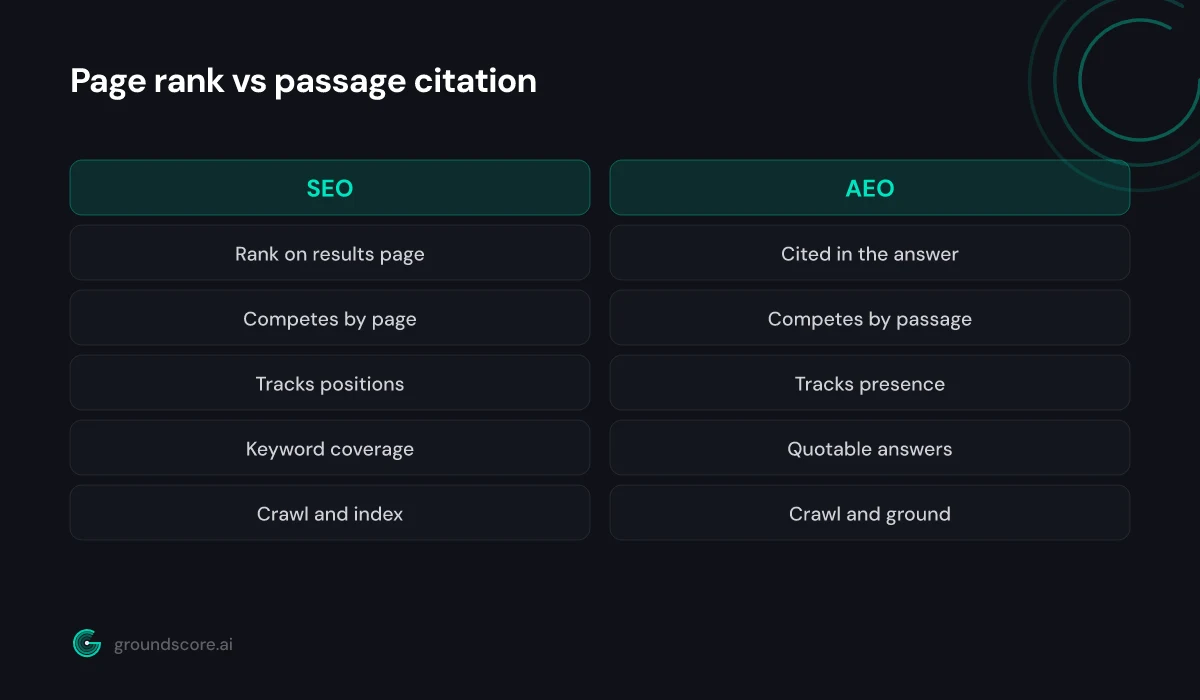
Here is the whole comparison in one table — the rest of the post unpacks each row:
| Dimension | SEO | AEO |
|---|---|---|
| Goal | Rank on a results page | Be cited inside the answer |
| Unit of competition | The page | The passage |
| Outcome shape | Graded: positions 1-100 | Binary: present or absent |
| Measurement | Rank tracking by keyword | Presence checks by question |
| Content shape | Keyword and topic coverage | Quotable, direct answers |
| Technical layer | Crawl, index, render | Crawl, parse, ground |
| Key crawlers | Googlebot, Bingbot | GPTBot, ClaudeBot, PerplexityBot, and peers |
| Volatility | Rankings move gradually | Answers vary run to run |
Read the table as a delta, not a replacement. Every AEO row sits on top of the corresponding SEO row rather than erasing it. A site with no crawlable pages fails at both; a site with strong pages but no quotable passages succeeds at one and quietly fails at the other. The interesting work — and the rest of this post — is in the rows where doing well at SEO does not automatically make you visible to answer engines.
Two rows deserve a flag before we go deeper. "Binary: present or absent" is the one that changes incentives most — there is no AEO equivalent of slowly climbing from position nine to position four, which makes measurement and iteration more important, not less. And "answers vary run to run" is the one that changes expectations most: an engine citing you once is not the same as an engine citing you reliably, and any comparison of the two disciplines that ignores that volatility will overpromise what a single good result means.
What actually stays the same?
Direct answer: Most of the foundation transfers. Crawlable pages, fast load, clean information architecture, real expertise, and earned authority all matter to both SEO and AEO. A site that ranks well has a head start on AI visibility — the same qualities that convince Google convince a retrieval system choosing sources to ground an answer.
This is the part the "SEO is dead" crowd skips. Answer engines that ground their responses in live web content need to find that content the same way search engines always have: by crawling links, reading HTML, and judging which sources seem trustworthy. Everything you did to be crawlable, fast, and coherent still pays.
Authority transfers too, in substance if not in mechanism. An engine deciding which source to quote for "how much does a kitchen remodel cost" gravitates toward sites that demonstrate real expertise, get referenced by others, and publish consistently on the topic — the same qualities link-based ranking was always trying to approximate. If you spent years building genuine topical depth, AEO does not send you back to zero. It sends you to a new scoreboard where that depth is necessary but no longer sufficient.
The practical implication: audit before you rebuild. Building GroundScore, I regularly see site owners assume they need a content overhaul when their actual AEO gap is one blocked crawler or a total absence of structured data — cheap fixes sitting on top of a foundation that was fine all along. Treat your SEO assets as the base layer and spend AEO effort only on the deltas the rest of this post describes.
How do the goal and the unit of competition change?
Direct answer: In SEO the competitive unit is the page and the prize is a position: ten results can all win something. In AEO the competitive unit is the passage and the prize is a citation: an answer references a handful of sources, and every other site is simply absent.
The results page was a marketplace with many stalls. Position three was a living; position eight still got clicks. Generated answers do not work that way. When ChatGPT or Perplexity answers a buyer's question, it names a few sources — and there is no consolation traffic for being the sixth-best answer, because the reader never sees a sixth source. Visibility stops being a gradient and becomes a threshold.
The unit change matters just as much. Search ranked whole pages, so SEO optimized whole pages: one keyword target, one title tag, comprehensive coverage. Answer engines retrieve and quote passages — a paragraph, a table row, a tight definition. That reshapes what "optimized" means:
- A single self-contained paragraph that fully answers one question can earn a citation even from a small site, because the engine quotes passages, not domain authority.
- A long, authoritative page where every answer is smeared across ten paragraphs gives the engine nothing liftable — strong page, weak passages.
- One page can win citations for several distinct questions if each is answered cleanly in its own section.
This is the most actionable difference in the whole comparison. You do not need to out-rank a bigger competitor's domain; you need one passage that answers the question better than any passage of theirs. Passage-level competition is the closest thing AEO has to a level playing field.
How does measurement change?
Direct answer: SEO measurement tracks positions for keywords over time. AEO measurement asks a set of real buyer questions across engines like ChatGPT, Claude, and Perplexity, then records whether your site appears in the answers. Because generated answers vary between runs, one-off spot checks mislead — you need repeated sampling.
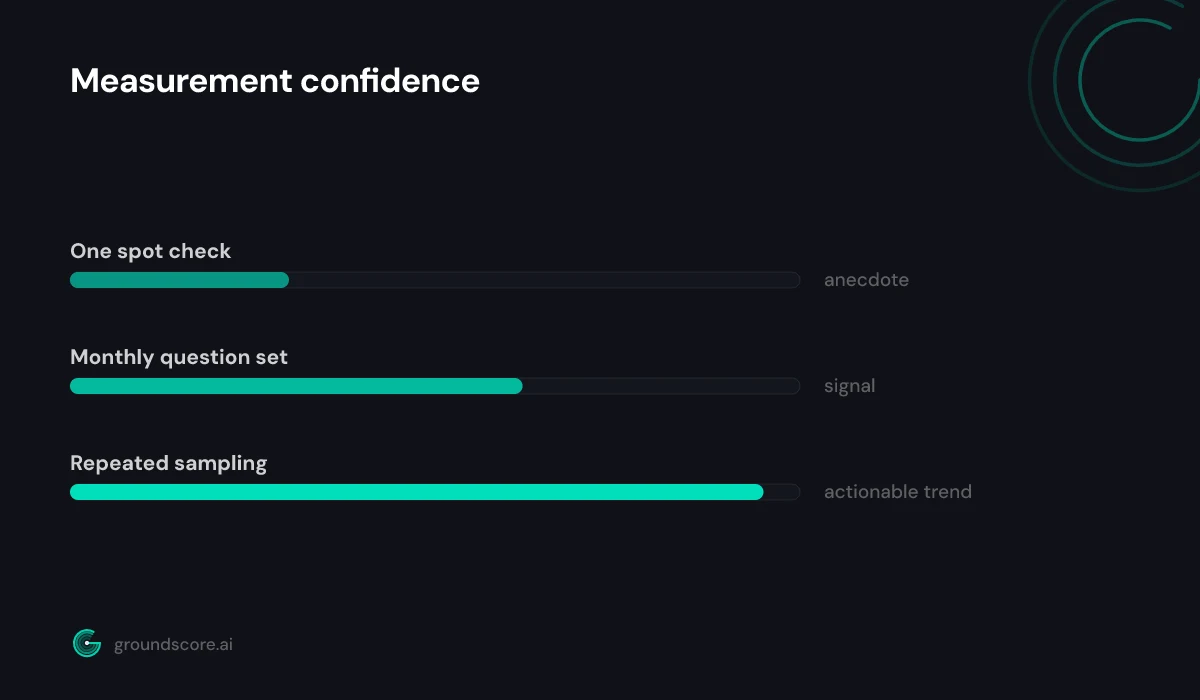
Rank tracking works because a rank exists: position seven is a fact you can log every morning. Generated answers have no equivalent. Ask the same engine the same question twice and you can get differently worded answers citing overlapping but different sources. The honest metric is not "where do I rank" but "how consistently am I present" — measured across a question set, across engines, across repeated runs.
That changes the workflow more than most SEO teams expect:
- Questions replace keywords. You track "best accounting software for restaurants" as a buyer would phrase it to an assistant, not as a two-word keyword with volume data.
- Sampling replaces snapshots. A single check proves almost nothing in either direction. Presence in most runs over a month is a signal; one appearance on Tuesday is an anecdote.
- Absence becomes the actionable datum. The question set where you never appear is your content roadmap, and competitors appearing where you are absent tells you exactly which passages are beating yours.
Manual spot checks are a legitimate way to start — ask the engines your top five questions and write down what happens. They stop scaling quickly, which is why systematic monitoring exists, but the principle matters more than the tooling: measure presence in answers, repeatedly, or you are steering AEO work blind.
How do the content and technical layers change?
Direct answer: Content shifts from keyword coverage to quotable, self-contained answers: sections that open with a 40-60 word direct response an engine can lift whole. The technical layer adds AI-specific crawler access, structured data that machines can parse, and files like llms.txt on top of the classic crawl-and-index checklist.
On the content side, the test for every important section becomes: could an engine quote this paragraph, alone, and fully answer the question? That pushes toward a recognizable shape — headings phrased as real questions, an immediate direct answer under each, supporting depth after the answer instead of before it, and tables for anything comparative. Not coincidentally, that is the shape this post uses; it is the shape we push every page toward.
On the technical side, three additions sit on top of standard SEO hygiene:
- AI crawler access. GPTBot, ClaudeBot, PerplexityBot, and their peers are separate user agents that robots.txt files and CDN bot rules frequently block — allowing Googlebot proves nothing. The step-by-step access audit covers how to verify all of them.
- Structured data with intent. Schema stops being a rich-results garnish and becomes the machine-readable statement of who you are and what each page answers — Organization, FAQPage, Article — kept in sync with the visible content.
- AI-facing files. An llms.txt file gives AI systems a plain-text map of your site. Adoption is still early, but it costs minutes.
None of this replaces the crawl-and-index fundamentals. It extends them for readers that parse rather than render.
Frequently asked questions
Is SEO dead now that AI answers first?
No. Traditional search still drives most web discovery, and the foundations of SEO — crawlability, authority, useful content — are prerequisites for AI visibility too. What has died is the assumption that ranking well automatically makes you visible everywhere. SEO remains necessary; it just stopped being the whole game.
Should I split my budget between SEO and AEO?
Think of it as one budget with a new line item, not a split. Most AEO work — direct answers, structured data, crawler access — improves the same pages your SEO already depends on. The genuinely new spend is measurement: tracking your presence in AI answers alongside the rankings you already track.
Can I rank well in Google but be invisible to AI engines?
Yes, and it is common. A site can hold strong rankings while blocking AI crawlers at the firewall, serving JavaScript-only content, or burying every answer mid-page. Rankings measure one system's judgment; AI presence is decided by different crawlers and different retrieval logic. The only way to know is to check directly.
Does AEO use different keywords than SEO?
AEO replaces keywords with questions. Instead of tracking "crm small business" you track "what CRM should a five-person sales team use?" — the phrasing a real person gives an assistant. Your existing keyword research is still useful raw material: most commercial keywords expand naturally into the buyer questions behind them.
Which should a new website prioritize first?
Do the shared foundation once: crawlable pages, real answers to real questions, basic authority signals. That serves both. Then add the cheap AEO deltas immediately — open crawler access, direct-answer formatting, schema — since they cost little on new pages. Retrofitting structure later is far more expensive than building with it.
The bottom line
SEO and AEO share a foundation and diverge at the finish. The goal moves from position to presence, the unit from page to passage, the measurement from rank snapshots to repeated sampling, and the content from coverage to quotability. Treat the overlap as leverage — everything you built still counts — and spend new effort only where the game actually changed.
If you want to know which side of that line your site is on today, run a free AI visibility check: one minute, no account, and you will see whether AI engines can find, parse, and cite what you have already built.
How visible is your site in AI search?
Check your AI visibility score in seconds. Free, no account needed.
Check your score