What a Google Knowledge Panel Is and How to Earn One
By Joe Della Mora, Founder, GroundScore
Search your own business name and you might see a box on the right side of the results: a logo, a description, a founding date, links to your profiles. That box is a Google Knowledge Panel, and it is worth understanding far beyond vanity. A Knowledge Panel is Google's public signal that it recognizes your business as a distinct entity it can describe with confidence, and that same entity recognition is what AI engines lean on when they decide whether to cite you. This guide comes from what we see at GroundScore scanning sites whose owners fixate on the panel itself while missing the underlying entity signals that actually move the needle. Here is what a Knowledge Panel is, where its data comes from, why it matters for AI search, the honest levers that help you earn one, and what no one can promise.
What is a Google Knowledge Panel?
Direct answer: A Google Knowledge Panel is an information box that appears in search results for a recognized entity, showing a summary Google assembled from its Knowledge Graph. It presents facts like a business description, logo, founding date, location, and official links, signaling that Google treats the subject as a distinct, understood entity.
The panel is the visible tip of something larger. Behind it sits Google's Knowledge Graph, a vast database of entities, people, places, organizations, products, concepts, and the relationships between them. When Google is confident it knows what an entity is, it can render a panel summarizing that entity directly in the results.
Panels come in a few flavors. Local businesses often see a panel tied to their Business Profile, with hours, reviews, and a map. Organizations, brands, and public figures can get a broader panel drawn from across the web. The common thread is entity recognition: the panel exists because Google has resolved your name to a specific thing it can describe, rather than treating it as an ambiguous string of words.
That distinction matters. Plenty of businesses rank well for their own name without ever earning a panel, because ranking a page and recognizing an entity are different achievements. A panel says Google has crossed the second threshold.
It also helps to be clear about what a panel is not. It is not an ad, and you cannot buy one. It is not a ranking position, so a page climbing the results does not summon a panel on its own. And it is not guaranteed to be permanent; panels can appear, change, and disappear as Google's confidence shifts with the signals it collects. Treating the panel as a durable trophy misreads what it is, a live readout of how well Google currently understands your entity.
Where does Knowledge Panel data come from?
Direct answer: Panel data is assembled from Google's Knowledge Graph, which draws on structured markup on your site, authoritative third-party sources like Wikipedia and Wikidata, business listings, and corroborating mentions across the web. Google resolves these signals into a single entity profile, then displays the parts it trusts as a panel.
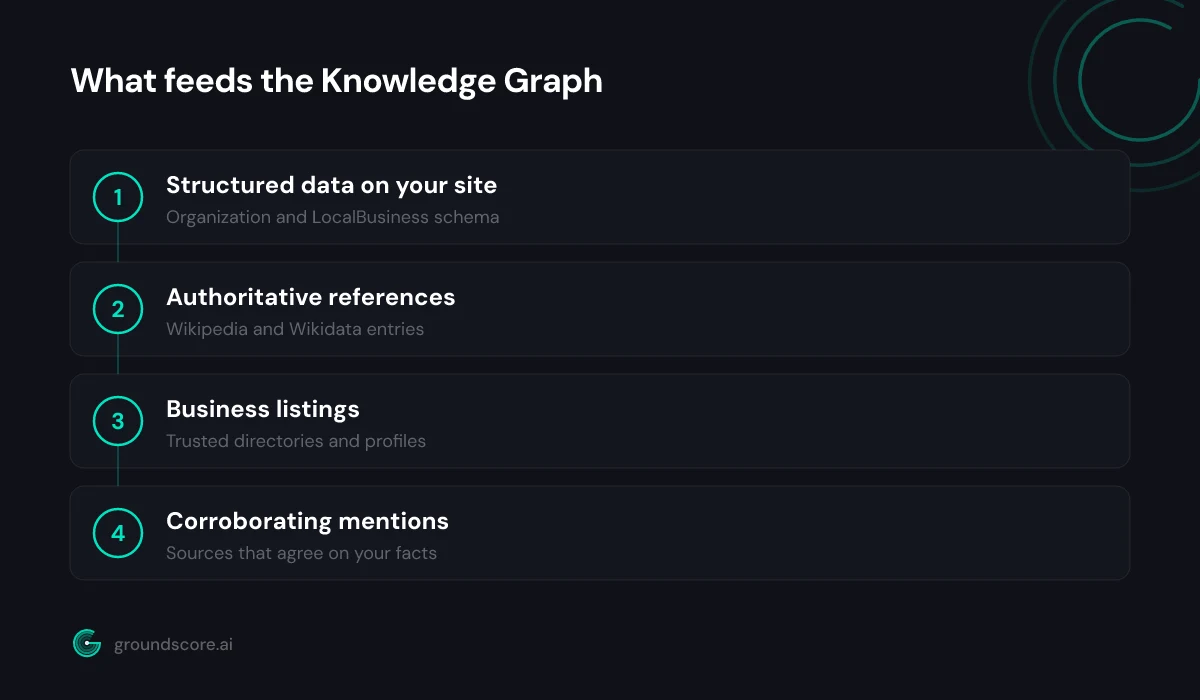
No single source controls a panel, which frustrates owners who expect a form to fill out. Instead, Google triangulates. Several kinds of input feed the graph:
- Structured data on your own site. Organization and LocalBusiness schema tell Google your official name, logo, founding date, and social profiles in a machine-readable form.
- Authoritative references. Wikipedia and Wikidata entries carry heavy weight for organizations and public figures, because they are curated, cross-checked entity records.
- Business listings and directories. Consistent presence in trusted directories corroborates that you exist and what you do.
- Corroborating mentions. Coverage, citations, and references across the web that all describe the same entity the same way.
The through-line is consistency. Google builds confidence when many independent sources agree on the same facts about you. When they conflict, on name, location, or founding date, confidence drops and a panel becomes less likely. Machine-readable identity, which we walk through in how to add Organization and Article schema for E-E-A-T, is the part you directly control.
Why does a Knowledge Panel matter for AI search?
Direct answer: A Knowledge Panel signals that your business is a recognized, well-defined entity, and AI engines reason in entities, not keywords. The same consistent identity, structured data, and corroboration that earn a panel also help engines decide you are a real, trustworthy source worth citing when they answer questions in your space.
This is the point most panel advice misses. The panel is not the prize; the entity recognition behind it is. AI engines like ChatGPT, Claude, and Perplexity do not think in strings of keywords. They reason about entities and relationships, the same way the Knowledge Graph does. When your business is a clearly resolved entity, an engine can connect a question in your category to you with more confidence.
The signals overlap almost entirely. Consistent name and description everywhere, structured data declaring your official identity, and independent sources that corroborate the same facts, all feed both a Knowledge Panel and an AI engine's willingness to cite you. This is why we treat entity clarity as part of the Authority and Trust pillar in the GroundScore score, and why it tends to move both surfaces at once.
Building GroundScore, the pattern we keep seeing is that businesses with a solid entity footprint, even without a formal panel, get cited more readily by AI engines than businesses with more content but a muddled identity. The engine, like Google, is trying to decide whether you are an accountable, knowable source. A clear entity answers that question before the content does.
Do not over-read the causation, though. A panel does not cause AI citations, and AI engines cite plenty of sites that have no panel. They share upstream signals. Earning a panel is a good proxy for having done the entity work, but the work is what matters, not the box.
It helps to see the three surfaces side by side, because they get confused constantly and they are earned in different ways:
| Surface | What it is | Main source | How you influence it |
|---|---|---|---|
| Knowledge Panel | Entity summary box | Knowledge Graph | Consistent identity, schema |
| Featured snippet | Lifted answer passage | A ranking page | Answer-first content |
| AI citation | Named source in an answer | Retrieved passages | Access, clarity, corroboration |
The table makes the shared root obvious. A featured snippet is about a passage, an AI citation is about a source, and a Knowledge Panel is about an entity, but consistent identity and structured data quietly feed all three. Invest in the entity layer and you improve your odds across every one of them at once, which is a better return than chasing any single surface in isolation.
How do you earn a Knowledge Panel?
Direct answer: You earn a Knowledge Panel by making your entity unambiguous: add Organization schema with consistent facts, keep your name and details identical everywhere, build authoritative references and listings, and, where legitimately warranted, a well-sourced Wikipedia or Wikidata presence. Then verify the panel through Google if it appears.
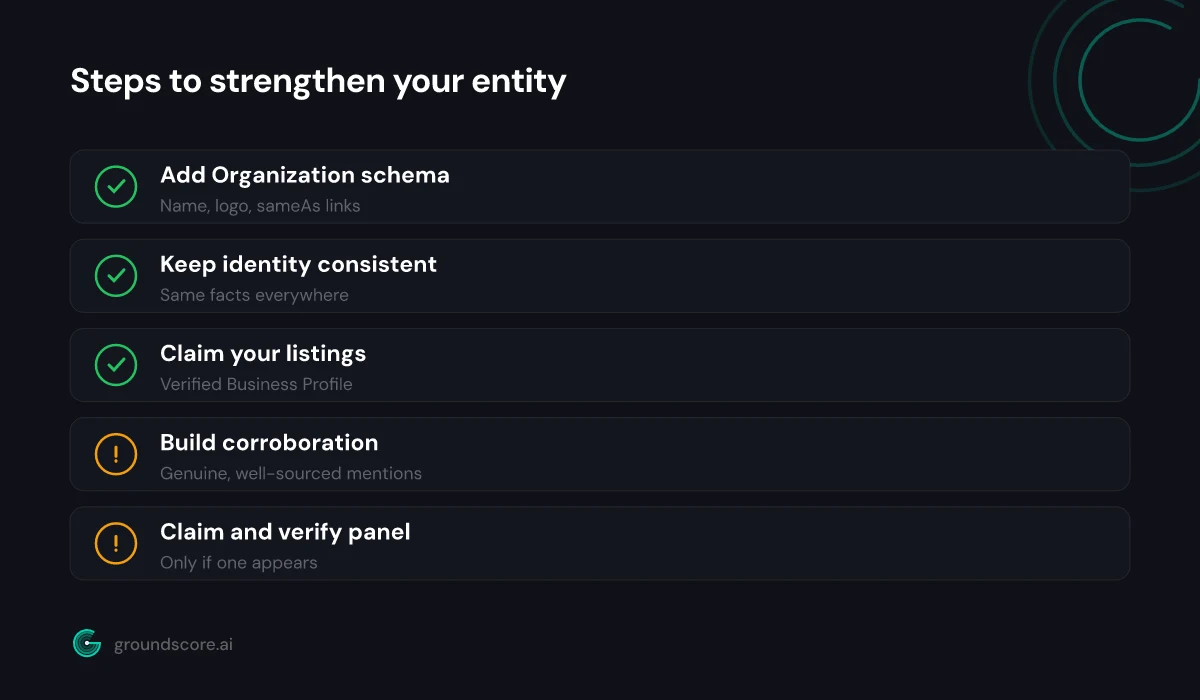
There is no submit button, but there are honest levers. In rough order of control:
- Add Organization schema. Declare your official name, logo, URL, founding date, and
sameAslinks to your verified profiles. This is the most direct signal you own. - Keep identity consistent. Use the same business name, address, and description across your site, listings, and profiles. Inconsistency is the most common reason confidence stays too low for a panel.
- Claim your listings. A verified Google Business Profile is the usual route to a local panel; consistent directory presence corroborates it.
- Build corroboration. Earn genuine mentions and references that describe your entity the same way. Wikidata accepts well-sourced entries, and a legitimately notable organization may qualify for Wikipedia, though notability rules are strict and gaming them backfires.
- Claim and verify. If a panel appears, Google lets a verified representative suggest edits, which improves accuracy over time.
The honest caveat runs through all of it: none of this guarantees a panel. Google decides based on confidence and, for broad panels, a notability bar you cannot buy your way past. What you can guarantee is that the entity work pays off regardless, because it strengthens your Authority and Trust signals whether or not the box ever renders.
That reframing is the practical takeaway. If you treat the panel as the goal, you will be tempted by shortcuts, thin Wikipedia attempts, purchased mentions, that create the exact inconsistency you are trying to avoid. If you treat entity clarity as the goal, the panel becomes a pleasant side effect of work that was worth doing anyway. Sort your identity signals for the AI engines and the local listings, keep them consistent over time, and let Google form its own confidence at its own pace. The businesses that earn panels are almost always the ones that stopped chasing the panel and started being an unambiguous entity.
Frequently asked questions
How long does it take to get a Knowledge Panel?
There is no fixed timeline, and no guarantee it happens at all. Local panels tied to a verified Business Profile can appear relatively quickly. Broader organization panels depend on Google's confidence building from consistent signals and corroboration over months. Treat it as a lagging indicator of entity work, not a deadline you can set.
Can I pay Google for a Knowledge Panel?
No. Panels are generated from the Knowledge Graph, not sold, and any vendor promising a guaranteed panel for a fee is a red flag. You can pay for legitimate work that strengthens your entity signals, schema, listings, corroboration, but the panel itself is Google's call, and no amount of money forces it.
What is the difference between a Knowledge Panel and a featured snippet?
A featured snippet is a passage lifted from a ranking page to answer a specific query. A Knowledge Panel is an entity summary assembled from the Knowledge Graph about a person, place, or organization. Snippets answer questions; panels describe entities. They come from different systems and are earned in different ways.
Does a Knowledge Panel directly cause AI citations?
No. A panel and an AI citation share upstream signals, consistent identity, structured data, and corroboration, but one does not cause the other. AI engines cite many sites without panels. Earning a panel is a useful sign you have done the entity work; the work, not the box, is what improves AI visibility.
Do I need a Wikipedia page to get a Knowledge Panel?
Not always. Local business panels usually come from a verified Business Profile without any Wikipedia entry. Broader organization and public-figure panels lean more on authoritative references like Wikipedia and Wikidata. A legitimate, well-sourced presence helps, but forcing a page you do not qualify for violates notability rules and can backfire.
How do I control what my Knowledge Panel says?
If a panel appears, you can claim it as a verified representative and suggest corrections through Google. Upstream, you influence it by keeping your Organization schema, listings, and public descriptions accurate and consistent. Google weighs your structured data and corroborating sources, so fixing conflicts at the source is the most reliable lever.
The bottom line
A Google Knowledge Panel is a visible sign that Google recognizes your business as a distinct entity it can describe with confidence, and that recognition rests on the same signals, consistent identity, structured data, and corroboration, that make AI engines comfortable citing you. Chase the entity work, not the box, and both surfaces improve together.
See where your entity signals stand today. Run a free AI visibility check to get your score across Authority and Trust, Site Readiness, and AI Presence.
How visible is your site in AI search?
Check your AI visibility score in seconds. Free, no account needed.
Check your score