7 Signals AI Engines Weigh Before Citing Your Website
By Joe Della Mora, Founder, GroundScore
When an AI engine assembles an answer, it chooses a handful of sources from everything it can reach. The AI citation signals behind that choice are not published as a ranking algorithm, and anyone selling you exact weightings is guessing. But the signals themselves are not mysterious: they follow directly from how retrieval-augmented systems work — fetch, parse, select, verify. That is the honest framing this post adds: no invented studies, just the seven checkable signals that mechanics imply, each with where to inspect it on your own site. The seven, in rough order of operation: crawl access, structured clarity, direct answerability, entity consistency, topical depth, freshness, and corroboration. Here is each signal, why the pipeline cares about it, and where to check yours.
Signals 1 and 2: crawl access and structured clarity
Direct answer: The first two signals are table stakes: 1) crawl access, whether AI fetchers can reach your pages at all, and 2) structured clarity, whether the content they fetch is parseable. Blocked crawlers and JavaScript-only pages fail before any quality judgment happens, so every other signal depends on these two.
Signal 1 — crawl access. Before any engine evaluates your content, a fetcher has to retrieve it: GPTBot and OAI-SearchBot for OpenAI, ClaudeBot for Anthropic, PerplexityBot for Perplexity. A robots.txt rule, a copied block-everything template, or a CDN bot-protection setting can turn all of them away silently. Nothing downstream matters if this fails, which is why it sits first. Check your robots.txt for the AI user agents by name, then check your WAF and CDN rules, which override robots.txt in practice — the full walkthrough is in how to check if AI crawlers can access your website.
Signal 2 — structured clarity. Access gets the fetcher in the door; clarity determines what it can carry out. Pages that render their content only through JavaScript can come back nearly empty to a fetcher that does not execute scripts. Clean HTML with real headings, plus schema markup that labels what the page is — Article, FAQPage, Organization — turns your page from a blob of markup into typed, machine-readable statements. Check any key page by viewing its raw HTML: if your main content is not in it, an AI fetcher likely is not seeing it either.
Building GroundScore, the pattern I keep seeing when we scan sites is that these two fail together — the same sites that block crawlers by accident also ship unparseable pages, because nobody was checking either.
Signal 3: passages that answer questions directly
Direct answer: Signal 3 is direct answerability. Retrieval systems select passages, not pages, and they favor passages that resolve the query on their own. A section that opens with a complete, standalone answer gives the engine something to quote; a section that builds to its point across eight paragraphs usually does not.
This is the signal most site owners can improve fastest, because it is pure writing. When an engine has retrieved a set of candidate pages, it needs specific text to ground its answer in. The unit of competition is the passage: a paragraph or short block that can be lifted and remain true, complete, and comprehensible.
Think about what survives that lift. "Pricing starts at $199 per month for a single site, billed monthly, with no setup fee" survives. "We believe pricing should be fair, which is why we've thought hard about our approach" does not. It answers nothing. The pattern generalizes: name the subject rather than leaning on pronouns, state the conclusion first rather than last, and keep one answer to one paragraph rather than smearing it across a section.
Where to check: open your most important pages and read only the first paragraph under each heading. If a stranger who asked the heading's question would not be satisfied by that paragraph alone, the section has an answerability problem regardless of what the rest of it says. The fix is usually not new information — it is moving the conclusion from the bottom of the section to the top and tightening it into a quotable block of roughly 40 to 60 words.
Signals 4 and 5: entity consistency and topical depth
Direct answer: Signal 4 is entity consistency: your name, address, offering, and organization facts read the same on your site, your profiles, and directories. Signal 5 is topical depth: a cluster of related pages that cover a subject beats one orphan post. Together they tell an engine who you are and what you know.
Signal 4 — entity consistency. Engines assemble a picture of your business from many sources: your pages, your schema, your social profiles, directories, and reviews. When those sources agree — same business name, same locations, same description of what you do — you resolve into a single, confident entity. When they conflict, you become a risk: citing you might mean repeating something wrong. Check yourself by searching your own business name and comparing the top results against your site, then make your Organization schema state the canonical facts explicitly.
Signal 5 — topical depth. One good post on a subject makes you a data point; a connected cluster of pages makes you a source. Depth shows an engine that a topic is your territory rather than a drive-by keyword play, and it multiplies your surface area: every follow-up question you cover is another query where one of your passages can be the best match. Check this by listing your money topics and counting real pages behind each. One page deep means thin; the fix is answering the follow-up questions you currently ignore, one focused page at a time.
These two compound quietly: consistent entities with deep coverage are exactly what an engine's safety instincts prefer to recommend.
Signal 6: freshness that matches the question
Direct answer: Signal 6 is freshness, weighted to the query. Questions with time-sensitive answers, like pricing, tooling, and anything dated, pull engines toward recently updated pages. Evergreen questions tolerate older content. The practical move is honest dates: update pages when facts change and let the modified date reflect it.
Freshness is the most misunderstood signal on this list, because people flatten it into "newer is better." The pipeline is more discriminating than that. Engines that retrieve live — Perplexity on every answer, ChatGPT in search mode — can see date signals and weigh them against what the question demands. "Best AI visibility tools in 2026" practically requires recent sources. "What is robots.txt" does not, and a solid page from years ago can keep winning it indefinitely.
That distinction should shape your maintenance budget. Inventory your key pages and label each one perishable or evergreen. Perishable pages — anything with prices, product capabilities, tool comparisons, yearly framing — earn a recurring review, and their dateModified should move when their facts do. Evergreen pages need accuracy checks, not cosmetic touch-ups.
Two honesty rules keep this signal working for you. First, never fake it: bumping a date without changing content is transparent the moment an engine compares versions, and it burns the trust the other signals earned. Second, show your dates — visible on the page and mirrored in Article schema's datePublished and dateModified fields, so human readers and machines see the same story.
Where to check: your highest-value perishable page. If its visible facts have drifted from reality, freshness is costing you citations on the exact queries closest to revenue.
Signal 7: corroboration from other sources
Direct answer: Signal 7 is corroboration: other sites saying the same things about you that you say about yourself. Engines cross-check claims across sources before repeating them, so mentions, reviews, directories, and coverage that agree with your own pages make you a safer thing to cite. Contradictions have the opposite effect.
An AI engine that cites you is putting its own credibility behind your claims, and it behaves accordingly. When retrieval surfaces several independent sources telling the same story about your business — who you are, what you do, whether you are any good at it — repeating that story is safe. When your site is the only place on the internet making your claims, the engine has one uncorroborated source, and uncorroborated sources lose to corroborated ones.
This is the outward-facing signal, and the slowest to move, but the work is concrete: earn reviews on the platforms your industry actually uses, keep your directory and profile listings alive and accurate, and pursue the mentions you can legitimately get — industry associations, local press, partner pages, supplier listings. Volume matters less than agreement; a handful of consistent, independent mentions beats a pile of contradictory ones.
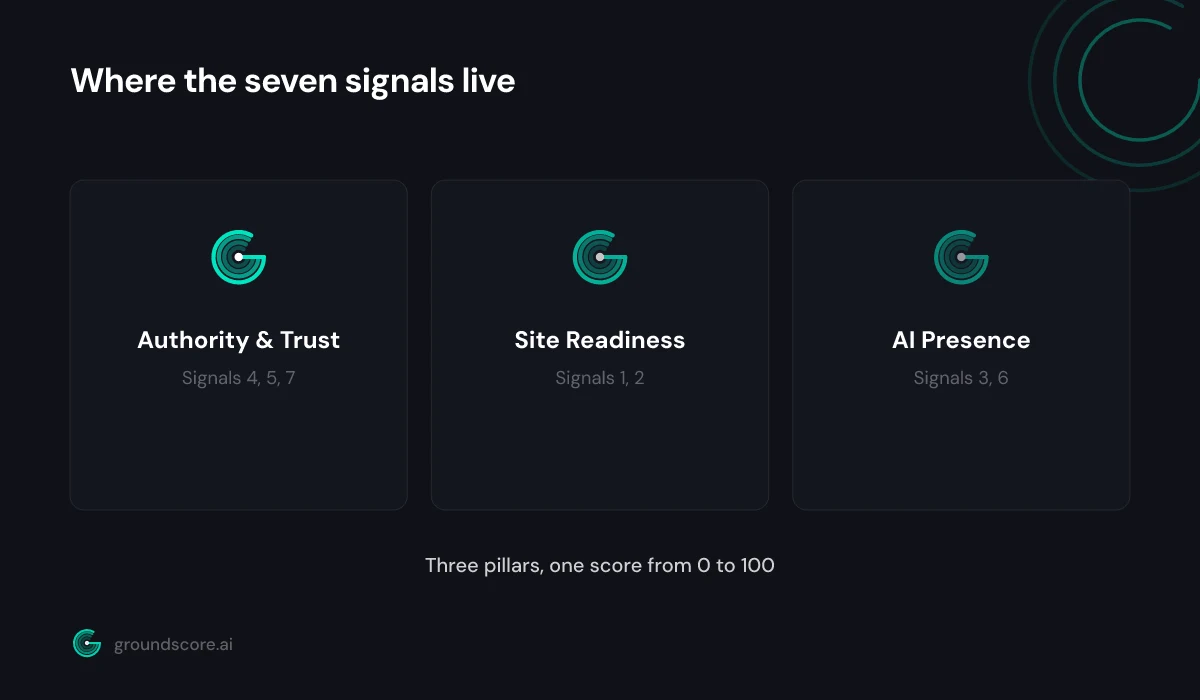
Notice how this signal locks together with entity consistency (signal 4): consistency makes your own story coherent, corroboration gets other sources telling it too. Here is the full list in one place:
| # | Signal | Where to check it |
|---|---|---|
| 1 | Crawl access | robots.txt, WAF and CDN bot rules |
| 2 | Structured clarity | Raw HTML, schema on key pages |
| 3 | Direct answerability | First paragraph under each heading |
| 4 | Entity consistency | Site vs profiles vs directories |
| 5 | Topical depth | Pages per money topic |
| 6 | Freshness | Dates vs actual facts on the page |
| 7 | Corroboration | Reviews, mentions, listings |
Frequently asked questions
Are these seven signals officially published by the AI companies?
No. OpenAI, Anthropic, Perplexity, and Google do not publish citation-ranking factors. These signals are derived from how retrieval-augmented systems mechanically work — fetching, parsing, passage selection, and cross-checking — and each is independently checkable on your own site. Treat any vendor quoting exact citation weightings with suspicion.
Which signal should I fix first?
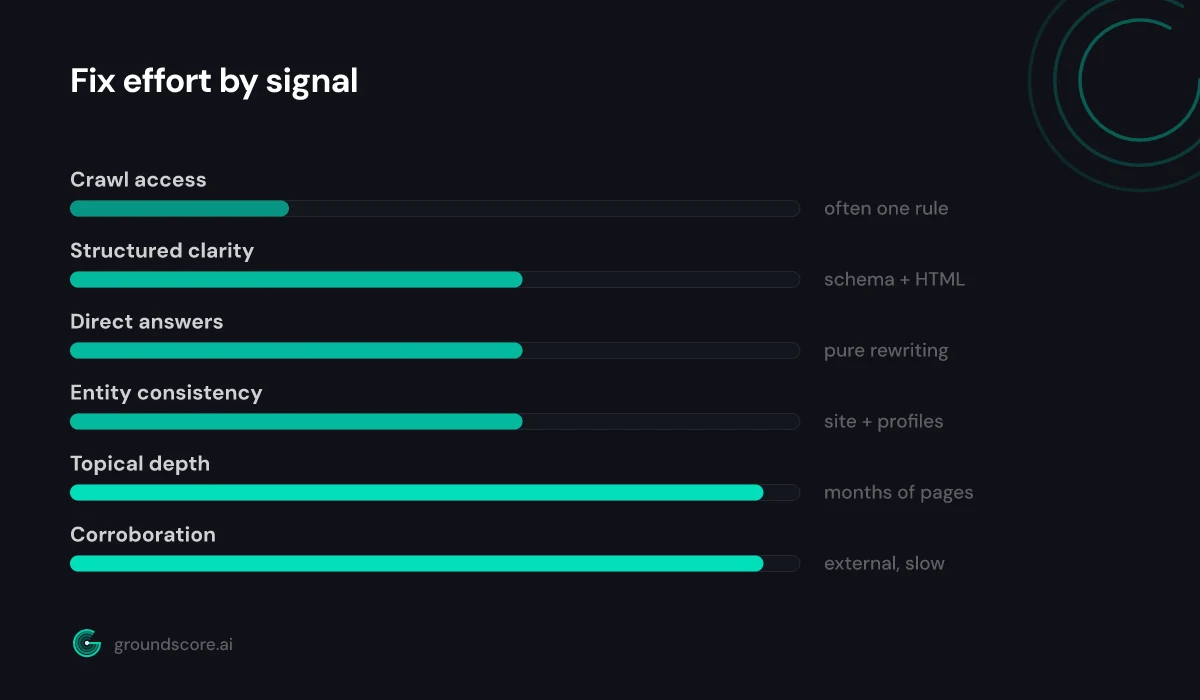
Crawl access, always. It gates everything else: a blocked fetcher never sees your structure, your answers, or your depth. It is also usually the fastest fix — often one robots.txt or CDN rule. After access, structured clarity, then direct answerability, which is the highest-leverage pure-writing improvement available.
How is this different from Google ranking factors?
The overlap is real — clean structure, authority, and freshness matter in both worlds. The difference is the unit of competition: Google ranks pages on a results list, while AI engines select passages to ground generated answers. That shift makes direct answerability and corroboration weigh more than they ever did in classic SEO.
Can I get cited with a small website?
Yes. Passage selection does not require a big site; it requires that some passage of yours be the cleanest available answer to a specific question. A small site that is crawlable, consistent, and deep on one narrow topic regularly beats larger generalist sites for the questions inside that niche.
How long does it take for these signals to improve?
Access and structure fixes can influence live-retrieval engines like Perplexity within days or weeks. Answerability rewrites follow a similar cycle. Entity consistency, depth, and corroboration are slower — they involve external sources and content production measured in months. Freshness is ongoing maintenance rather than a one-time fix.
How do I measure whether any of this is working?
Track presence in answers, not effort. Ask the engines your buyer questions on a schedule, log which sources they cite, and watch whether you enter the rotation. Answers vary run to run, so sample repeatedly. A free AI visibility check gives you that baseline across ChatGPT, Claude, and Perplexity in about a minute.
The bottom line
Seven signals, one pipeline: engines must reach you (1), parse you (2), find a quotable answer (3), trust that you are who you say you are (4), believe you know the territory (5), see that your facts are current (6), and confirm that others agree (7). None of it is secret, and all of it is checkable from where you sit.
Start with the baseline: run a free AI visibility check to see which signals are holding your site back before you spend a single hour fixing the wrong one.
How visible is your site in AI search?
Check your AI visibility score in seconds. Free, no account needed.
Check your score