9 Schema Types That Matter Most for AI Search Visibility
By Joe Della Mora, Founder, GroundScore
The schema types that matter for AI search are a much shorter list than the schema.org vocabulary suggests. The full vocabulary at schema.org defines hundreds of types; you need nine. This post names them, grouped the way they actually function — identity, content, commerce, and navigation — rather than as the flat alphabetical lists most guides recycle, because the groups map to the four questions an AI engine asks about your site: who are you, what does this page say, what do you sell, and how does it all fit together.
Structured data is one of the clearest levers in AI visibility work: it turns your pages from prose a model must interpret into facts a model can use. Here are the nine types, three groups of markup plus a priority-and-validation plan.
Identity schemas: Organization, LocalBusiness, and Person
Direct answer: Identity schemas tell AI engines who is behind a website. Organization establishes your company as an entity with a name, logo, and official profiles. LocalBusiness extends it with address, hours, and service area for physical or local businesses. Person identifies the humans — founders and authors — that content credibility attaches to.
1. Organization is the anchor. It declares your company's name, URL, logo, and — through the sameAs property — your official profiles elsewhere on the web. That last part is quietly important: it lets an engine connect your website to the other places it has seen you, consolidating scattered mentions into one entity. Add it sitewide, once, in your base template. Implementation note: keep the name field exactly consistent with how your business is written everywhere else; entity matching is unforgiving about casual variations.
2. LocalBusiness is Organization's local sibling, and for any business with a physical presence or service area it is the better choice. It carries address, geo coordinates, opening hours, phone, and price range — precisely the facts AI engines repeat when someone asks for a recommendation nearby. Implementation note: use the most specific subtype that fits (Plumber, Dentist, Restaurant) rather than generic LocalBusiness; specificity is free precision.
3. Person covers the humans. Mark up founders on the about page and authors on articles, with jobTitle and worksFor linking them back to the Organization. AI engines weigh who wrote something when deciding what to trust, and Person markup is how that authorship becomes machine-readable rather than a byline to guess about.
Content schemas: Article, FAQPage, and HowTo
Direct answer: Content schemas describe what a page says and how it is structured. Article marks up editorial content with author and dates. FAQPage pairs questions with standalone answers — a shape AI engines can lift directly into responses. HowTo lays out step-by-step instructions in machine-readable order. All three make passages easier to extract and quote.
4. Article belongs on every blog post and guide. It attaches a headline, author (a Person, ideally), publish date, and modified date to the content. The dates matter more than people expect: AI engines answering time-sensitive questions prefer content they can date, and undated prose is easy to skip. Implementation note: wire the author property to your Person markup rather than a plain text name, so the credibility chain stays connected.
5. FAQPage is arguably the highest-leverage content type for AI search, because its shape — a question paired with a self-contained answer — is exactly the shape AI answers take. Marking up real questions with 40 to 60 word standalone answers hands an engine quotable passages with no extraction work. We wrote a full implementation guide in how to add FAQ schema AI engines can actually use. Implementation note: the marked-up questions and answers must appear verbatim in the visible page.
6. HowTo does for instructions what FAQPage does for questions: it turns a procedure into named, ordered, machine-readable steps. Use it on genuine tutorial content — setup guides, repair walkthroughs, recipes-shaped anything. Implementation note: each step needs its own name and text; a single blob marked "step one through ten" defeats the point.
Commerce schemas: Product and its Service twin
Direct answer: Commerce schemas describe what you sell. Product covers physical or digital goods — name, description, brand, offers with price and availability. Service does the same job for service businesses: plumbing, consulting, design. When an AI engine recommends providers or products, this markup supplies the exact facts it repeats to the buyer.
7. Product is the ninth type most guides list first and the one that matters most narrowly: if you sell things, it is essential, and if you do not, skip it. The markup carries name, description, image, brand, and — through the offers property — price, currency, and availability. When a buyer asks an AI engine to compare options, these fields are the raw material of the comparison. Implementation note: keep price and availability current; stale offer data is the most common Product markup failure, and confidently wrong pricing is worse than none.
Service businesses should reach for Service, the same idea with a different shape — serviceType, provider, and areaServed instead of offers and SKUs. A plumber marking up "drain cleaning" with Service and an areaServed of their real coverage zone is giving AI engines exactly the who-does-what-where facts that local recommendation answers are built from. If your business sells both goods and work — a bike shop that repairs bikes — use both types on their respective pages rather than forcing one to cover everything.
Either way, the commerce layer only pays off on top of identity: a Product with no Organization behind it is an offer from nobody. Engines want the chain — this thing, sold by this business, at this location — intact.
Navigation schemas: WebSite and BreadcrumbList
Direct answer: Navigation schemas explain how your site fits together. WebSite declares the site as a whole — its name, URL, and search capability — so engines attribute pages to the right entity. BreadcrumbList exposes where each page sits in your hierarchy, giving AI systems the context of a page before parsing its body.
8. WebSite is the simplest type on this list: a name and URL for the site itself, usually on the homepage, optionally with a potentialAction describing your internal search. It exists so that engines can attribute any page they land on to a named site rather than a bare domain. Implementation note: this is the one type many CMS themes ship by default — check whether you already have it before adding a duplicate.
9. BreadcrumbList encodes the trail from homepage to the current page: Home, then Services, then Drain Cleaning. For an AI system deciding what a page is about, the trail is cheap, structured context — it says what neighborhood of your site the page lives in before a single paragraph gets parsed. Implementation note: the breadcrumb markup should mirror a visible breadcrumb trail on the page, and every item needs both a name and a URL.
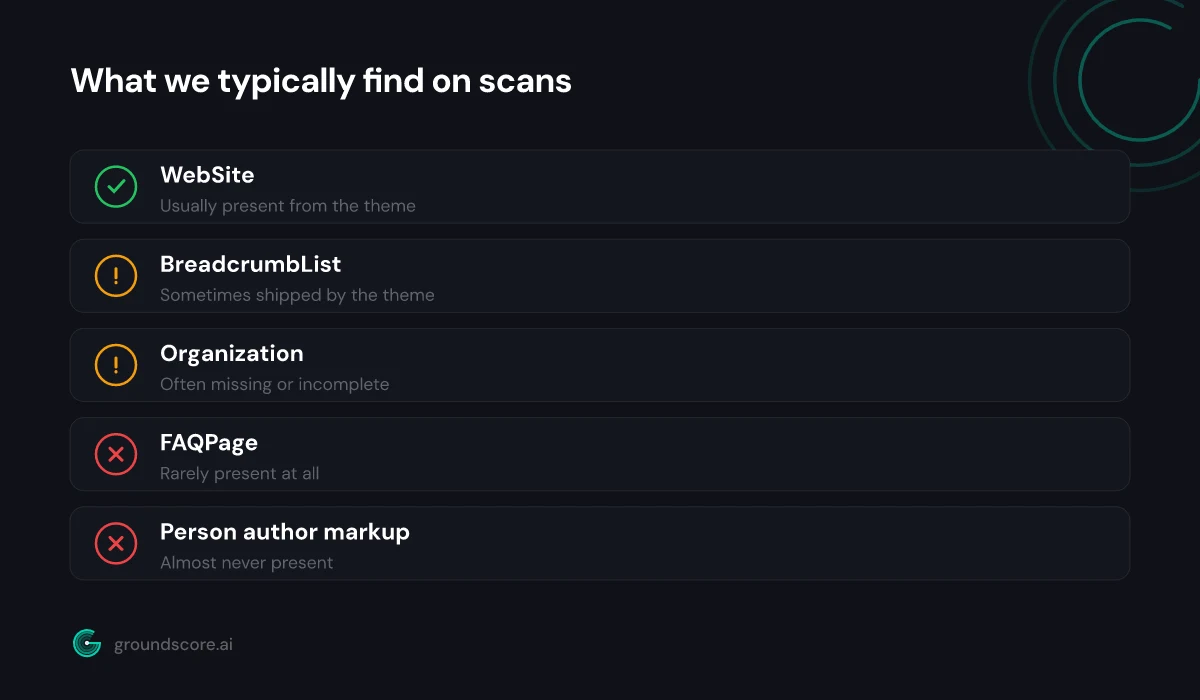
Building GroundScore, the pattern I keep seeing when we scan sites is markup that stops at whatever the CMS theme shipped — typically WebSite and sometimes BreadcrumbList, with nothing identifying the business, the authors, or the content. That is navigation without identity: the engine knows how your site is arranged and nothing about who you are. It is also why the priority order below starts where themes stop.
How to prioritize and validate your markup
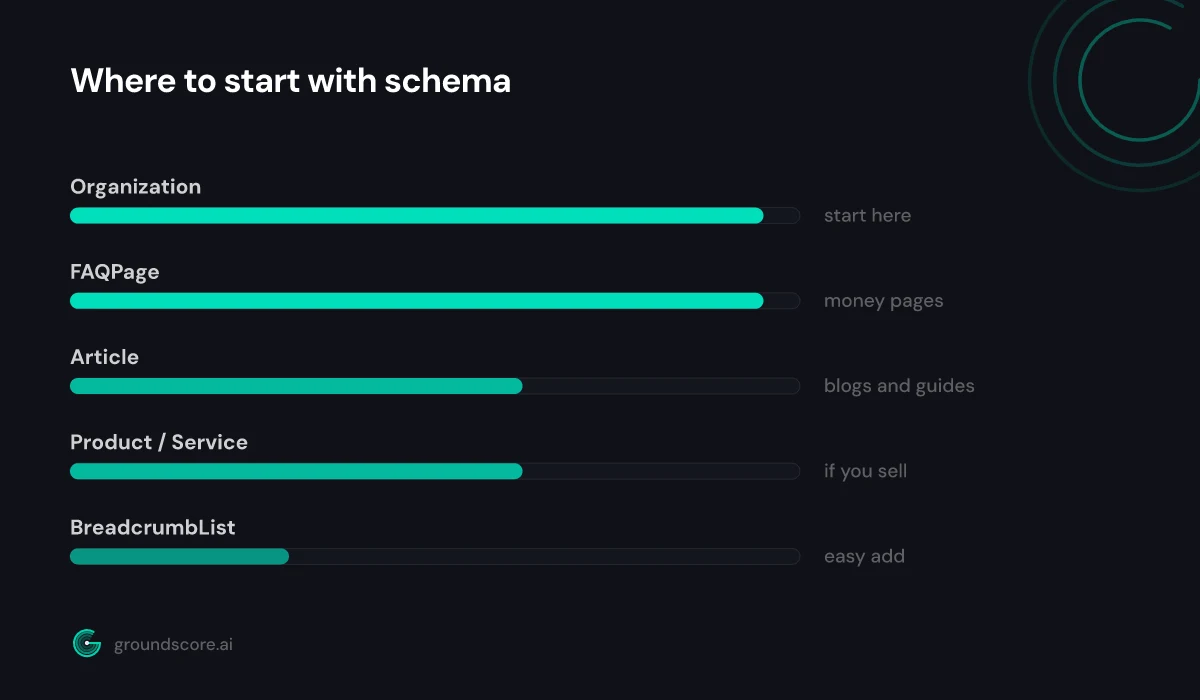
Direct answer: Start with identity: add Organization or LocalBusiness sitewide, plus Person for authors. Then mark up your money pages — FAQPage, Article, or Product where each applies. Validate every page with the schema.org validator before moving on: a parser that hits invalid JSON-LD will typically discard the entire block, wasting the work.
Here are all nine types in one view:
| # | Type | What it tells AI engines | Where it goes |
|---|---|---|---|
| 1 | Organization | Who the business is | Sitewide |
| 2 | LocalBusiness | Where and when you operate | Homepage, location pages |
| 3 | Person | Who the humans are | About and author pages |
| 4 | Article | What editorial content says | Blog posts and guides |
| 5 | FAQPage | Questions with standalone answers | FAQ and service pages |
| 6 | HowTo | Steps in machine-readable order | Tutorial pages |
| 7 | Product | What you sell, price, availability | Product pages |
| 8 | WebSite | The site as a named entity | Homepage |
| 9 | BreadcrumbList | Where a page sits in the hierarchy | Every page |
Work top to bottom, but skip what does not apply — a consultancy has no Product pages, and a purely online business should use Organization rather than LocalBusiness. The identity layer comes first because everything else references it: Article points at Person, Person points at Organization, Product is offered by Organization. Build the spine, then attach the limbs.
Validate as you go with the schema.org validator, not at the end. JSON-LD fails ungracefully — one syntax error and the whole script block is discarded silently, with no visible symptom on the page. Validate each template once after adding markup, and re-validate after any template change.
Frequently asked questions
What format should schema markup use?
JSON-LD — a script tag in your page's head containing the structured data as JSON. It is the format Google recommends, it keeps markup separate from your visible HTML, and it is by far the easiest to template, maintain, and validate. Avoid mixing it with older microdata on the same page.
Can multiple schema types coexist on one page?
Yes, and they usually should. A blog post can carry Article, FAQPage, and BreadcrumbList markup at once; a service page can combine Service, LocalBusiness, and FAQPage. Each type must describe content genuinely present on the page — coexistence is normal, decoration is the mistake.
Does schema markup guarantee AI engines will cite me?
No. Schema makes your content easier to parse, attribute, and trust — it removes friction, it does not create demand. Citation still depends on whether your content answers real questions well. Think of schema as one strong signal among several, not a lever that works alone.
Does the markup have to match the visible page?
Yes, exactly. The classic mistake is schema describing content the page does not show — FAQ markup with questions that appear nowhere, review stars with no reviews. Engines treat mismatches as deception, and the outcome ranges from ignored markup to lost trust. Mark up what is actually there.
How do I validate schema markup?
Paste the page URL or raw JSON-LD into the schema.org validator, and use Google's Rich Results Test to see which search features the page qualifies for. Fix errors first, warnings second. Re-validate after every template change — a single misplaced comma can silently invalidate the entire block.
Where should I start if my site has no schema at all?
Add Organization markup sitewide first — it is the anchor every other type references. Then add FAQPage to the pages where buyers actually have questions, and Article to your guides. That sequence gives AI engines your identity first and quotable content second, which is the order that pays off fastest.
The bottom line
Nine types, four jobs: Organization, LocalBusiness, and Person say who you are; Article, FAQPage, and HowTo say what your content means; Product — with Service for service businesses — says what you sell; WebSite and BreadcrumbList say how it all connects. Cover those and you have given AI engines a machine-readable version of your business that most competitors have not bothered to provide.
If you want to know which of the nine you already have and which are missing, a free AI visibility check inspects your structured data along with crawler access and AI presence — about a minute, no account needed.
How visible is your site in AI search?
Check your AI visibility score in seconds. Free, no account needed.
Check your score