7 Reasons AI Search Engines Ignore Your Website Entirely
By Joe Della Mora, Founder, GroundScore
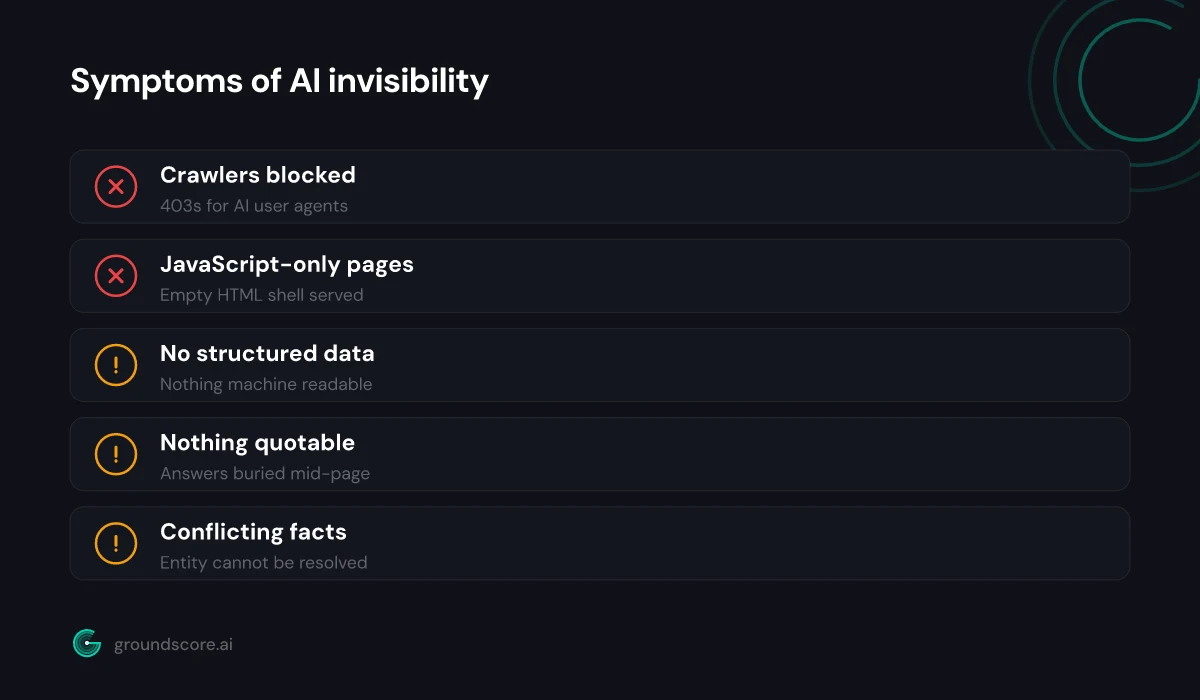
When AI search ignores your website, it rarely tells you why. You ask ChatGPT or Perplexity a question you should own, competitors get named, and your site simply is not there — no error message, no penalty notice, nothing to appeal. The good news: in the site scans we run, the causes are not mysterious. The same seven reasons explain almost every case of AI invisibility, they are all diagnosable from the outside, and every one of them has a concrete fix. This post is the troubleshooting list — seven reasons grouped by the layer they live in, ordered roughly by how often they turn out to be the culprit: hard access blocks first, then missing structure, then content problems, then identity, then authority. Work through them in order and you will find your blocker.
Reasons 1 and 2: AI crawlers never see your content
Direct answer: The two most common reasons AI search ignores a site are hard technical blocks: AI crawlers are denied in robots.txt or by a firewall, or the content only exists after JavaScript runs. In both cases the engine's retrieval step gets nothing usable, so your pages can never be cited.
1. Blocked AI crawlers. GPTBot, ClaudeBot, PerplexityBot, and their peers are distinct user agents, and a shocking number of sites deny them — through an old Disallow: / in robots.txt, a copied block-everything template, or a CDN bot-management toggle someone enabled during the scraping debates and forgot. The block is invisible to you because your browser is not a bot: the site works perfectly while every AI crawler bounces off a 403. The fix: audit access end to end — robots.txt, firewall rules, and live fetch tests. The five-step crawler access audit walks through exactly how, in about thirty minutes.
2. JavaScript-only content. If your pages arrive as an empty HTML shell that JavaScript fills in, crawlers that do not execute JavaScript see a blank page. Single-page-app frameworks produce this by default when nobody sets up server-side rendering. The cruel part: the site looks flawless to every human who visits, so nobody suspects the content simply is not in the HTML. The fix: server-side render or prerender your key pages, and verify by fetching them with a crawler user agent and reading the raw HTML you get back. If your answer text is not in that response, it does not exist for AI search.
Reason 3: your pages carry no structured data
Direct answer: Reason three is missing structured data. Schema markup — Organization, FAQPage, Article, LocalBusiness — gives AI systems a machine-readable statement of who you are and what each page answers. Without it, engines must infer everything from raw HTML, and pages that state the same facts explicitly are easier to trust and cite.
3. No schema markup. Retrieval systems work with imperfect signals under time pressure. A page that declares "this is a business called X, offering service Y, and this section answers question Z" in JSON-LD removes guesswork; a page that makes the engine deduce all of that from divs and marketing copy adds friction at exactly the moment a source is being chosen. Structured data is not a magic ranking lever — it is legibility, and legibility compounds.
The starting set is small and high-impact:
- Organization (or LocalBusiness) once, sitewide: name, URL, logo, and the same contact facts you publish everywhere else.
- FAQPage on pages that genuinely answer questions, with each answer written to stand alone.
- Article on posts and guides, wired to a real author and organization.
The fix: add the three types above to your most important pages first, keep the markup in sync with the visible text — mismatched schema is worse than none — and validate with the schema.org validator. Most platforms and SEO plugins can emit all three without touching code.
Reasons 4 and 5: there is nothing quotable to cite
Direct answer: Reasons four and five are content problems: pages that say nothing a competitor doesn't already say, and pages that never answer a question directly. AI engines assemble answers from passages. If no passage on your site states a clear, complete answer in its own words, there is nothing to lift.
4. Thin, undifferentiated answers. An engine choosing sources for "how much should gutter cleaning cost" has plenty of generic candidates. If your page on the topic is three hundred words of the same boilerplate advice as everyone else's, there is no reason to cite you over the incumbent. Engines reward pages that add something checkable: specifics from doing the actual work, honest trade-offs, the details generic content skips. The fix: for each page you care about, name what it says that no competitor's page says. If the answer is "nothing," rewrite it with the specifics only you can supply — that is the one asset AI search cannot get elsewhere.
5. Content that never answers directly. This one is everywhere. The page targets the right question, but the answer is smeared across twelve paragraphs of wind-up: the history of the industry, why the question matters, what factors to consider — everything except a passage that plainly answers it. Retrieval works at the passage level; an engine will not stitch your buried points into a citation when a competitor states the answer whole in fifty words. The fix: open every important section with the answer itself — direct, self-contained, complete enough to quote — and let the nuance follow. Question-shaped headings make those passages easy to find.
Reason 6: engines cannot tell who you are
Direct answer: Reason six is a missing entity footprint. If your business name, address, services, and site facts differ across your pages, directories, and profiles, AI systems cannot resolve you into one confident entity — and engines recommend businesses they can identify, not ones whose basic facts conflict from source to source.
6. No consistent entity footprint. When an engine considers recommending a business, it is implicitly answering identity questions: what is this company, where does it operate, what does it actually do, and do independent sources agree? A site with no real about page, three different name spellings across the web, an old address in one directory and a new one in another, and no Organization schema tying it together gives wobbly answers to all four. Uncertainty loses citations — engines answering on a user's behalf have every incentive to name businesses whose facts corroborate cleanly.
The fix is boring and effective:
- Publish a real about page: who is behind the business, what it does, where it operates.
- Pick one canonical version of your name, address, and phone, and correct every listing and profile to match.
- Add Organization or LocalBusiness schema stating the same facts, with links to your profiles so machines can connect the dots.
None of this is new advice — local SEO has preached consistency for years. What changed is the consequence: for an answer engine, an unresolvable entity is not ranked lower, it is left out.
Reason 7: nothing corroborates your authority
Direct answer: Reason seven is the absence of authority signals. AI engines favor sources other sites reference, that show a real organization, named authors, and depth on their topic. A site with no about page, no author, and no external corroboration gives a cautious retrieval system every reason to pick someone else.
7. Missing authority signals. This is the slowest problem to fix, which is why it is last — but it decides ties. When several sites answer a question equally well, engines lean toward the source that looks accountable and corroborated: content attributed to named people, an organization with a verifiable footprint, other sites referencing yours, real depth on the topic rather than one orphan post.
Building GroundScore, the pattern I keep seeing is sites that publish decent content anonymously — no author anywhere, no faces, no credentials, nothing on the wider web vouching for them. Humans might not consciously notice. Retrieval systems, built to avoid grounding answers in unaccountable sources, effectively do.
The fix, in ascending order of effort:
- Attribute your content: real author names, short bios, an about page that establishes who stands behind the site.
- Build topical depth where you want citations — a cluster of genuinely useful pages on your core subject beats scattered one-offs.
- Earn corroboration: industry associations, supplier and partner pages, local press, guest contributions. Each independent mention is another source agreeing you are who you claim to be.
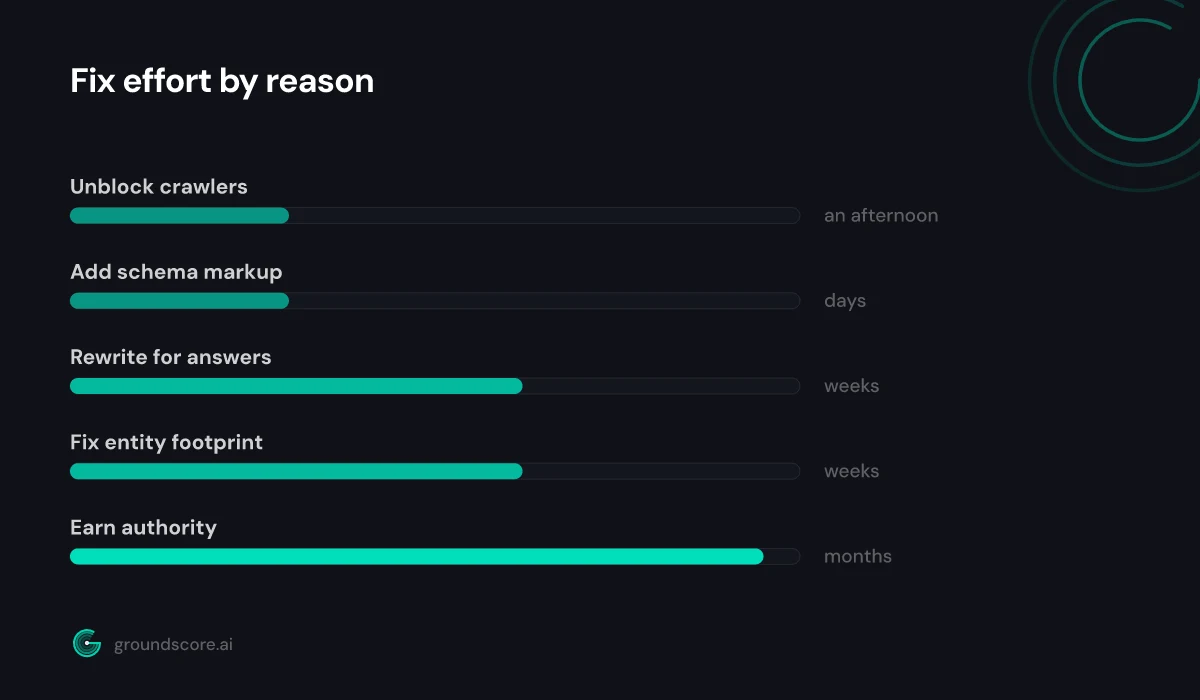
A note on sequencing all seven: resist the urge to fix them in parallel. Change one layer at a time and give the engines a chance to re-crawl between changes, or you will never know which fix actually moved your visibility. The reasons are ordered so that each fix makes the next one measurable — there is no point polishing quotable passages while a firewall is still returning 403s to every AI crawler that tries to read them.
Here is the full list as a diagnostic table:
| # | Reason | Layer | Fastest fix |
|---|---|---|---|
| 1 | AI crawlers blocked | Access | Audit robots.txt, CDN, and firewall |
| 2 | JavaScript-only content | Access | Server-side render key pages |
| 3 | No structured data | Structure | Add Organization, FAQPage, Article schema |
| 4 | Thin, generic answers | Content | Add specifics only you can supply |
| 5 | No direct answers | Content | Open sections with the answer |
| 6 | No entity footprint | Identity | About page plus consistent facts |
| 7 | No authority signals | Authority | Named authors, depth, corroboration |
Frequently asked questions
How do I find out which reason applies to my site?
Test in the order listed: access first, then structure, then content. Fetch your pages as an AI crawler would, check for schema, then read your key pages asking "is there a quotable passage here?" Or shortcut the diagnosis — an automated scan checks access, structure, and presence in one pass.
Can just one of these reasons make me completely invisible?
The access reasons can. Blocked crawlers or JavaScript-only content zero out everything downstream, because engines never see your pages at all. Reasons three through seven are cumulative rather than absolute — each one costs you citations you would otherwise win, and together they explain most invisibility.
How long does it take to show up after fixing these?
It depends on the fix. Access repairs take effect once crawlers revisit, and pages fetched live for user questions can benefit quickly. Content, entity, and authority improvements build more gradually as engines re-index and corroboration accumulates. Fix in order of effort, then measure monthly rather than refreshing hourly.
Do these reasons apply to Google's AI features too?
Largely, yes. Google's AI answers draw on its existing index, so the crawler specifics differ — Googlebot access matters more than GPTBot there — but structured data, direct answers, entity consistency, and authority signals move you in every engine. Fix the seven reasons once and you improve across all of them.
My competitors are cited and we're not. Which reason is it?
That situation usually rules out the market and points at your site: engines demonstrably answer questions in your category, they just answer them with someone else. Start with access, since it is binary and fast to check, then compare your best page's passages against what the cited competitor states directly.
The bottom line
AI invisibility feels opaque from the outside, but it decomposes into seven checkable causes: two access blocks, one structure gap, two content failures, one identity problem, and one authority deficit. Diagnose in that order — the early reasons are both the most common and the cheapest to fix — and stop guessing about the rest.
The fastest diagnosis is a free AI visibility check: it tests your crawler access, your structure, and whether AI engines actually cite you today, in about a minute, no account required.
How visible is your site in AI search?
Check your AI visibility score in seconds. Free, no account needed.
Check your score