Keyword Rank Tracking vs AI Citation Tracking Compared
By Joe Della Mora, Founder, GroundScore
For twenty years, "how is our SEO going?" had one canonical answer: the rank report. Rank tracking vs AI citation tracking is the measurement question of this transition, because a growing share of buyers now get their answer from ChatGPT, Perplexity, or Claude without ever seeing a results page — and a rank tracker is blind to every one of those moments.
This is not a "rank tracking is dead" post. It is a working comparison of what each measurement actually captures, written from the experience of building a citation tracker and watching where each one breaks. We will compare what each measures, how the unit of competition changes, why AI answers are so much more volatile, where the tooling stands in 2026, and whether you need both.
What does each one actually measure?
Direct answer: Keyword rank tracking records the position of your pages on a search results page for a fixed list of keywords. AI citation tracking records whether your site appears inside AI-generated answers — named, linked, or quoted — when engines like ChatGPT, Perplexity, and Claude answer questions in your market.
The two sound parallel, but they observe different events. A rank tracker observes a ranked list: for keyword X, your page sits at position 7. The list is public, ordered, and everyone competing for that keyword appears somewhere on it. Your metric is a coordinate.
A citation tracker observes a generated document. Someone asks a question; the engine writes an answer; your site either shows up in that answer — as a named source, a link, or a recognizable quote — or it does not exist in that interaction at all. There is no position 7. There is no page two. Presence is close to binary, and absence is silent: nothing tells you the answer happened without you.
That difference cascades into everything else. Rankings degrade gracefully — slipping from 3 to 6 loses traffic but not existence. Citations do not degrade; they disappear. It also changes what "coverage" means. A rank tracker covers keywords you chose. A citation tracker has to cover questions, phrased the way real buyers phrase them, because engines answer questions rather than keywords.
Here is the full comparison:
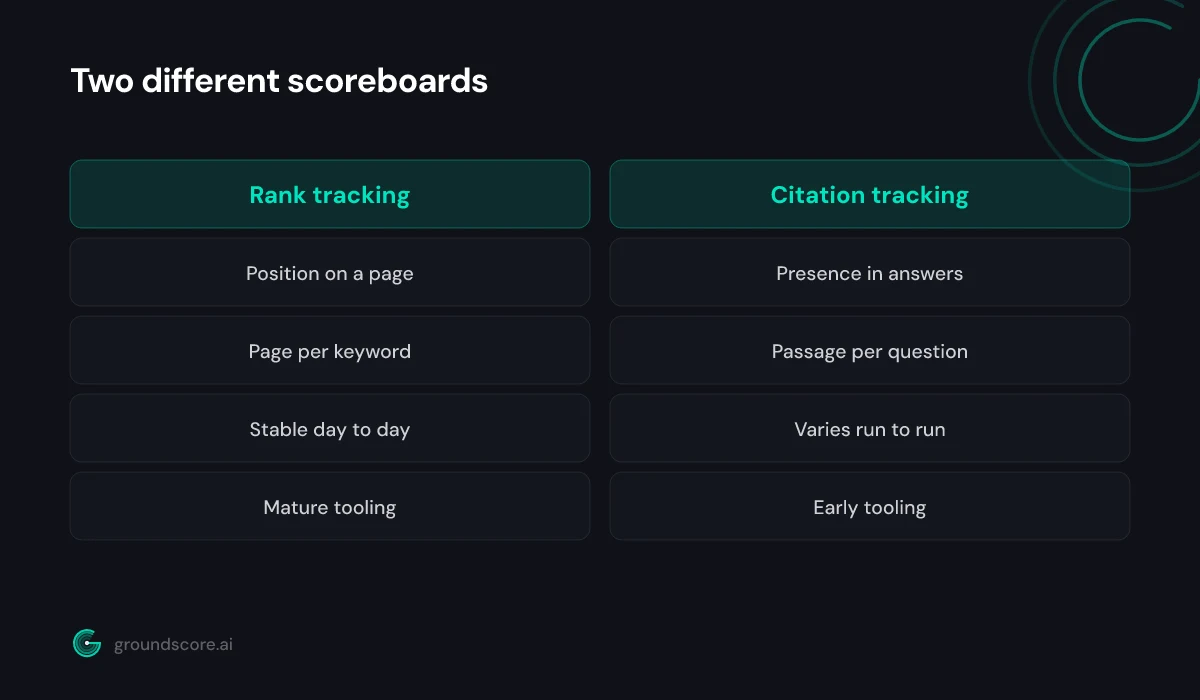
| Criterion | Rank tracking | AI citation tracking |
|---|---|---|
| What it observes | Position on a results page | Presence inside a generated answer |
| Unit of competition | Page vs page, per keyword | Passage vs passage, per question |
| Failure mode | Gradual slippage | Silent absence |
| Volatility | Relatively stable day to day | Varies run to run |
| Method needed | Periodic position checks | Repeated sampling of same questions |
| Tooling maturity | Mature, standardized, cheap | Early, methods vary widely |
| Action it drives | Optimize pages for keywords | Publish direct answers, fix access |
How does the unit of competition change?
Direct answer: In rank tracking the unit is a page competing for a keyword. In citation tracking the unit is a passage competing for a place inside one generated answer. An engine does not really cite your page — it cites the specific paragraph that answered the question better than every alternative it retrieved.
This is the deepest difference between the two, and it changes what you optimize. A page can rank on the strength of its overall relevance, authority, and links even if no single paragraph on it is particularly quotable. Answer engines work at a finer grain: they retrieve candidate pages, then extract the passages that most directly address the question, then build the answer from those passages.
The practical consequence: a page can be a strong ranker and a weak citation source at the same time. A 3,000-word guide that circles its subject for eight paragraphs before saying anything definitive gives an engine very little to lift. A modest page that opens each section with a clear, standalone, 50-word answer gives it exactly what the generation step needs.
So the two metrics reward different writing. Rank tracking rewarded topical coverage and keyword placement. Citation tracking rewards answer density — how quickly and cleanly each section resolves the question it raises. When your citation tracker shows a gap on a question you "should" win, the fix is usually not a new page. It is restructuring an existing page so the answer appears in the first paragraph instead of being smeared across twelve.
Why are AI answers more volatile than rankings?
Direct answer: Rankings come from a relatively stable index that changes when crawls and algorithm updates land, so day-to-day positions move slowly. Generated answers are produced fresh on every request, so the same question can cite different sources on different runs. Measuring citations honestly requires repeated sampling, not a single spot check.
Ask an engine the same question five times and you will not get five identical answers. Generation is probabilistic: the wording shifts, the set of cited sources shifts, and a site that appeared in three answers may miss the other two. None of that means the measurement is meaningless — it means one observation is not a measurement.
Building GroundScore's monitoring, this was the thing that surprised me most: how much the same question drifts between runs. One week a site is the second source in an answer; days later, with no change to the site, it is absent. Early on, single spot checks kept lying to us in both directions — false alarm one day, false comfort the next. Repeated sampling of a fixed question set is the only honest read.
The right mental model is polling, not lookup. You are estimating a tendency — "how often do we appear when this question gets asked?" — from repeated samples. That has three practical consequences:
- Never react to one run. A single absence is noise; a month of absence is signal.
- Keep the question set fixed. Changing questions between samples destroys comparability.
- Watch rates and direction, not individual answers. "Cited in most runs, trending up" is the shape of a real result.
Where does the tooling stand in 2026?
Direct answer: Rank tracking is mature: decades old, standardized, cheap, and broadly accurate. AI citation tracking is early: vendors differ on which engines they query, how often they sample, and whether results come from real queries or estimates. When evaluating a citation tracker, ask exactly what gets asked, where, and how often.
Rank tracking is a solved problem. The methodology is uniform across vendors, prices are commodity-level, and two competent tools will mostly agree about where you rank. You can buy it without reading the fine print.
Citation tracking is where rank tracking was in its early years: genuinely useful, methodologically unsettled, and uneven from vendor to vendor. The differences that matter are rarely on the pricing page. Some tools query the engines directly with real questions; others infer "AI visibility" from proxy signals and call it the same thing. Some sample repeatedly to handle run-to-run variance; others run each question once and present the snapshot as truth. Some track a question set you control; others score generic industry prompts that may not match what your buyers ask.
So the buyer's job is to ask methodology questions: Which engines do you actually query? Are these real queries or estimates? How many samples per question, how often? Can I see the raw answers behind my score? For what it is worth, GroundScore's answers are: real queries against ChatGPT, Claude, and Perplexity, sampled weekly on paid plans, with the underlying answers visible. Whatever tool you choose, a vendor that cannot answer those questions crisply is selling a black box — and our comparison of manual spot checks vs automated monitoring covers what doing it by hand can and cannot replace.
Do you need both during the transition?
Direct answer: Yes, for now. Traditional search still drives a large share of discovery, so rankings still matter and rank tracking stays. But a growing slice of buyers get answers without ever seeing a results page, and only citation tracking observes those moments. Run both, and treat citations as the leading indicator.
Dropping rank tracking today would be as premature as ignoring AI answers. The sensible posture is a split dashboard: rankings tell you how you compete where lists still rule, citations tell you whether you exist where answers rule.
They also cross-inform. The overlap between the two is large — the crawlability, structure, and authority work that supports rankings also feeds the retrieval step of answer engines. But the divergences are where the insight lives. Pages that rank well but never get cited are usually a structure problem: the content is authoritative but nothing in it is quotable. Being cited from pages that barely rank tells you answer engines' retrieval values something the ranked list does not — understand what, and lean into it.
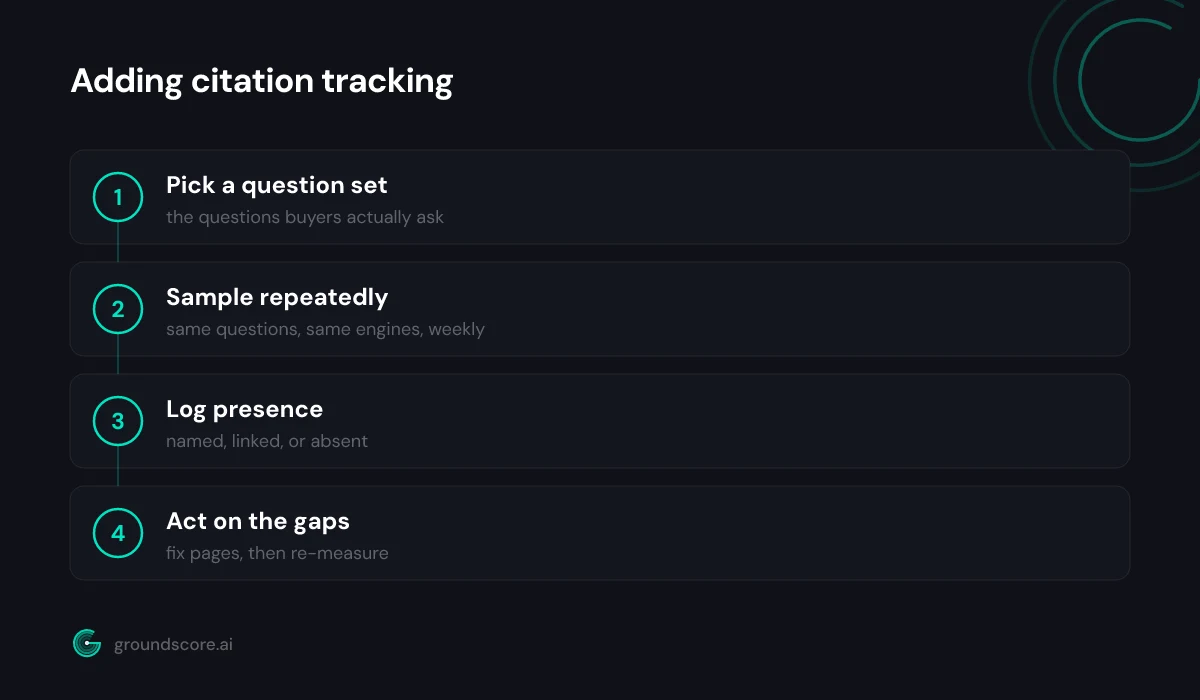
Start simple. Keep the rank tracker you have. Add a fixed set of ten to twenty real buyer questions, get a measured baseline of where you stand in AI answers, and sample on a schedule. Weight the citation side more each quarter, because that is the direction the audience is moving — and because binary visibility punishes late starters harder than slipping rankings ever did.
Frequently asked questions
Is rank tracking obsolete now?
No. Traditional search still drives a large share of discovery, and rankings remain a meaningful, measurable input to it. What has changed is sufficiency: rankings no longer describe your whole visibility, because AI answers are a growing surface rank trackers cannot see. Keep rank tracking; stop treating it as the complete picture.
What exactly counts as an AI citation?
Any verifiable appearance of your site inside a generated answer: named as a source, linked in the citations, or quoted recognizably in the answer text. Being vaguely paraphrased without attribution does not count, because you cannot measure it reliably. A good tracker logs the form of each appearance, since a link and a mention drive different outcomes.
Why do AI answers change between runs of the same question?
Generation is probabilistic. The engine composes each answer fresh, so retrieval and wording can differ run to run even when nothing changed on the web. That is why single spot checks mislead and why honest citation tracking relies on repeated sampling of a fixed question set, reporting rates and trends rather than one-off results.
Can I track AI citations manually?
Yes, and it is a fine way to start: fix a question set, ask each engine on a schedule, log who appears. The costs show up over time — hours spent, inconsistent phrasing, no history, and too few samples to smooth out run-to-run variance. Manual checks prove the need; automation makes the measurement trustworthy.
Which should a small business invest in first?
If you already have any SEO tooling, you have rank tracking covered — add visibility into AI answers next, because absence there is invisible in every report you currently read. Start with a free baseline check, then decide whether ongoing monitoring is worth paying for based on how far off your baseline is.
How often should AI citations be sampled?
Weekly sampling of a fixed question set is a solid default — frequent enough to smooth run-to-run noise into a trend, infrequent enough to reflect real recrawls and content changes. Daily sampling mostly measures generation randomness. Monthly leaves you guessing about which change moved the needle. Judge results monthly, on direction rather than single flips.
The bottom line
Rank tracking and AI citation tracking are not rivals; they watch two different stages of the same shift. One measures your coordinate on a list fewer buyers scroll; the other measures your existence inside the answers more buyers read. The uncomfortable property of the new metric is its binary nature — you are in the answer or you are nothing — which makes measuring it early worth more than measuring it perfectly.
See where you stand inside the answers today: run a free AI visibility check and get a scored baseline across ChatGPT, Claude, and Perplexity in about a minute.
How visible is your site in AI search?
Check your AI visibility score in seconds. Free, no account needed.
Check your score