Picking the Right Content Format for AI Search Answers
By Joe Della Mora, Founder, GroundScore
Choosing a content format for AI search is a buying decision: you are spending hours of writing on one shape of page, and the wrong shape underperforms no matter how well you execute it. Five formats cover nearly every question a buyer asks an AI engine — explainer, how-to, listicle, comparison, and buyer guide. They are the same five formats GroundScore's content engine drafts in, and this guide is the decision logic we use to pick between them, written down. Rather than describing each format in the abstract, it gives you three concrete filters — what the reader is asking, what they need to do next, and what already gets cited — plus a table mapping formats to the queries they win. Run the filters in order and the choice usually makes itself.
What is the reader actually asking?
Direct answer: Query intent is the first filter. Questions starting with "how do I" want a how-to. "What is" wants an explainer. "Which is better" wants a comparison. "Best X for Y" wants a listicle or buyer guide. Match the format to the grammatical shape of the question and you are most of the way there.
Question grammar is the strongest single clue, because AI engines answer in the shape the question implies. Ask Perplexity "how do I create an llms.txt file" and the generated answer arrives as numbered steps, grounded in sources that are themselves step-shaped. Ask "what is llms.txt" and the answer is a definition plus context, grounded in explainer-shaped sources. The engine is matching passage shape to query shape, which means your format decision is really a prediction about which shape the engine will need.
So start every format decision by writing the target question exactly as a buyer would phrase it, then reading its grammar:
- "What is X" / "why does X matter" — definitional intent. Explainer.
- "How do I X" / "how to X" — task intent. How-to.
- "Best X" / "top X for Y" — discovery intent, wants candidates. Listicle.
- "X vs Y" / "is X better than Y" — evaluation intent between known options. Comparison.
- "Which X should I choose" / "do I need X" — decision intent with criteria. Buyer guide.
The trap at this stage is writing the question you find interesting instead of the one buyers ask. Building GroundScore, the pattern I keep seeing when we scan sites is service businesses publishing explainers about their craft while their buyers are asking "which" and "how much" questions nobody on the site answers — a whole category of citation opportunities left on the table because the format decision was never consciously made.
What does the reader need to do next?
Direct answer: The next-step test breaks ties. If the reader must perform a task, write a how-to with ordered steps. If they must choose between options they already know, write a comparison. If they need candidates first, write a listicle. If they need to understand before any of that, write an explainer.
Grammar sometimes underdetermines the format, and this second filter resolves it. The same surface question hides different jobs. "Best schema types for AI search" could be a listicle (reader wants candidates to consider) or a how-to (reader has decided and wants implementation). You cannot tell from the words alone — you tell from where the reader is in their journey and what they will do the minute they finish reading.
Picture the reader closing the page. What happens next?
- They go do something on their site — they needed a how-to. Steps, prerequisites, an expected result. Anything else leaves them stranded mid-task.
- They pick one of several things — they needed a comparison if they knew the contenders, a buyer guide if they needed the criteria more than the contenders.
- They make a list to investigate — they needed a listicle: scannable, numbered, each item with enough substance to justify its slot.
- They now understand something and act later — they needed an explainer that builds the concept in a quotable arc.
This filter also protects you from the most common format failure: the hybrid page. A "guide" that half-explains, half-instructs, and half-compares serves none of those next steps completely, and its passages inherit the mush. When one page genuinely has two jobs, that is two pages — and the second one strengthens your topical depth anyway.
What already gets cited for the question?
Direct answer: Before writing, ask the engines your target question and look at what they cite. If the cited pages are all one format, that shape is likely what retrieval favors for the query. Your options are to match the winning format and execute it better, or cover an angle those pages miss entirely.
The first two filters reason from the question; this one checks the answer key. Type your target question into ChatGPT's search mode and Perplexity, run it a few times, and open the sources they cite. You are doing format reconnaissance: not reading for quality, just noting the shape of what wins. Are the citations flowing to step-by-step pages? Definition-first explainers? Big comparison tables?
Read the results like a buyer would:
- One format dominates the citations. Retrieval has, in effect, voted on the shape this query wants. Matching that format is the lower-risk play — you compete on execution, with cleaner direct answers, a better table, and tighter scope than the incumbents.
- Formats are mixed. The query's intent is broad or unsettled, and the engine is assembling answers from fragments. A more deliberately shaped page than any current source can become the anchor citation.
- The citations answer a neighboring question, not this one. This is the quiet opportunity: nobody has written the right page yet, so the engines are grounding on near-misses. The formats filters one and two point to will meet no real competition.
Keep the reconnaissance honest: engine answers vary run to run, so a single query proves nothing — sample the question several times before you conclude anything. The point is not to copy what exists; it is to avoid discovering after publishing that you brought an explainer to a how-to fight.
When does each format win citations?
Direct answer: Each format earns citations differently. Explainers win definition queries. How-tos win task queries and feed step-by-step answers. Comparisons win "versus" queries, where their tables get quoted. Listicles win "best" and "top" queries. Buyer guides win "which should I choose" queries, where engines echo their decision criteria.
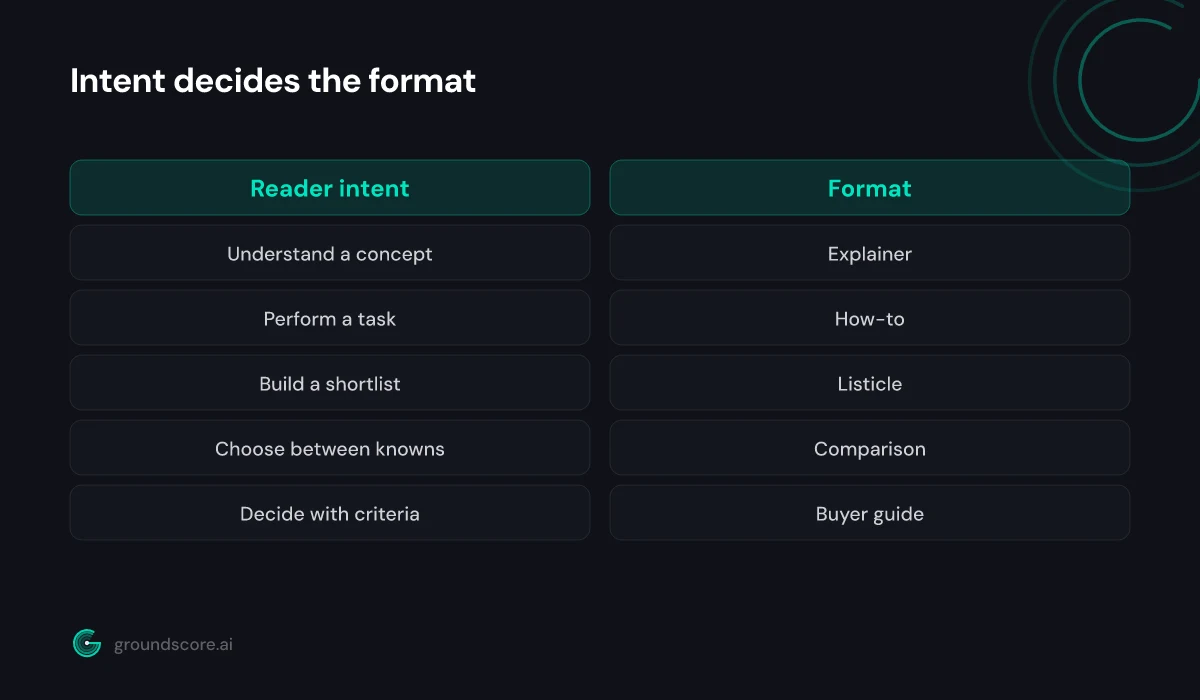
Here is the full decision table:
| Format | Query shape | Reader's next step | Where it wins citations |
|---|---|---|---|
| Explainer | "What is X" | Understand, act later | Definition and concept answers |
| How-to | "How do I X" | Perform the task | Step-by-step grounded answers |
| Listicle | "Best / top X" | Build a shortlist | Roundup-style recommendations |
| Comparison | "X vs Y" | Choose between knowns | Versus answers quoting tables |
| Buyer guide | "Which X for me" | Make a purchase decision | Criteria-driven recommendations |
A few notes the table cannot carry. Explainers age best — a clean definition can be cited for years — but they monetize furthest from the sale, so balance them against decision-stage formats. How-tos win a disproportionate share of task queries because so few competitor pages commit to real, ordered steps with prerequisites; commitment to the format is itself the moat.
Listicles live and die on delivering the promised count with genuine substance per item; padded entries drag down the passages around them. Comparisons put your most liftable asset — the table — at the center, which is why engines quote them so readily for "versus" queries. And buyer guides have a special property for AI search: engines answering "which should I choose" questions tend to reproduce the decision criteria of their sources, so a well-argued buyer guide can shape how the whole question gets framed, with your page as the attribution.
Every format still follows the same base template — question headings, direct answers up front, a table, an FAQ — which we broke down in how to write content AI engines actually cite. Format decides the skeleton; that template decides the muscle.
How do you decide in practice?
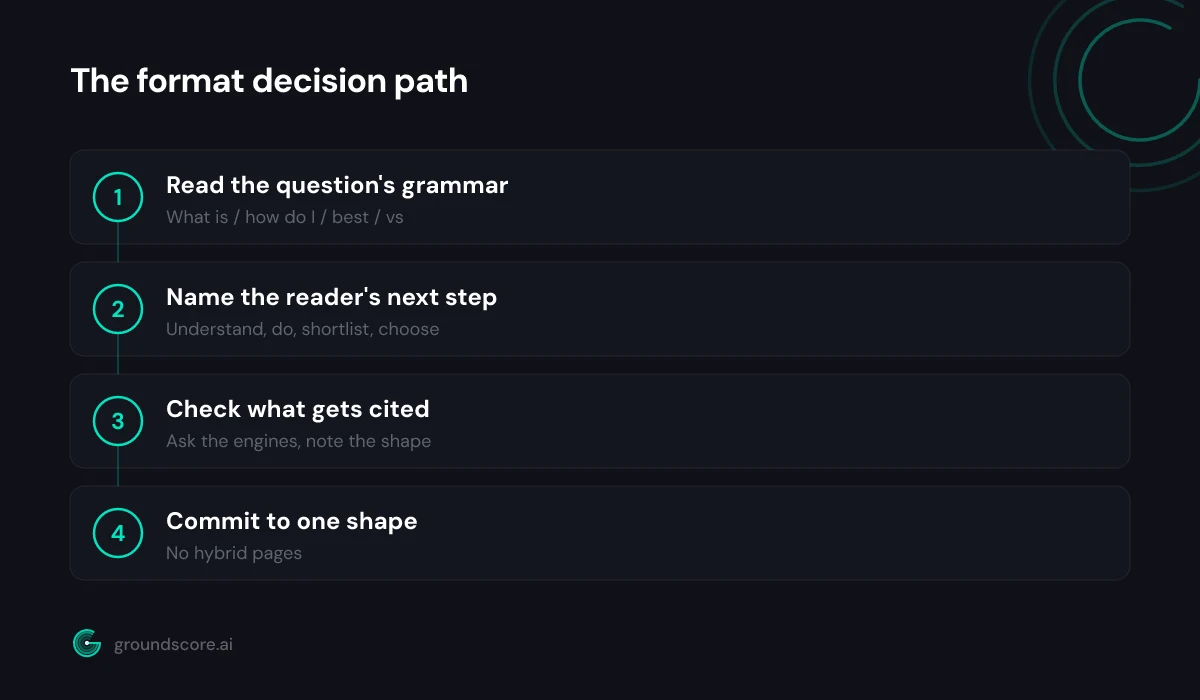
Direct answer: Run the three filters in order: intent, next step, then what already gets cited. When two formats survive, pick the one that produces more standalone, quotable passages for your topic. And commit: a page that is half listicle, half explainer usually loses to a page with one clear shape.
Concretely, the routine takes minutes, not meetings:
- Write the buyer question verbatim and read its grammar — that nominates a format.
- Name the reader's next step — that confirms the format or breaks the tie.
- Ask the engines the question and note the shape of the cited sources — that is the sanity check against retrieval reality.
- Commit fully to the winner: its structure, its promises, its scope.
The tiebreaker deserves one more sentence. "More quotable passages" is not abstract — count them. A comparison of two options yields a table plus a per-criterion verdict per section; an explainer of the same topic yields one definition plus supporting context. For a decision-stage topic, the comparison simply manufactures more liftable material. That is frequently the whole ballgame.
Finally, treat format choice as portfolio strategy, not a one-off. A topic cluster wants one explainer at the base, how-tos for its tasks, comparisons and a buyer guide at the decision layer, and a listicle at the discovery layer. Five formats, one subject, interlinked — that structure is what topical depth actually looks like to a retrieval system, and each page strengthens the citations of its neighbors.
Frequently asked questions
Can one page combine two content formats?
Resist it. Hybrid pages produce mushy passages that lose to single-shape pages on both queries. If a topic genuinely needs explanation and instruction, write an explainer and a how-to and link them. The exception is small garnish — a short table inside a how-to helps; a half-hearted second format does not.
Which content format is best for AI search overall?
None dominates universally, because engines match passage shape to query shape. The right question is which format wins your target query. That said, comparison pages punch above their weight in AI answers because their tables are the most liftable structure on the web, and "versus" queries are decision-stage gold.
Do AI engines actually cite listicles?
Yes, especially for "best" and "top" discovery queries, where roundup-shaped sources fit the answer the engine is composing. The listicles that win deliver their promised count with real substance per item. Thin, padded entries are the format's failure mode — they dilute every passage on the page.
How many formats should a small site use?
Eventually all five per money topic, but not at once. Start where your buyers are: the decision-stage formats — buyer guide, comparison — sit closest to revenue, while an explainer anchors the cluster's vocabulary. Add how-tos and a listicle as follow-ups. Depth on one topic beats format variety scattered across ten.
Should I rewrite existing pages into a different format?
Only when the reconnaissance says the format is the problem. If engines cite step-shaped sources for your query and your page is a meandering essay, restructuring it into a real how-to is often the highest-leverage rewrite available. If the format matches but citations go elsewhere, fix answerability first, not format.
How do I know if my format choice worked?
Presence in answers is the scoreboard. Ask the target question across engines before publishing, then again in the following weeks, and log whether your page enters the citations. Sample repeatedly, since answers vary between runs. A free AI visibility check automates that measurement if you would rather not run it by hand.
The bottom line
Format is a buying decision about your own hours: read the question's grammar, name the reader's next step, check what retrieval already favors, then commit to one shape and execute its template completely. Five formats, three filters, no hybrids — that is the whole system, and it is the same one our content engine runs.
Before you spend an afternoon on the wrong page, see where you stand today: run a free AI visibility check and find out which buyer questions your site is already winning — and which format gaps are costing you the rest.
How visible is your site in AI search?
Check your AI visibility score in seconds. Free, no account needed.
Check your score