How to Measure the ROI of Your AI Search Optimization
By Joe Della Mora, Founder, GroundScore

Measuring the ROI of AI search optimization sounds harder than it is, mostly because people expect a tidy revenue number the channel cannot yet produce cleanly. You can still measure it honestly, with a method that tracks real movement and resists the temptation to invent precision. This how-to walks through that method: establish a baseline, decide what a citation and a referral are worth to you, tally the cost of the work, read the monthly movement across score and citations and referrals, and attribute conservatively. You will need access to your analytics, a way to check whether engines cite you, and about an afternoon to set the baseline plus a recurring hour each month. No prior measurement setup is assumed. The math is simple arithmetic; the discipline is in being honest about what you can and cannot claim.
Step 1: Set a baseline before you change anything
Direct answer: Record three numbers before you optimize: your AI visibility score across the three pillars, how many target questions currently cite your site, and how much referral traffic AI engines already send. Without this snapshot taken first, you cannot prove any later movement came from your work rather than from noise or seasonality.
The baseline is the whole foundation, and skipping it is the most common mistake. If you start fixing things and only measure afterward, you have a number with nothing to compare it against.
Capture three things:
- Your score. Run a check and note the 0 to 100 score and the three pillar scores: Authority and Trust, Site Readiness, and AI Presence. GroundScore gives you all four in one pass at the free check.
- Citation baseline. Pick the questions that matter for your business, then record how many of them currently name your site in ChatGPT, Claude, or Perplexity. Because answers vary run to run, sample each question a few times rather than once.
- Referral baseline. In your analytics, note current traffic arriving from AI sources. We cover the mechanics in how to track whether AI search is sending you traffic.
Date-stamp all three. This snapshot is the "before" against which every later measurement is judged, and its value grows the longer you keep the series consistent.
One discipline is worth insisting on here: measure the same questions and the same referral sources every time. If the baseline tracks ten target questions and next month you swap three of them, your movement is contaminated by the change in the measurement itself, not just the change in your visibility. Freeze the question list and the analytics view at the baseline, write both down, and only revisit them deliberately. A messy, drifting baseline produces numbers that feel precise and mean nothing.
Step 2: Decide what a citation and a referral are worth
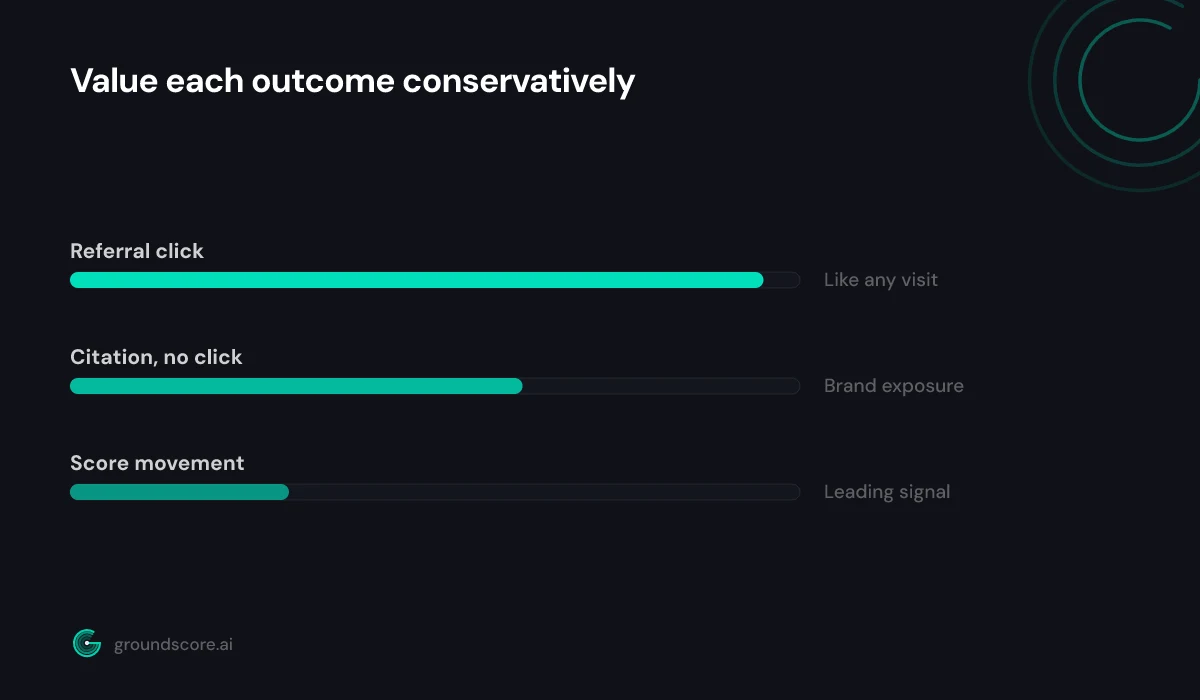
Direct answer: Assign a plausible value to each outcome using your own economics: what a lead is worth, your close rate, and your margin. A referral click has a value close to any other qualified visit; a citation without a click still carries brand value. Use conservative, defensible numbers you would be comfortable showing a skeptic.
You cannot compute ROI without deciding what the "R" is, and this is where honesty matters most. You are not inventing an industry number; you are applying your own known economics.
Start from what you already know. If a qualified visitor converts to a customer at some rate, and a customer is worth a known amount at your margin, then a referral click has a derivable value, the same way any channel's visit does. Nothing here is AI-specific; it is your normal unit economics applied to a new traffic source.
Citations without a click are harder and worth being modest about. When an AI engine names your business in an answer, that is brand exposure even if no one clicks, similar to an impression. Give it a small, conservative value or track it as a separate non-revenue metric rather than forcing a dollar figure. The goal is a number you can defend, not a flattering one.
Building GroundScore, the pattern we keep seeing is that owners either refuse to value citations at all, which understates the work, or assign wildly optimistic figures, which discredits it. A modest, written-down assumption you revisit quarterly beats both.
Step 3: Tally the true cost of the work
Direct answer: Add up everything the optimization actually cost: tool subscriptions, hours spent at a realistic hourly rate, and any content or contractor spend. ROI is a ratio of return to cost, so an honest denominator matters as much as the numerator. Undercounting your own time is the usual way this figure gets distorted.
The cost side is easier to measure but easy to fudge. Include every real input:
- Tooling. Any monitoring or optimization subscription. GroundScore is Business at $199 per month for one site, or Agency at $499 per month with three client sites included and $149 per additional active site, so the tooling line is knowable to the dollar.
- Time. The hours you or your team spent auditing, writing, and fixing, valued at a realistic internal rate. This is the line people skip, and skipping it makes ROI look better than it is.
- Outsourced work. Any content, development, or contractor spend tied to the effort.
Sum these into a total cost for the period you are measuring. Keep the period consistent with how you measure returns, monthly is usually right, so the ratio compares like with like. A clean cost figure is what separates a defensible ROI claim from a marketing one.
There is a nuance worth building in from the start: some of the cost is one-time and some is ongoing. Unblocking crawlers, adding schema, and rewriting a batch of pages are largely upfront investments that keep paying off for months. Monitoring and periodic content refreshes are recurring. If you lump everything into a single month, early ROI looks terrible and later ROI looks unrealistically good. Amortize the one-time work across the period it benefits, or at least note which costs were front-loaded, so the trend line reflects the real shape of the investment rather than an accounting artifact.
Step 4: Read the monthly movement
Direct answer: Each month, re-measure the same three baseline numbers and compare. Look at score change, citation gains on your target questions, and referral trend. Judge the direction over several months rather than reacting to any single reading, because AI answers vary run to run and one month is mostly noise.
Now the loop closes. On a monthly cadence, re-run exactly what you captured in Step 1 and line it up against the baseline.
| Metric | Baseline | This month | Movement |
|---|---|---|---|
| Visibility score | Recorded | Re-measured | Up, flat, or down |
| Cited questions | Count | Count | Net gained |
| AI referral traffic | Trend line | Trend line | Direction |
| Cost to date | 0 | Cumulative | Denominator |
The reason to watch the trend rather than a point is that AI engines are probabilistic. Ask the same question twice and you can get different sources, so a single month's citation count wobbles even when nothing changed. Two or three months of consistent movement is signal; one month is not. Weekly monitoring on a paid plan smooths this by sampling repeatedly instead of once, which is exactly why single spot checks mislead.
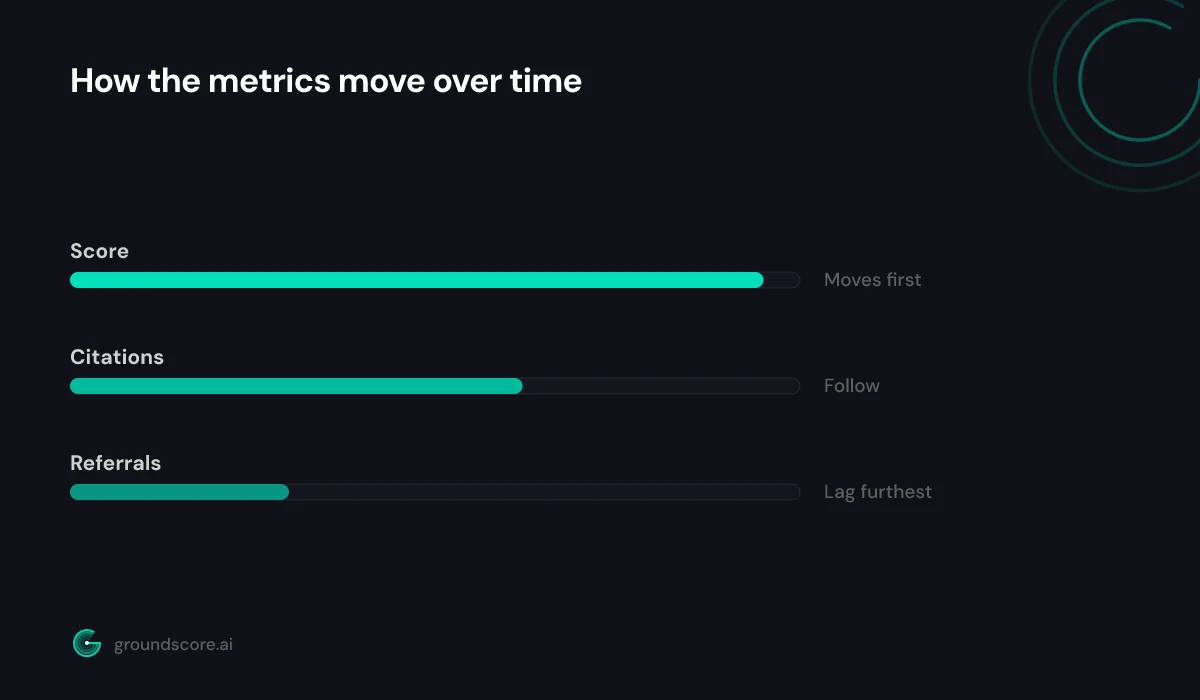
Read the three metrics together. Score should move first because it reflects fixes you control directly. Citations follow as engines re-crawl and re-ground. Referrals lag furthest, because they need citations to exist and readers to click. Seeing the three move in that order, over time, is what tells you the work is compounding.
Step 5: Attribute conservatively and report honestly
Direct answer: Combine the movement with your assigned values and cost to state a ROI range, not a false-precision figure. Attribute cautiously: credit AI optimization only for gains you can tie to it, note confounding factors, and present a conservative estimate. A defensible range beats a flattering number that collapses under one hard question.
The final step is turning movement into a claim you can stand behind. Multiply your citation and referral gains by the conservative values from Step 2, divide by the cost from Step 3, and you have a ROI estimate for the period.
Then discipline it. Real attribution has confounders: a seasonal bump, a separate marketing push, a competitor's site going down. Name these rather than pretending the AI work caused everything. Present ROI as a range with your assumptions written down, so a skeptic can inspect the math instead of trusting a single figure.
The honest version is more persuasive than the optimistic one. A report that says "conservatively, the work returned somewhere in this range, here are the assumptions and the caveats" survives scrutiny. A precise-looking number with hidden assumptions does not survive the first hard question, and in a channel this new, hard questions are guaranteed.
Keep the whole thing in one place. A simple monthly log of the baseline metrics, your value assumptions, the running cost, and the caveats becomes its own asset over time, because the trend it captures is far more convincing than any single month could ever be.
Frequently asked questions
How soon can I expect to see ROI from AI search optimization?
Expect the score to move first, often within weeks of technical fixes, then citations over a month or two as engines re-crawl and re-ground, then referral traffic last. Real ROI is a several-month trend, not a first-month result. Judge the direction over time rather than any single reading.
What if I cannot put a dollar value on citations?
Then track them as a separate non-revenue metric instead of forcing a figure. Count cited questions month over month and report the trend alongside referral value. Many businesses value referral clicks in dollars and treat citations as brand exposure measured in counts. An honest split beats a fabricated citation dollar value.
Do I need paid tools to measure AI search ROI?
No, you can baseline and re-measure manually with a free check and your analytics. Paid monitoring mainly saves time and improves accuracy by sampling repeatedly rather than once, which matters because AI answers vary run to run. Start free, and add tooling if the manual cadence becomes the bottleneck.
Why does my citation count change when nothing on my site did?
Because AI engines are probabilistic. Ask the same question twice and the set of cited sources can differ, so counts wobble run to run even with no change on your end. This is exactly why you sample each question several times and read the multi-month trend rather than reacting to a single measurement.
How is AI search ROI different from SEO ROI?
The method is similar, baseline, value, cost, movement, but the metrics differ. SEO tracks rankings and clicks; AI search tracks citations and referrals, and citations are binary and probabilistic rather than a graded position. Attribution is younger and noisier, so conservative ranges matter more than they do for mature SEO reporting.
What is the single most important number to track?
The citation trend on your target questions. Score tells you whether your site is ready, and referrals tell you whether readers click, but citations are the ground truth that AI engines actually surface you. If cited-question counts rise steadily over months, the rest tends to follow.
The bottom line
You can measure the ROI of AI search optimization honestly without pretending to precision the channel cannot yet support. Set a baseline first, value your outcomes conservatively, count the real cost, read the monthly movement, and attribute with caveats. A defensible range, tracked over time, is worth more than a flattering number that cannot survive scrutiny.
Start with the baseline you need for all of it. Run a free AI visibility check to capture your score and see which questions cite you today.
How visible is your site in AI search?
Check your AI visibility score in seconds. Free, no account needed.
Check your score