How Retrieval Shapes the Answers AI Engines Give You
By Joe Della Mora, Founder, GroundScore
Most advice about AI visibility skips the part that decides everything. Retrieval augmented generation AI search works in two moves: a retrieval step that goes and finds source material, and a generation step that writes an answer using only what that first step handed over. Site owners spend their energy on the second move, trying to write content a model will like, when the model never sees their content at all unless retrieval selects it first. Building GroundScore, the pattern I keep seeing is sites that read beautifully to a human and never enter the retrieval set. This post walks the pipeline stage by stage, explains why engines pull passages rather than pages, and maps each stage to something you control.
What is retrieval-augmented generation?
Direct answer: Retrieval-augmented generation is a two-part process where a system first searches an index or the live web for material relevant to a question, then feeds those retrieved excerpts to a language model that writes the answer. The model is constrained to what retrieval supplied.
The name is clumsy but the idea is simple. A language model on its own answers from what it absorbed during training: broad, frozen at a cutoff date, and prone to confident guessing about specifics it never learned. That is a poor fit for questions about your business, your pricing, or what changed last month.
So the engines bolt a search step onto the front. When a user asks something, the system runs one or more queries, collects a handful of documents or passages, and puts that text into the model's working context alongside the user's question. The model then composes an answer grounded in that supplied text, usually with citations pointing back at the sources.
Two consequences follow, and they are the whole reason this matters to you.
First, the answer's source pool is decided before the model writes a word. Retrieval is a filter, and it is a harsh one. A question might have thousands of legitimately useful pages behind it; retrieval hands over a few.
Second, citations come from that pool. An engine cannot cite a source it did not retrieve, which means every citation you have ever won was preceded by a retrieval win you never saw. Getting cited is downstream of getting retrieved, and almost all of the fixable failure happens upstream.
What happens at each stage of retrieval?
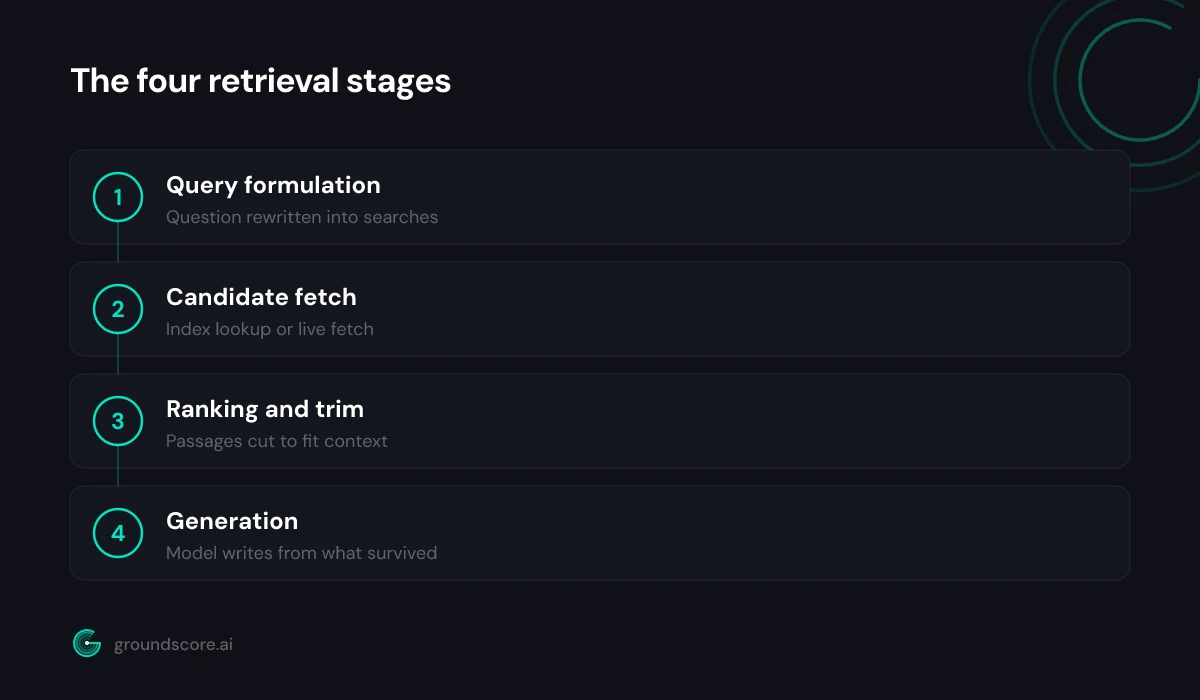
Direct answer: Four stages run in order: the engine rewrites the user's question into search queries, fetches candidate documents from an index or live web, ranks and trims those candidates to fit the model's context, then passes the surviving passages to the model. Failing any stage removes you entirely.
Stage one: query formulation. The user's words are rarely the search terms. Someone typing "who should I call about a leaking water heater in Tacoma" produces several machine-generated queries: a service query, a location query, maybe a comparison query. Your content is matched against those rewritten queries, not the original phrasing. This is why chasing the exact wording of a user question matters less than covering the underlying intent in language a search system recognizes.
Stage two: candidate fetch. The system pulls documents. Depending on the engine this means querying a search index built by a crawler, calling a partner search API, or fetching live URLs. If a crawler was blocked from your site, or your pages render as near-empty HTML to a fetcher, you are simply not in the candidate pool. No amount of downstream quality repairs that.
Stage three: ranking and trimming. Candidates get scored for relevance and cut down to what fits. Context windows are large now but not infinite, and engines deliberately keep the supplied set small because a tight set produces a cleaner answer. This is the most competitive stage and the least visible one.
Stage four: generation. The model reads the surviving passages and writes. It paraphrases, merges overlapping claims, drops material that does not answer the question, and attaches citations to what it used.
Notice that three of the four stages are search problems, not writing problems. That ratio is the single most useful thing to internalize about how AI answers get made.
Why does retrieval favor passages over pages?
Direct answer: Retrieval systems chunk documents into passages and score each chunk independently, because a model's context has limited room and a targeted excerpt answers better than a whole page. Your competition is not page against page. It is paragraph against paragraph.
Chunking is a practical necessity. A 3,000-word guide contains one paragraph that answers the question and 2,900 words that do not. Sending the whole thing wastes context and dilutes the signal, so retrieval systems split documents into smaller units and evaluate those units on their own merits.
That has real consequences for how you write.
A self-contained paragraph beats a well-structured page. If your best answer opens with "As mentioned above, this depends on the factors we covered," it is unusable as a chunk. Pull it out of the page and it means nothing. Engines quote what survives extraction.
Length works against you past a point. A section that buries its answer in the fourth paragraph is competing with someone whose answer is in the first sentence. The comprehensive-guide instinct from SEO does not transfer cleanly here; comprehensiveness is fine as long as each part stands alone.
Headings do real work. A heading phrased as the question a person would ask gives the chunk an explicit topic label, which helps both the matching step and the model deciding what a passage is about.
| Stage | What it evaluates | How you influence it |
|---|---|---|
| Query formulation | Intent behind the question | Cover intent, not exact phrasing |
| Candidate fetch | Crawler access and parseability | robots.txt, server-rendered HTML |
| Ranking and trim | Passage-level relevance | Self-contained, labeled sections |
| Generation | Clarity of supplied text | Direct, quotable answers |
We go deeper on the writing side in how to write content AI engines cite. The retrieval framing is what makes that advice make sense rather than sounding like arbitrary style rules.
Why can the model only quote what retrieval hands it?
Direct answer: A grounded answer is built from the passages placed in the model's context for that specific question. Anything outside that set is invisible to the model in that moment, no matter how authoritative, well-written, or relevant your page happens to be.
This is the part that surprises people, so it is worth being blunt. When an engine answers a question about your industry and names three companies that are not you, it did not weigh you against them and find you lacking. In most cases you were never on the table. Your absence was decided at fetch or ranking, silently, before any judgment about quality occurred.
That reframes what a bad result means. A missing citation is a retrieval diagnosis, not a content review. The right response is to ask which stage dropped you, not to rewrite the page a second time.
It also explains something owners find maddening: inconsistency. Ask the same question twice and you can get different sources. Retrieval involves generated queries, freshness effects, and ranking that shifts as the index updates. Two runs are two samples, not one truth. This is why a single spot check tells you almost nothing and why monitoring means repeated sampling over time.
There is one important exception. Models do carry training knowledge, and for well-established entities they will sometimes name a company from memory with no live source behind it. That is a weak, unreliable form of presence: it is stale, unverifiable, and impossible to influence directly on any useful timescale. Grounded citations are the surface worth working on.
The practical upshot is that content quality and retrieval eligibility are separate problems that both have to be solved. Excellent writing that a crawler cannot reach earns nothing. Perfect technical access wrapped around vague content earns a fetch and no quote.
How do you map each stage to a fix you control?
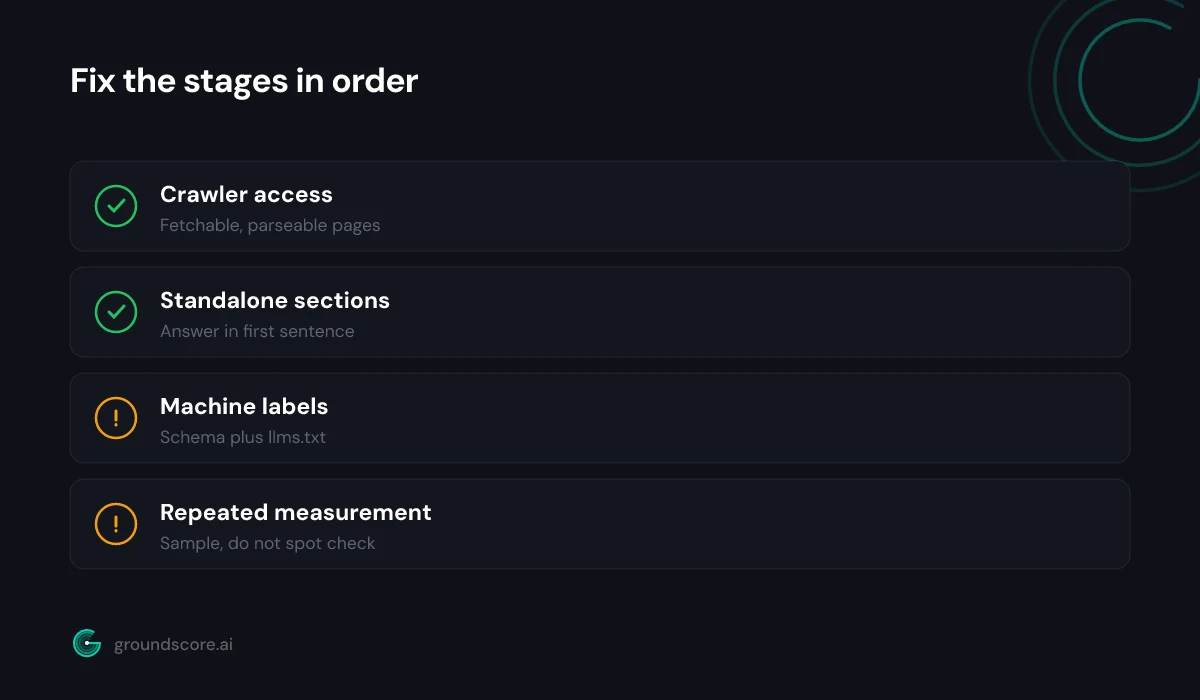
Direct answer: Work the pipeline in order. Confirm crawlers can fetch and parse your pages, then make each section a standalone answer with a question-shaped heading, then add structure that labels what pages are, then measure which questions actually retrieve you and repeat.
Sequence matters more than effort here, because a fix applied at the wrong stage produces zero movement and looks like the whole approach failed.
-
Fix fetch first. Check robots.txt for rules affecting GPTBot, OAI-SearchBot, ChatGPT-User, ClaudeBot, Claude-User, and PerplexityBot. Confirm your pages return real content without JavaScript execution. This is stage two, and nothing downstream matters until it passes.
-
Make passages extractable. Give every section a heading that names the question it answers, and open with the answer in one or two sentences. Then elaborate. Chunks that survive extraction are the ones that get quoted.
-
Label your content. Schema markup and an llms.txt file do not force retrieval, but they make what your pages are unambiguous to machines deciding relevance. Ambiguity is expensive at ranking time.
-
Cover intent, not phrasings. Because queries are rewritten, chasing long-tail wording is wasted motion. Answer the underlying question thoroughly and let query formulation find you.
-
Measure, then repeat. Ask real questions of real engines, log which sources come back, and watch the trend across runs rather than reading any single answer as a verdict.
Nothing here is exotic. The value of the pipeline model is that it tells you which unglamorous thing to do first.
Frequently asked questions
Do all AI engines use retrieval the same way?
No. Some maintain their own crawled index, some call a partner search API, and some fetch live URLs when a user shares one. The stages are broadly the same, but the crawlers involved and the freshness of results differ, which is why the same question can produce different sources on different engines.
Does more content improve my retrieval odds?
Only if each piece answers a distinct question well. Retrieval scores passages, so ten thin pages covering the same ground compete with each other and win nothing. One page with a genuinely self-contained answer outperforms a pile of near-duplicates that all bury the point.
Can I see what an engine retrieved for a question?
Partly. Engines that show citations reveal the sources that survived into the answer, which is the end of the pipeline rather than the whole candidate set. You cannot see what was fetched and discarded, so the practical method is sampling many questions and inferring patterns from what appears.
Why does my page get cited for one question but not a similar one?
Because query formulation rewrote the two questions differently, and a different passage set won. Small wording changes can shift which chunk of which document ranks highest. Consistency across related questions usually means your section covers the intent broadly, not that you matched a phrase.
Does retrieval care about my domain authority?
Indirectly. Engines grounding answers in a search index inherit that index's judgment about site quality, so authority influences whether you become a candidate. It does not override passage-level relevance, which is why strong domains still lose to smaller sites with a clearer answer.
How long after I fix something does retrieval reflect it?
It varies by engine. Live-fetch behavior can reflect a change almost immediately, while index-based engines refresh on their own schedules over days or weeks. Treat a fix as something you verify by monitoring over a month, not by re-asking the same question an hour later.
The bottom line
Retrieval is the gate, and generation is what happens after you are already through it. Once you see the pipeline clearly, most AI visibility advice sorts itself into stages: crawler access is stage two, self-contained writing is stage three, and everything about measurement is admitting you cannot see stages one through three directly.
Start by finding out which stage is losing you. Run a free AI visibility check to see whether engines can reach your site and whether they name you when asked.
How visible is your site in AI search?
Check your AI visibility score in seconds. Free, no account needed.
Check your score