Google AI Overviews vs ChatGPT: Where Buyers Search Now
By Joe Della Mora, Founder, GroundScore
Buyers researching a purchase now hit AI-generated answers in two very different places: a summary at the top of a Google results page, or a conversation with ChatGPT. The Google AI Overviews vs ChatGPT question matters to site owners because the two surfaces look similar — synthesized answer, handful of cited sources — while working differently underneath, and the differences decide how you verify your presence in each. This comparison stays qualitative: mechanics you can act on, no adoption statistics invented to sound authoritative. It also pushes back on the most expensive mistake we see owners make, which is treating the two as one problem or picking a side. Here is where each answer appears, what grounds it, how sources get chosen, what to optimize, and how to check where you stand in both.
What are Google AI Overviews?
Direct answer: AI Overviews are AI-generated summaries that appear at the top of a Google results page for many queries. They are grounded in Google's search index, link out to the pages they draw from, and sit above the classic organic results, which still appear below the summary.
The defining trait of an AI Overview is that it lives inside a results page. The buyer typed a query into Google, and what comes back is a hybrid: a generated summary up top, source links attached to it, and the familiar ranked results underneath. Nothing about traditional search disappears; it gets pushed down.
That placement shapes buyer behavior. The overview answers the surface question, and the sources it links become the shortlist for anyone who wants to go deeper. A buyer might read the summary, click one cited source, or scroll past to the classic results — all three paths exist on the same page, which is precisely what makes this surface a hybrid rather than a replacement.
For a site owner, the important mechanical fact is what feeds it: Google's regular search index, crawled by Googlebot. There is no separate AI Overviews crawler to allow or block. Google-Extended, the control many owners assume governs this, applies to Gemini model training — not to whether your pages can appear in AI Overviews. The levers that exist are the ones you already know: be indexed, be crawlable by Googlebot, and mind your snippet settings, since content Google cannot show as a snippet is content it cannot quote in a summary either.
How does ChatGPT answer buyer questions?
Direct answer: ChatGPT answers in conversation rather than on a results page. In search mode it queries a live index, fetches pages, and cites the sources it used inline. There is no ranked list underneath: the answer is the whole surface, and follow-up questions reshape it in place.
ChatGPT starts from a different premise. The buyer is not scanning a page of options; they are talking to an assistant. Ask which CRM fits a five-person sales team and you get a synthesized recommendation with a few cited sources. Ask a follow-up — "which of those has the best free tier?" — and the answer rebuilds around your refinement, carrying the context forward. The conversation, not the query, is the unit of research.
There is no page two, and there is nothing below the answer. If your site is not among the sources the answer drew from, you are not present in that buyer's research at all. That absence is silent: no impression, no ranking to track, nothing to scroll to.
The plumbing is OpenAI's, not Google's. OAI-SearchBot builds the search index ChatGPT's search mode draws on, and ChatGPT-User fetches pages live when a user asks about something specific. Your Google standing does not transfer: a site blocked from OpenAI's crawlers is invisible here no matter how well it ranks, and a site OpenAI can read can be cited without ranking anywhere notable. The two systems judge you independently, which is the recurring theme of this comparison.
How do the two compare side by side?
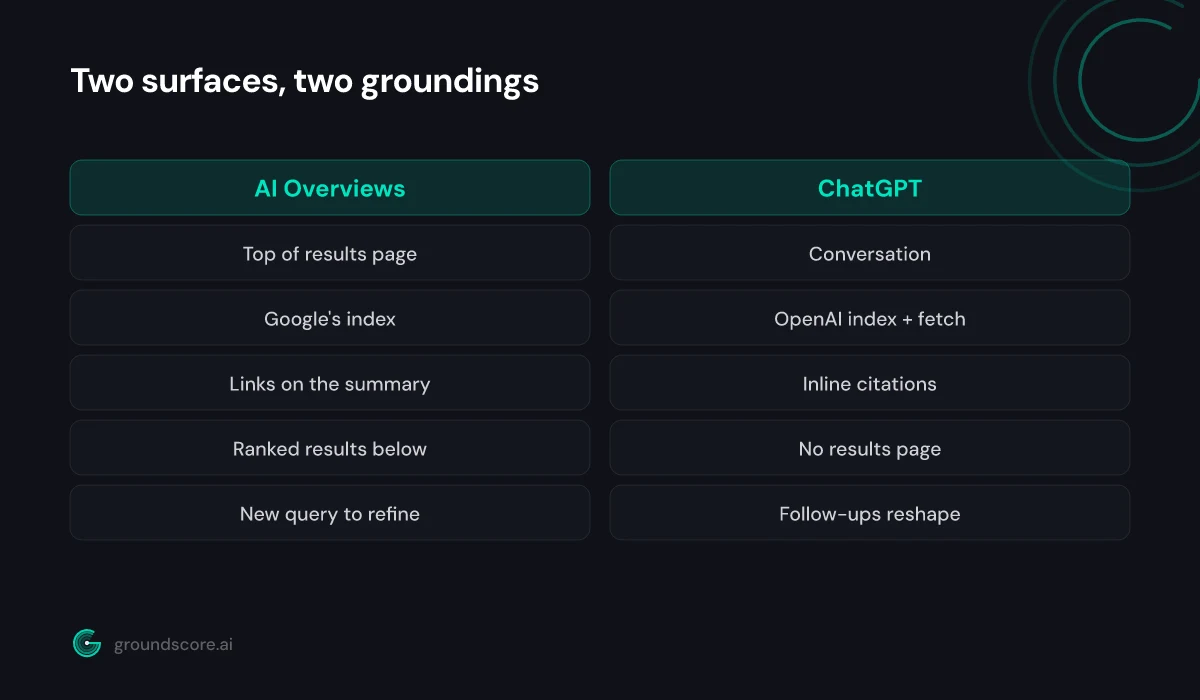
Direct answer: The differences cluster around surface and grounding: AI Overviews summarize on top of a results page and draw on Google's index, while ChatGPT answers conversationally and grounds search answers in its own retrieval. What both reward is nearly identical — crawlable pages, quotable direct answers, and consistent, corroborated facts.
The full picture in one table:
| Dimension | Google AI Overviews | ChatGPT |
|---|---|---|
| Where the answer appears | Top of a results page | Inside a conversation |
| What grounds it | Google's search index | OpenAI's search index + live fetches |
| What sits around it | Classic ranked results below | Nothing — the answer is the page |
| How sources show up | Links attached to the summary | Inline citations in the answer |
| How buyers refine | New query, new results page | Follow-up questions reshape the answer |
| Crawler that matters | Googlebot | OAI-SearchBot, ChatGPT-User |
| Blocking control | robots.txt + snippet settings | robots.txt for OpenAI agents |
| How you check presence | Run queries, inspect the overview | Ask in search mode, log citations |
Two rows deserve emphasis. The grounding row explains why presence in one says nothing about presence in the other — different indexes, different crawlers, different retrieval. The refinement row explains why buyer behavior differs: an AI Overview is a snapshot per query, while a ChatGPT thread narrows toward a decision, which is why late-stage, specific questions are disproportionately where ChatGPT citations pay off.
Underneath the table, both engines run the same basic pipeline — retrieve candidate pages, select quotable passages, attribute sources. We walk that pipeline stage by stage in how AI engines decide which websites to cite, and it is the reason the optimization overlap in the next section is so large.
What should a site owner optimize for each?
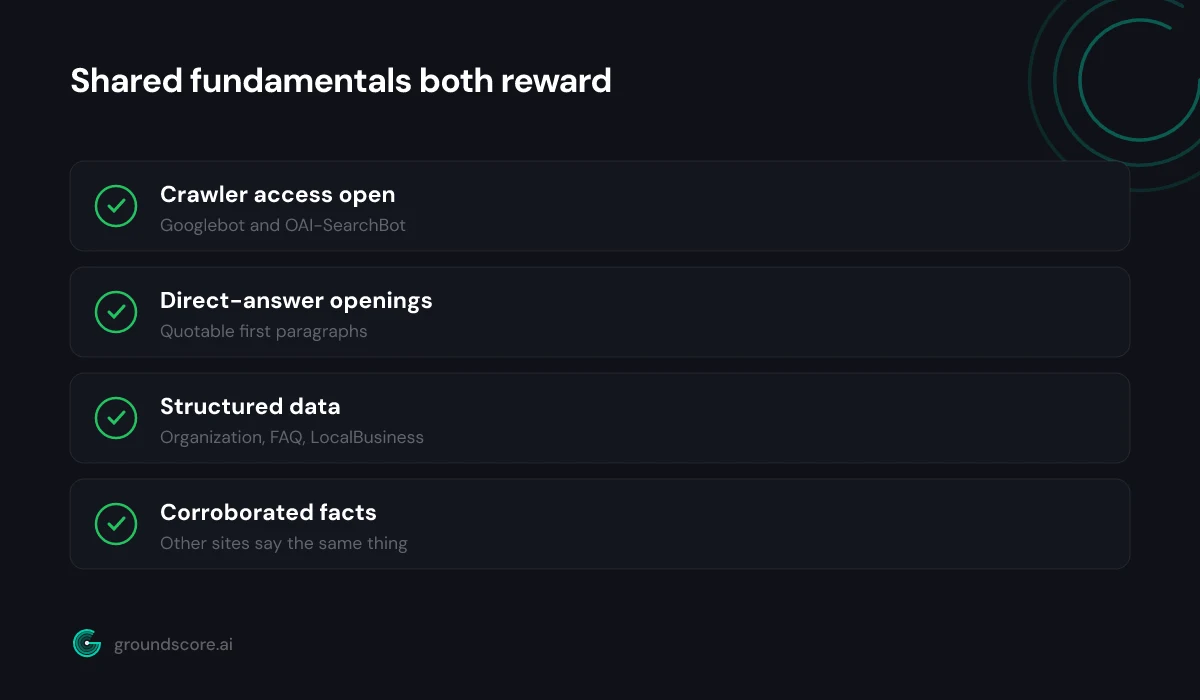
Direct answer: Mostly the same things, once. Both engines need crawler access, pages whose openings answer a question directly, structured data that makes facts machine-readable, and corroboration from other sites. The engine-specific work is thin: confirm Googlebot access and snippet settings for AI Overviews, OpenAI crawler access for ChatGPT.
Building GroundScore, the pattern I keep seeing when we scan sites is an owner who has invested heavily in one surface and assumes the other follows automatically — strong Google presence with OpenAI's crawlers blocked by a leftover rule, or the reverse, a site tuned for ChatGPT citations that Google can barely snippet. The work was never wasted; it was just never checked against the second surface.
The shared fundamentals are the bulk of the job. Crawlable pages, with robots.txt and firewall rules that admit the crawlers you actually want. Openings that answer the question in the first paragraph, because both engines select passages, not pages. Structured data — Organization, FAQ, and friends — so your facts survive machine reading. And corroboration, because both engines prefer sources that independent sites agree about. Do that work once and both surfaces benefit; it is the same set of moves we walk through for local businesses in how to get your local business recommended by ChatGPT.
The per-engine remainder fits in an afternoon. For AI Overviews: confirm Googlebot access, confirm your pages are indexed, and check you have not set restrictive snippet controls that keep Google from quoting you. For ChatGPT: confirm OAI-SearchBot and ChatGPT-User are allowed in robots.txt and not blocked by your CDN. Neither list justifies picking a side; the fork comes after the shared foundation, and it is small.
How do you check where you show up?
Direct answer: For AI Overviews, run your buyer queries in Google and note whether a summary appears and which sources it links. For ChatGPT, ask the same questions in search mode and log the citations. Repeat over time, because one-off checks mislead — both surfaces vary between runs and queries.
Build one question list and use it against both surfaces. Ten to twenty questions your buyers actually ask, from broad ("best accounting software for freelancers") to specific ("does [category] software handle quarterly estimated taxes"). The list matters more than the tooling: test the questions buyers ask, not the keywords you rank for.
On Google, run each query and record three things: whether an AI Overview appears at all (it does not trigger for every query), whether your site is among its linked sources, and where you sit in the classic results below. That last one is your control — it tells you whether an overview absence is a visibility problem or just a query that does not produce overviews.
In ChatGPT, ask each question with search enabled and log which sites get cited. Then re-ask on another day. Generated answers vary run to run, so a single check proves almost nothing in either direction; the pattern across repeated samples is the honest measurement.
Expect divergence, and read it as information. Cited in overviews but absent from ChatGPT usually points to an OpenAI-side access problem or thin corroboration outside Google's ecosystem. The reverse usually means indexing or snippet issues on the Google side. Symmetric absence means the shared fundamentals need work first. The engines disagree just often enough to make checking both non-optional.
Frequently asked questions
Should I optimize for AI Overviews or ChatGPT first?
Neither, in the sense the question implies. The shared fundamentals — crawler access, direct-answer content, structured data, corroboration — serve both engines and represent most of the work. Do those once, then spend the small engine-specific remainder: Googlebot and snippet settings for overviews, OpenAI crawler access for ChatGPT. Picking a side mostly means neglecting half your buyers.
Does blocking GPTBot remove my site from Google AI Overviews?
No. GPTBot is OpenAI's crawler and has no connection to Google's systems. AI Overviews are built from Google's regular search index, crawled by Googlebot. The costs stay separate too: blocking GPTBot affects OpenAI model training, while blocking Googlebot would remove you from Google search entirely, overviews included.
Do good Google rankings guarantee appearing in AI Overviews?
No. Rankings help — overviews draw on the same index, and well-ranked pages are strong candidates — but the summary quotes passages, not positions. A page that answers the question directly in a quotable paragraph can be cited over one that outranks it. Ranking gets you into the candidate pool; answer structure gets you quoted.
Can ChatGPT cite my site if I barely rank in Google?
Yes. ChatGPT's search mode draws on OpenAI's own index and live fetches, not Google's rankings. A crawlable site with clear, direct answers and consistent facts can earn citations while ranking modestly. The engines judge independently, which is exactly why presence needs checking in each surface rather than inferring one from the other.
Are AI Overviews replacing regular Google results?
No — they sit on top of them. The classic ranked results still render below the summary, and plenty of queries produce no overview at all. What changes is attention: for queries that do trigger an overview, the summary and its linked sources absorb the first look that used to belong to position one.
How often should I re-check my presence in both?
Monthly is a sane cadence for most sites, with several runs per question each time, because single checks mislead on surfaces this variable. Re-check sooner after meaningful changes — unblocking a crawler, restructuring key pages, adding schema. Judge the trend across months rather than celebrating or panicking over any single answer.
The bottom line
Google AI Overviews and ChatGPT are not rivals you choose between; they are two surfaces the same buyers now use, one grafted onto the results page you already compete on, one replacing the results page entirely. The mechanics differ — index, crawlers, citation style, refinement — but the qualities both reward are the same crawlable, quotable, corroborated site. Build that once, then verify presence in each surface instead of assuming either carries the other.
Verification is the step most owners skip. A free AI visibility check shows where your site stands with ChatGPT, Claude, and Perplexity in about a minute — pair it with a manual pass on your own Google queries and you have both halves of the picture.
How visible is your site in AI search?
Check your AI visibility score in seconds. Free, no account needed.
Check your score