What Is Answer Engine Optimization (AEO)? A Plain Guide
By Joe Della Mora, Founder, GroundScore
Answer engine optimization (AEO) is the practice of making your website visible to AI systems that answer questions directly — ChatGPT, Claude, Perplexity, and Google's AI features — rather than just ranking in a list of links. If you know SEO, the concept will feel familiar, but the mechanics differ in ways that matter. Most explanations of AEO stop at "write good content." This one comes from building a tool that scans sites for exactly these gaps every day, so it focuses on what the work concretely touches — crawler access, machine-readable structure, and measured presence in answers — instead of abstractions. Below: what answer engines are, how AEO differs from SEO, the three layers every AEO task maps to, what a realistic month of the work looks like, and where to start this week.
What is an answer engine?
Direct answer: An answer engine is an AI system that responds to a question with a synthesized answer instead of a list of links. ChatGPT, Claude, Perplexity, and Google's AI Overviews all work this way: they retrieve relevant sources, generate a direct response, and cite or recommend a handful of websites inside it.
Traditional search hands you a ranked list and lets you choose. An answer engine does the choosing for you. Ask "what's the best invoicing tool for a two-person plumbing company?" and you get two paragraphs of prose naming three or four products — sometimes with linked citations, sometimes with a flat recommendation and nothing else.
Under the hood, most of these systems combine two ingredients. The first is the model's trained knowledge: what it learned about the world, and about businesses like yours, during training. The second is retrieval. When a question needs current or specific information, the engine searches the web, fetches pages, and grounds its answer in what it finds. That second path is the one most businesses can actually influence this quarter, because it depends on whether your pages can be found, fetched, and quoted right now — not on what a model memorized months ago.
The consequence that matters: answer engines are binary in a way search results never were. A results page has ten slots, plus a second page for consolation. A generated answer references a handful of sources and ignores everyone else. There is no page two of an answer. Either your site is part of the response or the person asking never learns you exist. That visibility problem is the entire reason AEO exists as a discipline.
How is AEO different from SEO?
Direct answer: SEO earns a position on a results page; AEO earns a citation inside a generated answer. The overlap is large — crawlable pages, clear structure, and real authority help both — but AEO adds new requirements: AI crawler access, quotable passage-level answers, and measuring whether engines actually mention you.
Building GroundScore, the pattern I keep seeing when we scan sites is that Google strength and AI visibility travel together less often than you would expect. Sites with years of solid SEO behind them show up in scans with AI crawlers blocked at the firewall, no structured data on their most important pages, and no presence at all in answers about their own category. The foundation transfers; the finish work does not.
Three differences do most of the explaining:
- Different crawlers. OpenAI, Anthropic, and Perplexity run their own user agents — GPTBot, ClaudeBot, PerplexityBot, and several more. Allowing Googlebot says nothing about them, and plenty of robots.txt files and bot-protection rules block them, sometimes deliberately, configured years ago for reasons nobody remembers.
- Different unit of competition. SEO competes page against page. Answer engines assemble responses from passages. A paragraph that answers one question cleanly can get quoted even from a modest site, and a strong page with no quotable passage can be passed over entirely.
- Different scoreboard. Rankings tell you nothing about your AI presence. The only measurement that means anything is asking the engines real buyer questions and recording whether your site appears in what they say back.
A full side-by-side comparison deserves its own post, and one is coming. The short version for now: keep your SEO, then add the AEO layer on top of it rather than treating them as rivals.
What does AEO work actually touch?
Direct answer: AEO work touches three layers: access (can AI crawlers reach and read your pages), structure (can machines parse who you are and what each page answers), and presence (do AI engines actually cite you when users ask relevant questions). Every meaningful AEO task maps to one of these three.
| Layer | Question it answers | Typical work |
|---|---|---|
| Access | Can AI crawlers reach and read your pages? | robots.txt fixes, CDN and firewall rules, llms.txt |
| Structure | Can machines parse who you are and what you answer? | Schema markup, direct answers, clean headings |
| Presence | Do engines cite you when it counts? | Baseline scans, question tracking, gap content |
Access is the gate. If GPTBot, ClaudeBot, or PerplexityBot cannot fetch your pages — because robots.txt disallows them, a bot-protection rule challenges them, or your content only exists after JavaScript runs — nothing else on this list matters. Access work is unglamorous and fast: read your robots.txt, review your CDN's bot settings, and consider publishing an llms.txt file so AI systems get a clean, plain-text map of what your site is about.
Structure is legibility. Schema markup states in machine-readable terms who your organization is, what your pages cover, and which questions they answer. Headings that match real questions, and opening paragraphs that answer them outright, give retrieval systems passages worth lifting.
Presence is the scoreboard. It is measured directly: ask ChatGPT, Claude, and Perplexity the questions your buyers ask, and record whether you show up. Presence work means finding the questions where you are absent and closing those gaps with content that deserves the citation.
What does a monthly AEO workflow look like?
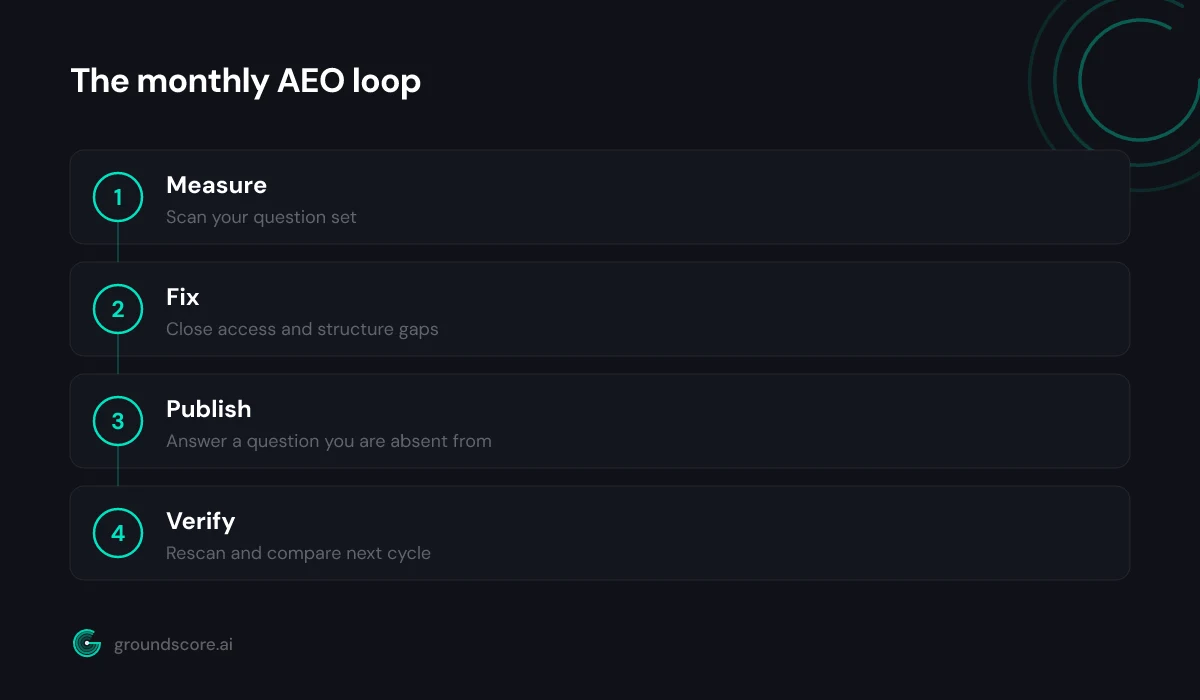
Direct answer: A monthly AEO workflow has four repeating stages: measure where you currently appear in AI answers, fix the highest-impact access and structure gaps, publish content that answers real buyer questions directly, and verify what changed on the next scan. Each cycle compounds on the one before it.
The monthly cadence is not arbitrary. Generated answers vary from run to run, engines refresh their indexes on their own schedules, and content takes time to be crawled and picked up. A single check tells you where you stood at one moment; a monthly loop tells you whether anything you did actually moved the needle.
In practice the four stages look like this:
- Measure. Run your question set — the queries a real buyer would ask — across the engines and log where you appear, where competitors appear, and where nobody gives a good answer.
- Fix. Pick one or two access or structure items and finish them completely. An unblocked crawler or a schema rollout beats ten half-done tweaks.
- Publish. Write one page that answers a question you are currently absent from, and answer it in the first paragraph, not the eighth.
- Verify. Next cycle, compare. Presence appearing where it was missing is the win condition; nothing moving for months is the signal to change approach.
Teams that skip straight to publishing usually regret it. Content aimed at engines that cannot crawl your site, on pages machines cannot parse, is effort spent on the wrong layer — which is why the loop starts with measurement rather than writing.
Where should you start with AEO?
Direct answer: Start with measurement, not tactics. Run a baseline check of how your site currently shows up in ChatGPT, Claude, and Perplexity, then audit crawler access in robots.txt. Those two steps take under an hour and tell you whether your problem is reachability, structure, or simply invisible content.
The temptation is to start with the tactic you read about most recently — usually schema or llms.txt. Resist it. Without a baseline you cannot know whether that tactic addresses your actual gap, and you will have no way to tell later whether it worked.
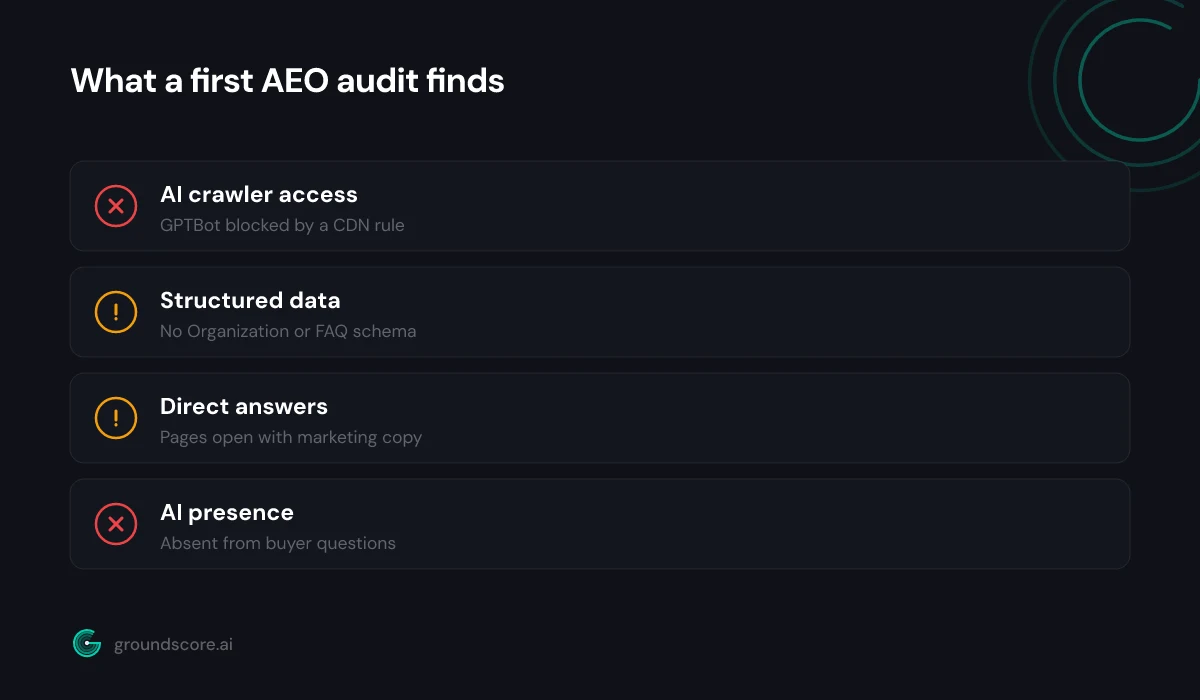
A sane first week looks like this. First, get a baseline: ask the engines the five questions that matter most to your business and write down what they say, or use a scoring tool to do it systematically. Second, open your robots.txt and check whether the AI user agents are allowed — this is the single most common hard blocker, and it costs nothing to fix. Third, look at your most important page and ask the uncomfortable question: if an AI engine quoted one paragraph from this page, is there a paragraph worth quoting?
One more framing that helps: score yourself, even roughly. GroundScore expresses AI visibility as a 0-100 score across three pillars — Authority & Trust, Site Readiness, and AI Presence — because a number forces honesty about where you actually stand and gives the monthly loop something concrete to move. You do not need our tool to apply the idea. Grade each layer for your own site, harshly, and let the weakest one pick your first project.
Whatever you find, you now have something most site owners do not: an honest picture of which layer — access, structure, or presence — is holding you back, and a loop for fixing it one month at a time.
Frequently asked questions
Is AEO just SEO with a new name?
No. They overlap heavily — crawlable pages, real authority, and useful content help both — but AEO adds work SEO never required: allowing AI-specific crawlers, structuring passages so they can be quoted whole, and measuring presence inside generated answers instead of positions on a results page.
Do I need to stop doing SEO to do AEO?
No — keep your SEO running. Traditional search still drives most discovery for most sites, and the foundations you build for Google transfer directly to AI visibility. The sensible move is adding AEO checks to an existing program: crawler access, direct answers, structured data, and a monthly presence baseline.
How long does AEO take to show results?
It varies too much to promise a number honestly. Access fixes can take effect as soon as engines recrawl your site, while presence in answers builds gradually as engines pick up new content and corroboration. Treat it like SEO: a compounding monthly practice, not a one-time project with a deadline.
What does AEO cost?
Doing it yourself costs time more than money. Tooling ranges from tens of dollars per month into the low hundreds, GroundScore's Business plan is $199 per month for one site, and a free check covers the baseline at no cost and with no account. Agencies charge more but remove the work entirely. Measure for free before spending anything.
Does AEO matter for small local businesses?
Yes — arguably more than for anyone else. When someone asks an AI engine for a plumber, a dentist, or an accountant nearby, the answer names a handful of businesses and stops. Local sites with consistent business facts, service pages that answer real questions, and open crawler access are exactly what engines cite.
Which AI engines should I care about first?
ChatGPT, Claude, and Perplexity cover the major answer-engine behaviors between them: search-grounded answers, live page fetching, and citation-heavy responses. Google's AI features matter too, but they largely reward the same fundamentals. Optimize the underlying layers once and you improve across all of them at the same time.
The bottom line
AEO is not a reinvention of marketing. It is the recognition that a growing share of buying research now ends inside a generated answer instead of on a results page — and that being absent from those answers is invisible in a way a page-three ranking never was. The work itself is concrete: open the gate for AI crawlers, make your pages legible to machines, and measure your presence month after month.
The fastest way to find out where you stand is a free AI visibility check — it takes about a minute, needs no account, and shows which of the three layers is holding your site back.
How visible is your site in AI search?
Check your AI visibility score in seconds. Free, no account needed.
Check your score