AI Search vs Voice Search: What to Optimize for Now
By Joe Della Mora, Founder, GroundScore
Ask a question out loud to a smart speaker and you get one spoken answer. Type the same question into ChatGPT or Perplexity and you get a written answer with sources you can click. Both skip the ranked list of blue links, which is why AI search vs voice search often gets treated as one problem. It is not. The two pull from different places, reward different content, and reach people in different moments. This comparison comes from what we see at GroundScore scanning sites that invested hard in voice years ago and assumed the work would carry into AI engines. Sometimes it does; often it does not. Here is what each one is, how each actually answers a question, what they genuinely share, where they diverge, and where your effort pays off right now.
What is the difference between AI search and voice search?
Direct answer: Voice search is a spoken query answered aloud by an assistant like Siri, Alexa, or Google Assistant, usually returning a single result. AI search is a typed conversation with an engine like ChatGPT, Claude, or Perplexity that returns a written answer, often citing several sources a reader can open.
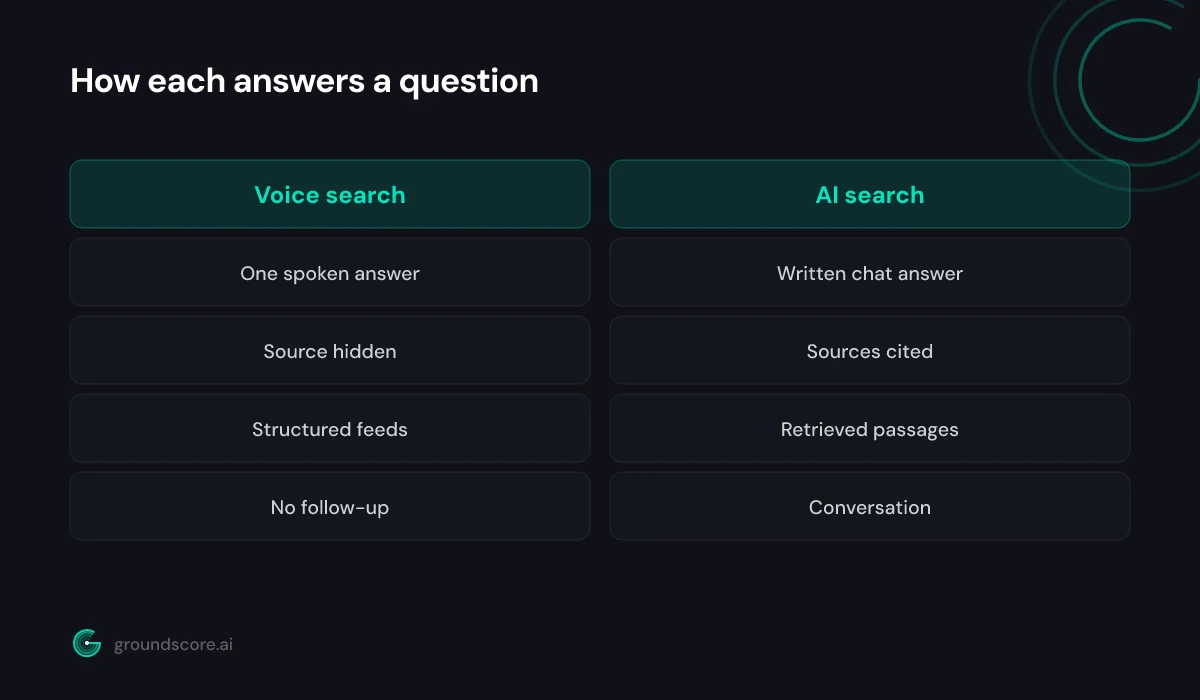
The gap starts with the interface, and the interface shapes everything else. A voice assistant speaks, so it picks one answer and reads it. There is no room for a list, a citation, or a follow-up link the way a screen allows. That single-answer constraint has driven voice optimization advice for a decade: win the one spot or get nothing.
AI search runs on a screen, usually inside a chat window. The engine can write a paragraph, name three sources, format a table, and wait for your next question. It is a conversation, not a lookup. That difference in surface changes what the engine rewards and what a user does after the answer arrives.
There is also an ownership pattern worth naming. Voice assistants are tied to hardware and platform ecosystems, so the answer often depends on which device you own and which services it trusts. AI search engines are largely device-agnostic; you reach the same ChatGPT from a phone, a laptop, or a browser extension. That makes AI search easier to optimize for as a single target rather than a fragmented set of assistant behaviors.
How does each one actually answer a question?
Direct answer: Voice assistants typically read one result drawn from a structured source, a featured snippet, or a knowledge graph, giving no visible citation. AI engines retrieve and synthesize passages from several pages, then generate an answer that names the sources it leaned on so the reader can verify and click through.
Voice assistants lean heavily on structured, pre-digested data. A weather answer comes from a weather feed; a business hours answer comes from a listing; a definition comes from a knowledge graph entry. When the assistant does read from the open web, it usually pulls a single concise passage it judges as the direct answer. The mechanics reward tight, factual, well-marked-up content that a machine can lift without ambiguity.
AI engines work differently. They retrieve a set of candidate passages relevant to the question, then a language model composes an answer grounded in those passages. Search-grounded engines like Perplexity almost always show citations; ChatGPT and Claude cite when they browse or fetch live. The engine is not looking for the one blessed answer. It is assembling several and deciding which to quote or reference.
Building GroundScore, the pattern we keep seeing is that a page written as one clean, self-contained answer does well in both worlds, but for different reasons. Voice wants a liftable snippet. AI search wants a quotable passage it can attribute. The overlap is real, which is why the two get conflated, but the failure modes diverge fast once you look past the shared surface.
What do AI search and voice search share?
Direct answer: Both reward concise, direct answers, clean structured data, and a clear entity identity. A page that states its answer plainly, marks it up with schema, and presents a consistent business identity tends to perform in voice and AI search alike, because both systems parse machines-first rather than skim like a human.
The shared ground is larger than the marketing suggests, and it is worth being honest about. Three things help in both systems:
- Concise, direct answers. Voice needs a passage short enough to speak; AI engines favor a passage self-contained enough to quote. Leading with the answer instead of burying it serves both.
- Structured data. Schema markup tells both kinds of machine what a page is, what a business does, and which facts are authoritative. FAQ, Organization, and LocalBusiness schema earn their keep across the board.
- Entity clarity. Both systems reason about your business as an entity, not a bag of keywords. Consistent name, address, and description everywhere your business appears helps a voice assistant trust a listing and helps an AI engine decide you are a real, citable source.
This is why the "AEO is just voice search again" argument has a kernel of truth. If you did the structured, answer-first work for voice years ago, you are not starting from zero. Much of that content is exactly what an AI engine wants. We cover the broader shift in SEO vs AEO: what actually changes, and the shared fundamentals are the reason the transition is an evolution rather than a demolition.
Where do the two diverge for optimization?
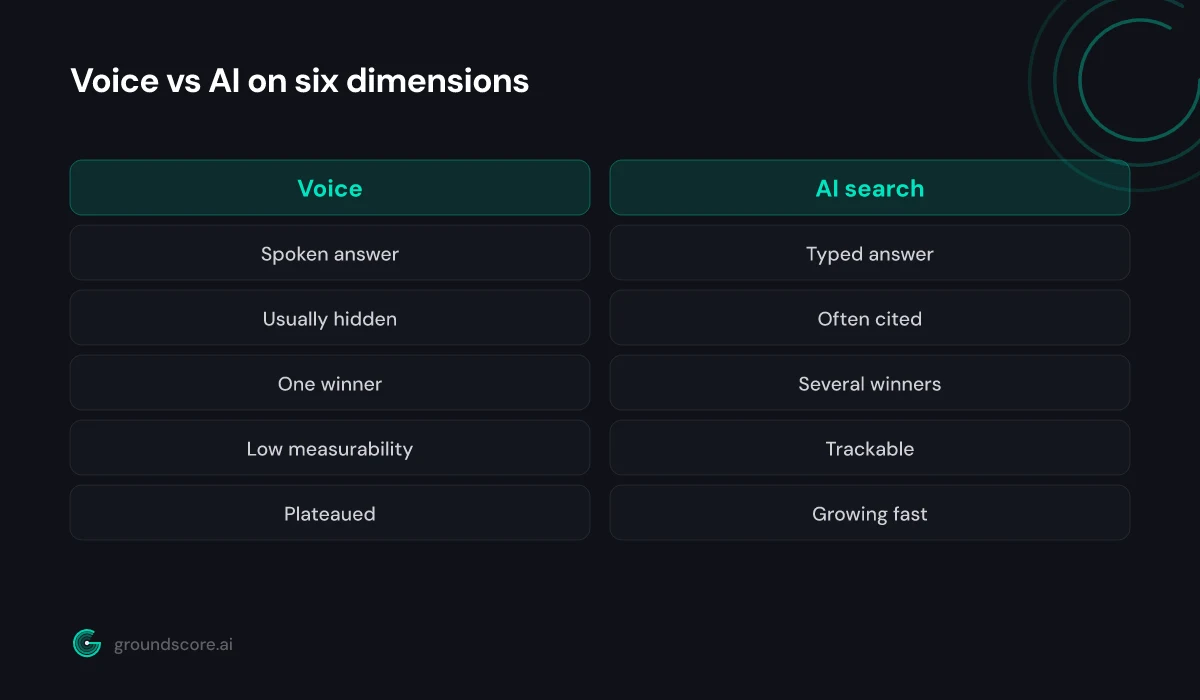
Direct answer: They diverge on citations, competition, and reach. AI search shows sources and rewards quotable passages, so a mention is measurable and clickable. Voice usually hides its source and returns one answer, so being second is being invisible. AI search is also growing fast, while voice usage has largely plateaued around narrow tasks.
The divergence that matters most is measurability. When an AI engine cites your site, you can see it, log it, and eventually trace a referral click back to it. GroundScore is built on that fact: it queries the engines, records whether your site is cited, and tracks first-party AI referrals when readers click through. Voice offers almost none of that visibility. The assistant speaks, the user acts or does not, and you rarely learn whether your content was the source.
The unit of competition differs too. Voice is winner-take-all for a given spoken query. AI search names several sources per answer, so there is room for more than one winner, and the practical goal shifts from "beat everyone" to "be one of the cited few."
Here is the side-by-side:
| Dimension | Voice search | AI search |
|---|---|---|
| Interface | Spoken, one answer | Typed chat, written answer |
| Sources shown | Usually hidden | Often cited and clickable |
| Winners per query | One | Several |
| Measurability | Very low | Trackable citations and referrals |
| Common use | Quick facts, commands | Research, comparison, decisions |
| Momentum | Plateaued | Growing fast |
The use-case split is the last real difference. Voice dominates hands-free moments: timers, weather, playing music, a quick fact while driving. AI search is where people do open-ended research and make considered decisions, which is exactly where buyers evaluate a product or a local service. That is the moment most businesses care about winning.
Where should you spend your effort now?
Direct answer: Spend most of it on AI search, because it is growing, measurable, and where buying research happens, while banking the shared fundamentals that also serve voice. Unblock AI crawlers, publish answer-first pages with schema, keep your entity identity consistent, and measure whether engines cite you. Skip voice-only tactics with no AI payoff.
The efficient move is to optimize for the overlap first and treat voice-specific gains as a bonus. Almost everything that earns an AI citation also helps a voice assistant, so you are not choosing one at the expense of the other; you are choosing where the incremental, non-shared effort goes.
A practical order of operations:
- Confirm AI crawlers can reach you. Check robots.txt and your CDN rules for blocks on GPTBot, ClaudeBot, and PerplexityBot. This is AI-specific and voice will not tell you it is broken.
- Write answer-first pages. Lead each key page with a direct, self-contained answer. This serves both systems and is the single highest-leverage content habit.
- Add structured data. Organization, FAQ, and LocalBusiness schema pay off in both worlds.
- Keep your entity consistent. Same name, address, and description everywhere. Both systems reward it.
- Measure AI presence. Query the engines and log citations. Voice offers no equivalent signal, so this is where measurement lives.
The one thing not worth chasing is voice-only optimization that has no AI-search payoff: micro-tuning for a specific assistant's phrasing quirks, for instance. That effort does not compound. The shared fundamentals do, and they set you up to win the surface that is actually growing.
Think of it as a portfolio decision. The shared fundamentals are the core holding, safe, compounding, useful across every surface. AI-specific work is where you concentrate the incremental effort, because that is where the growth and the measurable feedback are. Voice-only tactics are the speculative fringe you can mostly skip. Allocate accordingly and you get most of the voice benefit for free while putting real energy where the return is clearest.
Frequently asked questions
Is voice search dying?
No, but it has settled into a narrow role. Voice is durable for hands-free tasks like timers, commands, weather, and quick facts, and that usage is steady. What has stalled is voice as a research or shopping channel. For considered decisions, people increasingly type questions into AI engines instead of speaking them.
Does optimizing for voice search help AI search?
Partly. The shared fundamentals carry over well: concise answers, structured data, and consistent entity identity help both systems. What does not carry is anything voice-specific, and voice gives you no visibility into AI crawler access or citations. Treat voice work as a strong head start, not a finished job.
Which AI engines should I optimize for first?
Start with ChatGPT, Claude, and Perplexity, the three GroundScore checks. Between them they cover the main behaviors: conversational answers, live page fetching, and search-grounded responses with citations. Optimizing for these three covers most of what any AI engine needs, and their citations are measurable in a way voice results are not.
Can I measure voice search results the way I measure AI citations?
Not really, and that is a key difference. Voice assistants rarely reveal their source, so you cannot reliably tell whether your content was spoken. AI engines show citations and can send trackable referral clicks, which is why AI presence is measurable and voice presence mostly is not.
Do I need different content for voice and AI search?
Usually not. A page written as one clean, direct answer with schema markup serves both. The differences are technical and situational, not a demand for separate content. Write answer-first pages once, mark them up properly, and you satisfy the shared requirements of both systems without maintaining two versions.
Where do buyers actually make decisions, voice or AI search?
Overwhelmingly AI search. Voice handles quick, low-stakes tasks, but open-ended research, comparison, and vendor evaluation happen on a screen where people can read, follow citations, and ask follow-ups. If your goal is to be found during a buying decision, AI search is the surface that matters most right now.
The bottom line
Voice search and AI search look alike from the outside because both replace the list of links with a single answer, but they reward different work and reach people in different moments. The smart play is to bank the shared fundamentals, then put your incremental effort into AI search, because it is growing, measurable, and where buyers do their research.
The first step is knowing whether AI engines cite you at all today. Run a free AI visibility check, get your score, and see exactly where you stand.
How visible is your site in AI search?
Check your AI visibility score in seconds. Free, no account needed.
Check your score